Showing posts with label human sacrifice. Show all posts

Saturday, 18 March 2023

Three sacrifices

In this article I will talk about two (actually three) sacrifices, which marked the beginning and the end of the Trojan war...

7th c. BC Mykonos pithos

It contains the oldest depiction of the Trojan Horse, the way Homer described it...


Now in my article "Trojan horse", I talked about the proposition by the Italian naval archaeologist, Francesco Tiboni, that the famed Trojan horse was not a horse at all, but a ship, with a horse head on the prow...

Like this one, from a depiction of Phoenician ships found in the palaces of Assyrian kings from the 7th and 8th centuries BCE.

It is because of this that the Greeks called the Phoenician ships "horses", and the Phoenicians "the horse people".

Tiboni says that "it would make far more sense to think of the Greeks' treacherous gift to the Trojans as a ship, because nautical 'hippos' were commonly used to carry tributes to the enemy - such as precious metals - after defeats."

"A ship's hold would also have made a better hiding place for soldiers than a wooden horse's belly. And a reference in Virgil's Aeneid to wary Trojans calling for the sinking of the Greek gift seems odd outside of a nautical context." concludes Tiboni...

I agree with Tiboni. But my article was not about what Trojan horse really was. My article was about the fact that both Phoenicians and Greeks had sea gods associated with horses...Very strange...

Well, strange that is, until you look at the sailing season in the Eastern Mediterranean and the natural mating season of horses, which is characterised by vicious stallion fights...They pretty much overlap...

When horses start their mad mating fights, in Apr, it's time to put your ships into the water...

When horses stop their mad mating fights, in Sep, it's time to take your ships out of the water...

Why? Cause of the weather...And particularly because of the winds...This table, from a South Aegean Yachting site, gives directions of the prevailing winds in Aegean sea during the sailing season: Apr-Oct...

Even today, with much better boats, this is the safe sailing season...Because of the fact that this is when the persistent Northerly trade winds blow over the Aegean...
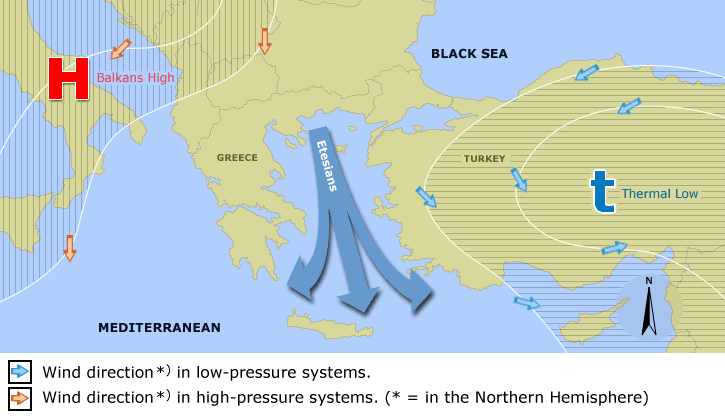
They start in Apr, but stabilise in May, and blow towards Levant and Egypt until Sep, when they become unstable again and cease all together in October...

These are "etesian" winds, and I talked about them in my post "Anat", about this Semitic "warrior" goddess worshipped by the Canaanites & Egyptians during the Bronze and Iron Ages.

She was a sister and the right hand woman of the rain god Baal...Interestingly, Baal's enemies were two brothers, Mot, the god of death, and Yam, the sea god...Strange division of power, right?

Well, apparently, Mot, the god of death, was by the people of Levant equated with the sun...I talked about this in my post "Oldest Arabic poem"...

Not surprising considering that we find sun as the god of death in Middle East since the time of Sumerians...Nergal, the destructive sun of the late summer...Which is the strongest and most deadly in Jul/Aug...In Leo...Hence, Nergal the lion man...I talked about this in my post "Winged superhuman hero"...

If we look at the climate in Levant, we can see that the climatic year is divided into cool wet season, ruled by Baal, and hot dry season, ruled by Mot...Hot, dry season being also the sailing season, we end up with brothers Mot and Yam, "natural" enemies of Baal...

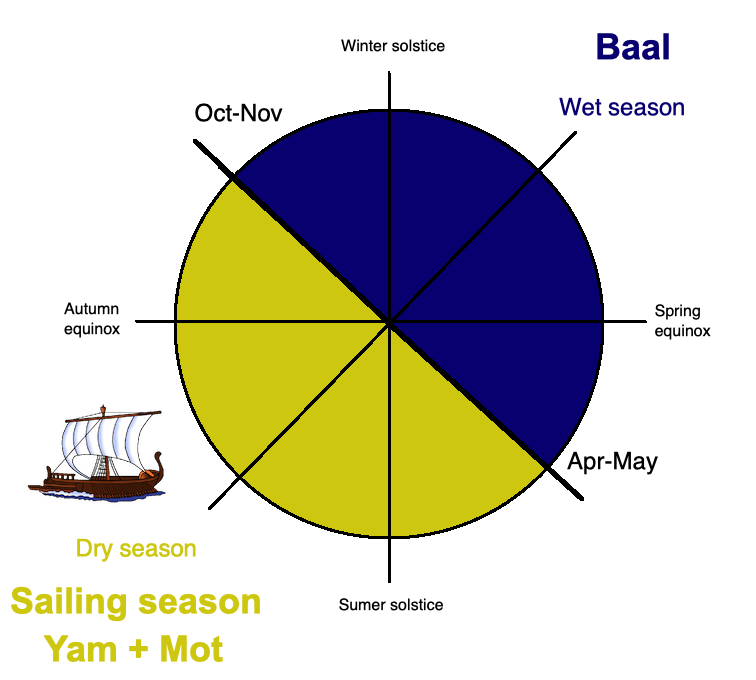

So in the Anat mythology, she is said to have killed Arsh, a monstrous attendant of Yam, the sea god and "the darling of the gods"...In order to bring Baal back to power...Apparently Arsh means "towards the land"...Who is Arsh? Who does Anat kill?

Well, the "etesian" winds of course, which blow "towards the land" of Levant and Egypt during the hot, dry season in the Eastern Mediterranean. And which stop blowing right when the hot, dry season, ruled by Mot, Sun, ends and the cool, wet season, ruled by Baal starts...

Sooooo....What the hell does any of this have to do with the beginning and the end of the Trojan war????? πŸ™‚

Well, a lot...You want to sail in Aegean sea, you need to know all of the above, very very well...

Sorry about the long intro, but I think it was necessary...

You see, the Greeks could not have set sail for Troy, at the beginning of the war, before the beginning of the sailing season, in Apr...And they couldn't have set sail for Greece, at the end of the war, after the end of the sailing season, in Oct...

Wait, the prevailing winds in the Aegean during the sailing season are northerly winds...And if the Greeks wanted to sail across the sea, they needed to have a keel (A large beam along the underside of a ship’s hull from bow to stern which gives the ship's structure its rigidity), in order to stabilise the ship, and allow them to sail with the side winds...

Well, the oldest shipwreck we have (last time I checked) with a keel is Uluburun shipwreck, a shipwreck of a Late Bronze Age Phoenician ship, dating to ca. 1400 BC.

Here is the ship structure with the central keel and the horse head stem invented by Phoenicians...Looks familiar to anyone?


But did Greeks have ships with keels? Well, based on the available depictions of ancient Greek ships, they definitely did...Way back in the 3rd millennium BC...This Minoan seal is from 2000BC from this great site: "The Greek Age of Bronze"...

Unfortunately, we don't have any actual shipwrecks to prove this. But considering that Greeks were able to sail from Aulis, where they assembled, to Troy, and back, using side Northerly winds, proves that they must have had boats with keels...

Well, they could have done it technically, providing there was wind...And here we come to the two sacrifices, which I mentioned way up there in the first tweet, and which marked the beginning and the end of the Trojan war...

Finally...πŸ™‚

The sacrifice that marks the beginning of the Trojan war, is the famous one, the sacrifice of Iphigenia: 

"As the Greek fleet gathers in Aulis to prepare for war against Troy, Agamemnon, the leader of the Greeks, kills a deer in a grove sacred to the goddess Artemis."

"Artemis punishes Agamemnon by STOPPING THE WINDS, so that Agamemnon's fleet cannot sail to Troy. Calchas the seer tells Agamemnon that to appease Artemis, he must sacrifice his eldest daughter, Iphigenia."

"At first Agamemnon refuses, but pressured by the other commanders, he finally agrees. Iphigenia gets either killed, or at the last moment replaced with a deer by Artemis herself, who accepts the sacrifice, RESTARTS THE WINDS, and the Greeks sail to Troy."

Here is a typical depiction of the sacrifice of Iphigenia, Greek, 450-400 BC. Kiel Antikensammlung Kunsthalle B538

The sacrifice that marks the end of the Trojan war, the sacrifice of Polixena/Polixene is less well known: 

"An oracle prophesied that Troy would not be defeated if Trojan Princess Polyxena's brother, Prince Troilus, reached the age of twenty."

"So, Achilles kills Troilus and then falls in love with Polyxena and tells her about his vulnerable heel. She then tells that to her brothers, Paris and Deiphobus, who ambush Achilles in the temple of Apollo, and shoot him in the heel with an arrow, guided by Apollo himself."

"After the burial, Achilles' ghost comes back to the Greeks to demand that Polyxena is sacrificed "so as to appease the wind needed to set sail back to Greece". Polyxena, gets sacrificed, the winds start blowing and the Greeks sail away."

Interesting...

While depictions of the sacrifice of Iphigenia are quite subdued, the depictions of the sacrifice of Polyxena are anything but...

The most famous one is this gruesome image, showing Polyxene's throat being slit over the sacrificial fire alter, from an Atic black-figured amphora, dated to 570BC-550BC. Currently in the British Museum...

The second most famous one is this one from the so called "Polyxena sarcophagus", a late 6th century BC sarcophagus from Phrygia.

Anyone still here? πŸ™‚

Interesting, right...Two sacrifices of young princesses, to get good winds...

And two questions:

Was there once a custom to sacrifice girls "for good winds"?

When did Greeks make these sacrifices? At what time of the year?

I can't answer the first question. I believe so, but can't prove it...

But,I can answer the second question, and I think I can give you the approximate time of the year of  the beginning and the end of the Trojan war...Cool right?

Spoiler: the same time of the year...

So we know that the Greeks could only sail from Aulis to Troy from April to October...We know that they had to sacrifice Iphigenia to get the winds "start blowing again". So this must have been sometime after the beginning of the sailing season...Which is April...

But when exactly? Which month? To answer this, we will first have to look at the third sacrifice...The one that took place during the first gathering of the Greek army at Aulis...Before their first attempt to reach Troy, which failed miserably cause no one knew where Troy was.πŸ™‚

So, after all the ships gathered at Aulis, Greeks performed a sacrifice...

Homer, in Iliad, doesn't specify to which god did Greeks make their sacrifice.

But Apollodorus, in Epitome, explicitly states that they sacrificed to Apollo.

Why did the Greeks sacrifice to Apollo before sailing for Troy? 

Well, when does the sailing season start? 

In Apr/May...The beginning of the hot dry half of the year, dominated by the sun...

It is the sun, that heats up the Eastern Mediterranean...Which creates an updrift, which sucks the cooler air from Europe to start streaming southward, creating the etesian trade winds...And they get stronger as the summer progresses...

You know how Phoenicians believed that Mot, the god of death, the sun, and Yam, the sea god, are "brothers"...No wonder they thought that...It was easy to see for everyone that the hottest the sun was, the better the sailing conditions were...

According to Hesiod, the best time to go sailing was in Jul/Aug...Which is when the sun is the hottest...And when the etesian winds are the strongest...

Oh by the way, you know how both Phoenician and Greek sea gods loved horses...And how Phoenicians considered Sun god and Sea god to be linked (brothers)...Well, ever heard of a solar horse? That pulls sun's chariot? 

Bronze Age "Sun Chariot" pulled by a horse, Denmark 1400 BC...

But I am digressing, again πŸ™‚ So Greeks are sacrificing to the sun god, when suddenly, a snake slithered from the altar to a sparrow's nest in a plane (platanus) tree nearby. It ate the mother and her nine chicks, then was turned to stone. 

Calchas the seer interpreted this as a sign that Troy would fall in the tenth year of the war...

That's the same Calchas who during the second gathering of the Greeks at Aulis, before they actually set sail for Troy, told Agamemnon to sacrifice his daughter "for good winds"...

So the above mad "prophetic scene" with the snake, plane (platanos) tree and sparrows, is actually a complex animal and plant calendar marker, which points at exact time of the year when the first gathering of Greeks at Aulis took place...And the first sacrifice to Apollo...

First the snake. Snake is the only true solar animal. It is in our world when sun is in our world (day and hot part of the year) and it is in the underworld when sun is in the underworld (night and cold part of the year). 


Considering that the Greeks were praying to Apollo, appearance of his holy animal is not a surprise at all...BTW, knowing that snake is a solar animal, the fact that Apollo took over the snake temple at Delphy makes a lot more sense now, doesn't it?

Anyway, apart from being the symbol of the sun and sun's heat, snake is more specifically a calendar marker for Apr/May, beginning of summer. Why? Because this is the time when most common snakes in Europe mate...And fight...Something not easy to miss if you are out and about...


So the snake comes out of the Apollo's altar, and slithers up a platanus tree...

Platanus, is a very common tree in Greece...And because its distinctive red ball flowers appear in Apr/May, which are hard to miss, it is a perfect plant calendar marker for this time of year...

"This is all circumstantial!!!" I can hear classicists yell...

Enter sparrows πŸ™‚

The snake slithers up the plane (platanus) tree and devours a sparrow and her chicks...Now there are two types of sparrows that live in Greece: 


L: house sparrow http://oiseaux-birds.com/card-house-sparrow.html

R: Spanish sparrow http://oiseaux-birds.com/card-spanish-sparrow.html

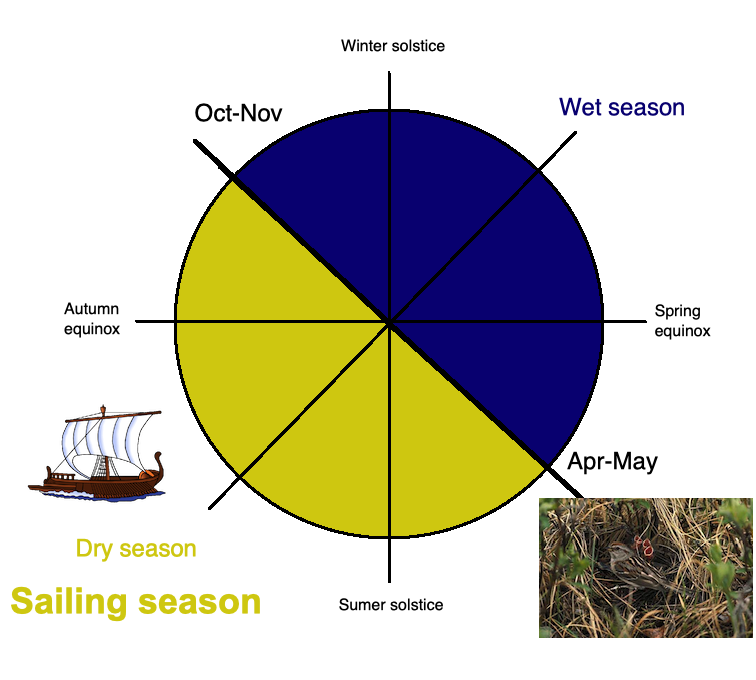
Both house sparrow and Spanish sparrow nest in Apr/May...Incubation lasts 11-14 days and the chicks become independent at about 25-28 days...Sooooo...


So, the only time of the year when a snake could have devoured a nesting sparrow and her chicks on a plane (platanos) tree, is Apr/May...

The beginning of the sailing season in the Eastern Mediterranean, right when the northerly trade winds start to blow down the Aegean sea...

Cool, right? 

Homer doesn't give us a clue when did the second gathering at Aulis take place, but I would bet that it took place at the exact same time of the year, in Apr/May, the beginning of the sailing season...

When the northerly trade winds start blowing...Well they did, eventually, after Agamemnon sacrificed his daughter to Apollo's "twin sister" Artemis...Who was in her earliest incarnation associated with the Sun...Twin!!!...And snakes...And Gorgone......I will talk about it soon...

Well actually, Homer does, in a way, symbolically, give us a clue when the second gathering in Aulis took place, and when the Greeks sacrificed Iphigenia "for good winds": after Agamemnon killed a sacred deer...

Now I will soon write an article about Artemis and her sacred deer...But here I would just say that there is a time of the year, when all the stags die, and only hinds/does are left to graze the meadows...And that happens in Apr/May...Clue in this article, "The return of the Apollo to Delphi", where I analyse symbols depicted on this large Cycladic krater...

So, I think that we can pretty confidently say that the Greeks performed the first sacrifice in Aulis, and set sail for Troy in Apr/May...But when did they perform the second sacrifice in Troy and set sail back for Greece?

If I was a betting man, I would say in Apr/May, at the beginning of the sailing season in Eastern Mediterranean...You want to catch "the good winds" early...

The scene depicts Polixene being dragged towards the mound representing the tomb of Achilles, whose ghost is depicted as a miniature warrior flying above it...Love it πŸ™‚ So far so expected...

The unexpected things are:

The ivy leaves and fruit on the shield of the Greek warrior standing to the left of Polyxene...

Huge snake and small lion depicted on the tomb of Achilles...

Polixene is depicted being dragged from the Ivy to the snake-lion...

Why?

Now in this article, "Woman and a pitcher", I explained why Ivy is linked to winter and the Winter sun, Dionysus...Ivy flowers in Autumn, and bares fruit during winter...See the little dark dots on the ivy wreath around Dionysus's head?  

This is what is depicted on the shield of the Greek soldier who is standing behind Polyxene, blocking the way of the horses which are following Polyxene...Solar horses???

So Polyxene is being dragged from the winter, the season of ivy fruits, to the "season that starts when snakes begin to mate (Apr/May) and ends when lions begin to mate (Jul/Aug)"...Summer, also  the best time to sail in Eastern Mediterranean...

Do you think that it is interesting that the grave mound, is symbolically linked to summer? Knowing that Phoenicians symbolically linked the god of death and the sun? I do...

Considering that Greeks sacrificed Polyxene on the grave of Achilles, with the snake, the marker for the beginning of summer depicted extra large, I would say that this sacrifice "for good winds", at the end of the Trojan war, took place at the beginning of summer, in Apr/May...

And just like the two sacrifices that wer performed "for good winds" in Aulis, and which were dedicated to Apollo and "his twin sister", this one that was performed in Troy is also most likely performed in the temple of Apollo, or dedicated to Apollo...

Cause it is the sun that heats up the sea and causes the northerly trade winds to begin to blow down the Aegean sea...And as expected, after the sacrifice, the good winds begin to blow...And the Greeks leave Troy and set sail to Greece...

Oh, BTW, Here is another Etruscan vessel, where ivy was used as a plant calendar marker related to Apollo...

These Etruscans knew stuff...Which Greeks seemed to have forgotten...I talked about it in my post "Skipping"...

So this is it from me for today I think...Hope you didn't give up half way through this article, and that you have found it interesting...

To read more about ancient animal and plant calendar markers, start here…then check the rest of the blog posts related to animal calendar markers I still didn't add to this page, and finally check my twitter threads I still didn't convert to blog post...I am 9 months behind now...

Saturday, 19 February 2022

Blood and mortar

Saint Tsar Lazar fresco from Curtea de Arges Monastery, Romania. Pic from the paper: "Medieval name and ethnicity: Serbs and Vlachs" by Ştefan Stareţu, University of Bucharest.

This beautiful monastery church was built in the early 16th c. by Princess Milica Despina Branković, wife of the Duke Neagoe Basarab, Ruler of Wallachia... Milica was of Serbian origin, and closely related to Serbian noble houses of Branković and Lazarević...

Now there is an interesting legend about the building of the church. For some reason, the builders were not able to keep the church walls standing up. Whatever they build during the day, collapsed during the night...

Finally, the architect in charge of the build, certain Master Manole, was threatened with death by his employers if he didn't finish the church...

After much deliberation with his masons about what to do,  Manole remembered an ancient custom of placing a living woman into the foundations of buildings in order to insure they don't collapse...

So he suggested that the first woman who came to the building site the following day, with the food for her husband, should be the one used as the sacrificial victim...

All the other masons, of course, warned their wives not to come to the building site then next day, except Manole. And so Manole was forced to sacrifice his own wife Ana. And that is how the church was built...

Interestingly, there is an identical legend about the building of the Fortress of Deva, also in Romania...

In this legend, a stonemason named KΕ‘mΕ±ves Kelemen – finds that the castle he’s trying to build keeps falling down, and is forced to sacrifice his beloved wife and mix her remains into the mortar in order to make the castle stand...

Another legend with the same plot is the legend about the building of the Bridge of Arta, a stone bridge that crosses the Arachthos river in the west of the city of Arta (Άρτα) in Greece...

According to the legend, the builders could not build the bridge, because, the foundations they built during the day, would collapse and were swept by the river during the night...

Finally "a bird with a human voice" informed the Head Builder that, in order for the bridge to remain standing, he should sacrifice his wife...He did, and this is how the bridge was built...

There is also an identical Serbian legend about the building of the Skadar fortress. The legend, in a form of an epic poem, was published for the first time in 1815 in a version recorded by Vuk Karadžić from the singing of a Herzegovinian storyteller named Old Rashko...

In 1824, Vuk Karadžić sent a copy of his folksong collection to Jacob Grimm, who was particularly enthralled by "The Building of Skadar" epic poem. Grimm translated it into German, and described it as "one of the most touching poems of all nations and all times"...

The poem describes the building of a fortress on the Bojana river at Skadar, today in Albania, in the 14th c. by the Serbian MrnjavčeviΔ‡ brothers (King VukaΕ‘in and his brothers UgljeΕ‘a and Gojko)...

Whatever the brothers built during the day, was pushed into the river during the night by Vila (a mountain fairy). 

Eventually, vila said to the king VukaΕ‘in, that if he wanted his fortress to stand, he would have to build a living person into the fortress foundations...

And, the Vila said, it will have to be one of the brothers' wives. Whichever one comes to the building site first the next day, with the food for the builders, will have to be sacrificed...

VukaΕ‘in and UgljeΕ‘a both warn their wives, and so Gojko, the youngest brother, had to wall up his young wife alive within the walls of the fortress...

As his wife just gave birth to the twins, boy and girl, called Stojko and Stoja (Stoj means stand, be upright), she begged the builders to leave her breasts exposed, so she can feed her babies...

This relief, currently in Vienna, made in 1906 by Croatian sculptor Ivan Meőtrović, depicts the scene of the sacrifice...

You can find the full English translation of the poem (in a somewhat archaic English) here...

Anyway, I believe that this legend could be of Serbian in origin. The reason for that is that the custom of making blood sacrifices on the foundations of buildings, in order to make them stand, is still common among Serbs...

Not only that, According to Vuk Karadžić, there was a belief still strong during the 19th c. that it was impossible to build a large building without a human sacrifice...

Because, of course, you could't build people alive into buildings any more, builders "stole people's shadows and built them into the foundations or the walls"...

Vuk Karadžić claimed that people even avoided the building sites because they were afraid their shadow could be walled-up and they could die without it...

This belief and custom were recorded by ethnographers in many parts of the Balkans inhabited by Serbs. I talked about this belief and practice in my post "New house"...

But to me, very interesting thing about these legends is that the sacrificial victim is always a woman, the wife of one of the builders...

This gives a completely new meaning to the Serbian proverb: "Ne stoji kuΔ‡a na zemlji nego na ΕΎeni" - The house doesn't stand on the ground but on the woman...I talked about this proverb in my post "Baba - the main beam that supports the house"...

Tuesday, 23 February 2021

Helmet?


This amazing object is officially described like this: "Gold parade helmet with the image of warriors. Scythian culture. Found in the mound of Peredereyev Grave (ΠŸΠ΅Ρ€Π΅Π΄Π΅Ρ€Π΅Π΅Π²Π° Могила), Zrubnoe. Donetsk region, Eastern Ukraine. 4st century BC"...But...

Is it possible that this is not a "ceremonial helmet" but instead a "ceremonial cup" used in human sacrifices? Well the scene depicted on the vessel surely shows a man about to be slaughtered...

Herodotus says that: "Of all their enemies that they take alive, they sacrifice one man in every hundred...to their god Aries...which they represent by a scimitar placed on a pile of sticks..."

"They pour wine on the men's heads and cut their throats over a vessel; then they carry the blood up on to the pile of sticks and pour it on the scimitar"...Is this the vessel used for collection of the sacrificial blood??

Oh, and Herodotus also says that "Scythians drank the blood of the first person they have overthrown"...You need cups for that too...Like this one? More from Herodotus on Scythians can be found here

PS: I was just shown this pic of the top of this object, from "Images of scythians on the “helmet” from perederieva mohyla kurgan"


Cups usually don't have holes at their bottoms...So... πŸ™‚

PPS: Another similar strange object, found in 1898 in Kurghip tumulus, Krasnodar, Maykop district, Russia. Gold. Height 5,4 cm. Dated to 4th century. BC...Two warriors, one holding a sword and the other holding a severed head of an enemy, holding onto a spear together...Is this some ritual? Definitely confirms that Scythians liked cutting heads of their enemies off...


Friday, 24 November 2017

Thanksgiving


When people say "thanksgiving" today, the immediate association is "the day when Americans and Canadians eat roast turkey to celebrate....something".

Americans commonly trace the Thanksgiving holiday to a 1621 celebration at the Plymouth Plantation, where the settlers held a harvest feast for three days after a successful growing season. 

The origins of Canadian Thanksgiving are traced to the French settlers who came to New France in the 17th century, who celebrated their successful harvests. 

The European settlers in America celebrated the end of harvest because thanksgiving festivals which mark the end of harvest have been celebrated all over Europe probably since the arrival of agriculture.

The word "harvest" comes from the Old English word "hærfest", meaning "autumn". It then came to refer to the season for reaping and gathering grain and other grown products.

The harvest season, autumn, begins on the 2nd of August when we find Lughnasadh which is in England known as Lammas, meaning "loaf Mass" and is celebrated on the 1st of August. And the autumn ends on the 5th of November when we find Samhain which is celebrated on the 31 of October and St Martin's day which is celebrated on the 11th of November.

The most well known end of harvest festival is St Martin's day or Martinmas, when people celebrate successful end of agricultural year. Martinmas is celebrated on November 11 each year. This is the time when autumn harvest was completed, autumn wheat seeding was completed, sheep were brought down from the mountain pastures and the annual slaughter of the pigs, which were fattened on acorns, was also done. (An old English saying is "His Martinmas will come as it does to every hog," meaning "he will get his comeuppance" or "everyone must die".)

Originally, thanksgiving was celebrated as a day of giving thanks to "Heavenly father" or the "Sky father" for basically not destroying the crops.

As I said already all agricultural societies in Europe had some form of end of harvest festival. Here I would like to talk a bit more about the end of the harvest festivals which used to be celebrated by the ancient Irish and ancient South Baltic Slavs. The links between these two festivals are so striking that they are pointing at a almost certain cultural link between these two people.

In Ireland the end of the harvest period, the end of autumn, was also the end of the year. The mass held to give thanks for the good harvest and the good year, was held on Samhain, Haloween, Irish New Year, which is today celebrated on the 31st of October. But the date of Samhain was originally probably 5th of November, the true mid point between autumn equinox and winter solstice.

Now the God to whom Ancient Irish gave thanks for their harvest was called Crom Cruach, which is another name of Crom Dubh, the old Irish god of agriculture.

The most famous worshiper of Crom Cruiach (Crom Dubh) was Tigernmas, sometimes called Tiernmas, an Irish high king who is said to have ruled Ireland during late Bronze Age.

According to "The Metrical Dindshenchas" Tigernmas and three quoters of his followers died while worshiping Crom Cruaich,  "a cruel deity propitiated with human sacrifice", on the Magh SlΓ©cht (Field of Prostration), on 31 October (Samhain, Halloween), 1413 B.C. His grave there is marked by a standing stone.

What is interesting is that this custom of human sacrifices during thanksgiving could have been brought to Ireland by the people known as Fomorians who according to the ancient Irish annals were the first people to settle Ireland. They came to Ireland at some stage during the 4th millennium bc and brought with them the knowledge of agriculture. They lived in Ireland alone for a while.  But then, after the flood, during the 3rd millennium bc came the people of PartholΓ³n who are credited with introducing cattle husbandry, ploughing, cooking, dwellings, trade, and dividing the island in four. But then Partholon and all his people later died of plague leaving Fomorians as the single inhabitants of Ireland again. Then The people of Nemed came, the descendants of the brother of Partholon, and they found Fomorians living in Ireland. They fought the Fomorians under Nemed and won. But after Nemed's death, Fomorians enslaved Nemed's people and demanded a heavy tribute: two thirds of their children, grain and cattle. The tribute that Nemedians had to give to Fomorians was exactly the same as the tribute Tigernmas had to give to Crom Dubh. Nemed's son gathered an army of sixty thousand, rose up against them. After a great slaughter on both sides, only thirty of Nemed's people escaped in a single ship, scattering to the other parts of the world, leaving again only Fomorians in Ireland. Well actually the Lebor GabΓ‘la Γ‰renn says that when the next invaders, the Fir bolg, came then found Ireland empty. But Lebor GabΓ‘la Γ‰renn also seems to suggest that Fir bolg and Fomorians were one and the same people. At least Macalister, the translator and editor of the Lebor GabΓ‘la Γ‰renn thought that this could be so when he says that:

"The line between the Fir Bolg and the Fomorians is not clearly drawn…"

What is also very interesting is that Fir Bolg are also said to have been the descendants of Nemed who was the descendant of Partholon's brother. This makes Fomorians and the people of Partholon one and the same people. 

We have to ask ourselves why are the Fomori most directly linked to Fir Bolg. The Lebor GabΓ‘la Γ‰renn states:

"Partholon took Ireland: he dwelt there five hundred and fifty years, till the  Cynocephali (dog headed, wolf headed) drave him out, and there escaped [survived] not one of his children alive."

Who were these wolf people?  Macalister suggests that “the Cynocephali introduced into the subsequent Partholon story have no place in the orthodox narrative, unless we are to equate them to the Fomoraig". But maybe they are to be equated with Fir Bolg. What is the old Irish word for wolf? It is "faolchΓΊ". Could it be that Fir Bolg are Fir faolchΓΊ, wolf people, wolf head people, Cynocephali? The Fir Bolg are first mentioned in the 9th century Historia Brittonum, where they are referred to as the Builc...

Then came the Tuatha DΓ© Danann, another group of descendants of Nemed who was descendant of Partholon's Brother. They defeated the Fir Bolg in the first Battle of Magh Tuiredh and took possession of Ireland. But then they had to defeat the Fir Bolg again, this time under the name of Fomorians at the Second Battle of Magh Tuireadh. Interestingly the Annals of Loch CΓ© call Magh Tuiredh "Magh-Tuiredh-na-Fomorach" and explain that Magh-Tuiredh what the place "where the Fomorians were imposing their tributes on the men of Erinn..." So here Irish annals are equating Fir Bolg with Fomorians. The name Mag Tuired (modern spelling: Magh Tuireadh) means "plain of pillars" or "plain of towers". Crom Cruach, the god venerated by Tigernmas on Magh SlΓ©cht, was represented by a large idol, made completely of gold, which stood on the plain of Magh SlΓ©cht  Twelve smaller idols, these of stone, formed a ring around the Crom Cruach. Were pillars which were standing on Magh Tuireadh the same pillars which stood on Magh SlΓ©cht and which represented , Crom Cruach (Crom Dubh)??? And if so was Magh SlΓ©cht actually the same as Magh Tuireadh?

At the end of the Second Battle of Magh Tuireadh, Bres, the leader of the Fomorians was found unprotected on the battlefield by Lugh, the leader of the Tuatha DΓ© Danann. Bres pleaded for his life with him. Lugh spared Bres because he promised to teach the Tuatha DΓ© Danann agriculture. Bres is said to have possessed the the secret knowledge of "How shall the men plough?  How shall they sow?  How shall they reap?". He gave that secret to Lugh, the leader of the Tuatha DΓ© Danann and his life was spared. From this we clearly see that it was Fomorians who brought the agriculture to Ireland. 

What is interesting about this story is that both Bres, the leader of the Fomorians and Lugh the leader of Tuatha DΓ© Danann at the Second Battle of Magh Tuireadh were half Fomorian and half Tuatha DΓ© Danann.

Lugh's father was Cian of the Tuatha DΓ© Danann, and his mother was Ethniu, daughter of Balor, of the Fomorians. Bres's father was Elatha of the Fomorians and Eri, daughter of Delbaith of the Tuatha DΓ© Danann.

This means that the Tuatha DΓ© Danann, who are said to have replaced Fomorians as the rulers of Ireland actually claim descent from or at least close kinship with the Fomorians. Actually the line between the Fomorians and the Tuatha DΓ© Danann is so blurred, that in the "lebor gabΓ‘la Γ‰renn" we read:  

“At the end of three days and three nights thereafter the Sons of MΓ­l broke the battle of Sliab Mis against demons and Fomoraig, that is, against the TΓΊatha DΓ© Danann"...

This line literally equates the Fomorians and the Tuatha DΓ© Danann.

From the above we see that Fomorians brought the secret of the grain agriculture to Ireland and preserved it until the time of Tuatha DΓ© Danann. We also see that when the Milesians came to Irleand, the Fomorians were still there. Lebor GabΓ‘la Γ‰renn tells us that the Irial FΓ‘id father of Ethriel and grandfather of Tigernmas:

"...cleared twelve plains, dug seven royal forts, and fought four battles against the Fomorians..."

The Fomorians were apparently still in Ireland at the time of  CΓΊ Chulainn. In the medieval Irish tale entitled "The Training of CΓΊ Chulainn", preserved as a copy by Richard Tipper in British Library, we read:

"CΓΊchulainn came to the place and saluted them. 'What is this sorrow or the misery upon you?' says CΓΊchulainn. The damsel answered and this she said: ‘A royal tribute which the tribe of Fomorians carry out of this country every seventh year, namely, the first-born of the king's children. And at this time it has come to me to go as that tribute, for to the king I am the dearest of his children.’‘What number comes to lift that tribute?’ asks CΓΊchulainn. ‘Three sons of Alatrom of the Fomorians,’ she answers, ‘and Dub, Mell and Dubros are their names.’"

This means that we still find Fomorians in Ireland during Iron Age, 4000 thousand years after they arrived to Ireland.  

Finally we find Crom Dubh as the main agricultural deity of Ireland in the 5th century AD when St Patrick had to defeat him in order to Christianise the Irish. 

And even today, in some parts of Ireland, the last Sunday in July, which marks the beginning of the harvest season, is called "Domhnach Crom Dubh" which means "Crom Dubh's Sunday"...

So here is the question:

Did Fomorians, who brought agriculture to Ireland, also brought with them their god of agriculture, Crom Cruach (Crom Dubh) and is this why the both Crom Cruach, Crom Dubh and Fomorians demanded human sacrifices? And if Tigernmas was worshiping From Cruach (Crom Dubh), was he worshiping Fomorian god? And if so, was Tigernmas a Fomorian king? I believe so.

James Bonwick thought so too. In the book "Irish Druids and Old Irish Religions" he identified Tigernmas, the king who perished while worhiping Crom Cruach, Crom Dubh, the god of agriculture, with Balor, the King of Fomorians. This is based on the fact that the ancestry of the god Lugh is usually given as Lugh son of Eithliu daughter of Balor but in the text Baile in ScΓ‘il it is given as Lugh son of Eithliu son of Tigernmas, thus equating Tigernmas and Balor, the king of Fomorians.

So who were these Fomorians then and where did they come from? Irish historians agree that the name Fomorians means probably sea people, or people who came from across the sea, or sea pirates. Where could have been that land across the sea famous for its sea pirates whose name sounds like Fomori?

This is south Baltic part of Germany and Poland, called Pomerania or Pomorje. 
Pomerania, Pomorje is a Slavic word meaning the land by the sea. The word comes from po + more = by, along + sea. The people living by, along the sea are in Slavic languages called pomori, pomorci, pomorjani, meaning the sea people, coast people. 

This is the territory of Pomerania, Pomorje:


Pomerania (German: Pommern, Latin: Pomerania, Polish: Pomorze) is a historical region on the south shore of the Baltic Sea. The name Pomerania comes from Slavic po more, which means Land at the Sea. The adjective for the region is Pomeranian (Polish: pomorski, German: pommersch), inhabitants are called Pomeranians (Polish: Pomorzanie, German: Pommern).
This land was famous for its sea pirates and traders. Pomerania is also the place where we find Baltic Slavs who made human sacrifices in medieval time to their gods at the end of harvest at the beginning of November, at Samhain. 

Now remember Tigernmas, the Irish king who died in Mag Slecht, with three fourths of the men of Ireland in his company, on Samhain night to be particular, while worshiping of Crom Cruaich; for he was the king-idol of Ireland? Tigernmas is said to have been the first king to give drinking-horns to his followers. The god to whom Pomeranian Slavs sacrificed people on Samhain was Svetovid. He is sometimes referred to as Beli (or Byali) Vid (Beli = white, bright, shining), and is often depicted with a sword or bow in one hand and a drinking horn in the other. Drinking horn was used for divination during the Slavic ceremonies. In Slavic mythology, the "horn of plenty" is the equivalent of Dagda's "cauldron of plenty". Dagda is then in turn believed to be another name of Crom Dubh, Crom Cruach

In "The Handbook of Religions in Ancient Europe" by Lisbeth Bredholt Christensen, Olav Hammer, David Warburton we read that written source about the Baltic Slavs stress the importance of a feast held in the autumn, in Arcona "after the harvest" and in Riedegost in November.

The harvest in the South Baltic ends at the same time as in Ireland, in October, when the last acorns are collected. So "after the harvest" is basically the same as "in November". And November is actually not "in the autumn" but at the beginning of the winter according to the old Serbian calendar which is the same as the old Irish calendar. I already talked about this calendar in my post about "Two crosses".

A pan Slavic term for sacrifice "treba" means "something that has to be done, something that should be done". Another general Slavic term for feast "zertwa" originally meant sacrifice, the meaning it still has in Serbian. It also meant "to praise god".

Obviously Slavs and particularly Serbs, equated praising god with sacrifice.

Ibn Rosteh noted in the sixt century that Slavs prayed to the god of heaven and fire for good crops. This god of heaven and fire was Dabog, who was also among Serbs known as Triglav. Triglav was, as the Book of Veles states, at the same time Svetovid (Sun god), Perun (Thunder god) and Svarog (Fire god). So when we read in the ancient histories that Slavs sacrificed people to Svetovid and Svarog, there is really no contradiction here.  And what is most interesting is that Dabog (Good, Giving god) was among Serbs also known as Hromi Daba. Which is very close to Chrom Dubh who MΓ‘ire MacNeill in "The Festival of Lughnasa: A Study of the Survival of the Celtic Festival of the Beginning of Harvest" identifies as another name of Dagda (Good, Giving god). DΓ‘ithΓ­ Γ“ hΓ“gΓ‘in in "Myth, Legend & Romance: An encyclopaedia of the Irish folk tradition" identifies Crom Dubh as another name of Donn, god of death and ancestral deity. Which is interesting considering that among Serbs Dabog, Hromi Daba, is also considered to be god of death and ancestor of all Serbs...

Saxo Grammaticus describes the the appeal made by the priest and the people to the Sun god Svetovid (Sventovit), asking for abundant future harvests over a huge offering of bread during the autumnal (read November) feast held in Arcona. This was clearly a thanksgiving mass performed at the end of the harvest period, where thanks was given to the heavenly father for giving the good harvest.

Sources discussing the pre-Christian Slavs briefly mention the sacrifice of animals (mostly Cattle). Cattle, especially bull sacrifice, was since antiquity considered to be a replacement for human sacrifice. In Ireland the main sacrificial animal offered to Crom Dubh was bull, which was sometimes sacrificed at the beginning of the harvest and the beginning of autumn, on Crom Dubh day, the 2nd of August, and sometimes at the end of the harvest, at the end of autumn, the 5th of November, on Samhain.

But in South Baltic Slavic lands, main sacrifice performed during the thanksgiving was clearly human sacrifice. Most of the documentary evidence comes from the West Slavic Polabian area and primarily concerns Lutitians. Brun of Querfurt mentions that the Lutitians carried out human sacrifices to Svarozic, or more precisely, that they offered human blood and human heads to the deity.

This sound strangely similar with the obsession of the ancient Irish with cutting off their enemies heads...Did Irish offer them to their god, Crom Dubh as a sacrifice?

Contemporary chronicles connect the Lutici to the Veleti (Wilti, Vilci). Adam von Bremen (Gesta II,22) refers to them as "Leuticios, qui alio nomine Wilzi dicuntur", and Helmold von Bosau (Chronica Slavorum I,2) says "Hii quatuor populi a fortidudine Wilzi sive Lutici appellantur." Modern scholarship sometimes refers to both entities by a double name, e.g. "Wilzen-Lutizen" in German or "Wieleci-Lucice" in Polish.

There is no certain etymology for the name Wiltzi (Vilci). But what is very interesting is that in Slavic languages Vuk, Volk, Vlk, Vilk means wolf. So the tribal name Wiltzi, Vilci could mean "wolf people". These wolf people, who were also known as Lutitzes, Lutitians are the biggest South Baltic Slavic tribe which is mentioned in relation to the Samhain human sacrifices. Now remember Fir Bolg, who seemed to have been the same as the Fomorians and who seem to have been the same as the Cynocephali, the Dog Headed or Wolf Headed people?? Were Fir Bolg, Fir FaolchΓΊ, Wolf People, Volci, Wiltzi from Pomorje, Pomerania? After all both the Irish Fomorians and the Pomeranian Wiltzi performed human sacrifices during Samhain thanksgiving feast...

In "The Handbook of Religions in Ancient Europe" we can further read that according to the earliest account, from approximately 990 written down by Tietmar, a commander of a Polish stronghold surrendered and was then beheaded on the battlefield as a sacrifice. Apparently some years later, the Luttitians similarly executed two missionary monks. This alleged practice of human sacrifice in Rethra is confirmed later by Adam of Bremen, who mentions the martyrdom of the two monks and the execution of Bishop John of Macklenburg on the 10th of November 1068, probably during the annual feast held at that time. The bishop had been captured during a revolt by the neighbouring Obodrites some months earlier, but was sacrificed in Lutitian Rethra at the beginning of November. He was executed on the main square of Reidegost-Rethra, the main sanctuary of the Luttitians. His corpse was dismembered and the head stuck on a spear and offered to the main god of Rethra. The importance of the head of the victim is emphasised by Adam of Bremen, describing how the Lutitians treated the bishop's head 'sacrificing it as a token of victory to their god', probably bringing it to the shrine, while the corpse of the dead bishop, with hands and legs cut off, was left in the consecrated field in front of the sanctuary. Many of our sources specify that human sacrifice took the form of beheading, which may suggest that the sacrificial blood was of some importance. The head as an object of Slavic human sacrifice to Svarozic is mentioned already in 1008 by Saint Brun of Querfurt in his letter to the German king Henry II....The victims of human sacrifice among the Slavs were mostly captured enemies...

The fact that the Bishop John of Macklenburg was kept alive until the beginning of November and only then executed, shows that he was kept as a sacrificial victim for the thanksgiving feast marking the end of the harvest and the end of autumn. This shows that Baltic Slavs might have always made human sacrifices in November, on Samhain, just like Tigernmas was accused of doing in Ireland millenniums earlier.

I believe that so many links between the descriptions of human sacrifices that Fomorians intoduced in Ireland and which were performed on Samhain (beginning of November) and the descriptions of human sacrifices performed by Pomeranians at the beginning of November (Samhain) is astonishing.

Are we here talking about one and the same people, worshiping one and the same Sky god, Good god, Giving god, Dabog (Triglav who is Svetovid, Perun, Svarog) (Dagda), Hromi Daba (Chrom Dubh)? Or is this just another amazing coincidence?

Whatever the answer, I bet you will never look at thanksgiving in the same way.

For the end I will leave you with this image of a Scythian feast taken from a golden plate found in Sachnovka kurgan. If you glance at the image you will see the scene of a joyous party with lots of eating, drinking (from drinking horns) and singing.


But if you look more carefully at the first two figures on the left, you will see this:


Two men sacrificing a ram? If so, why does the second man have his hand on the first man's head, as if to pull his head back before slitting his throat? Is this maybe a depiction of a bound man about to be slaughtered as a human sacrifice?  Does this image depict what later Slavic chroniclers described as Slavic Samhain Thanksgiving feast?