Showing posts with label mortar and pestle. Show all posts

Monday, 1 February 2016

Stones with narrow bottomed bowls

In my post about bullaun stones, the ancient grinding stones, I mentioned that these types of stones are also found in the South Eastern Baltic are. This is one of many old hollowed stones from the Baltic. They are called bowl stones and are, like in Ireland and in Slavic countries, regarded as sacred. The place where the stone is located is used as a place of worship. The diameter of this stone is about 60 cm and a depth - about 15 cm. In the past people considered the accumulated water as sacred and thought that it had healing properties. In the past the stone used to be called the stone of god.


You can see many more of these stones if you run this search. Here are some of them. This one is called "Lielais Daviņu Akmens" which means great stone of giving, offering, great altar. It seems that the stone was linked to harvest rituals.


This stone stands on a hill, where an old oak forest grew until the seventeenth century. The hill was a site of a pagan temple. 


For information about these stones in English look at the pages 27 - 33 of the book "Studies into the Balts’ Sacred Places".

I was just made aware of an article about an interesting half-made bowl-stone from Baltic region. On its top part there's a circular groove of a similar size as the usual bowls on other stones, as if someone had intended to gouge out a bowl there too but stopped half way through the process of gouging the hole. 


We can deduce though that this is how these bowl stones were actually made from their name in Lithuanian. Lithuanian word for bowl is dubuo, dubeni akameni...These words come from Slavic root dub meaning wood, oak but also to gouge. This second meaning comes from the time when utensils were made by gouging bowl like holes in pieces of wood and later stone. In Southern Slavic languages Dubiti means to gouge and Dubeni, Dubeno means gouged, with a gouged hole, bowl in it...Dubeni kameni in South Slavic languages means gouged stones, bowl stones...

But there is a special kind of these bowl stones which are found in the South Eastern Baltic that fall into a class of their own. These are so called "stones with narrow bottomed bowls". 


There are all together 250 narrow-bottomed bowls, but it is quite possible that more once existed, but were destroyed. Majority of these stones are concentrated in two areas: Central and Northern Lithuania / Central Latvia and in Eastern Lithuania. Only a couple of such stones were found in Samogitia.

Historical and archaeological records show that the stones with narrow bottomed bowls are very similar in dimensions and shape, regardless of the area in which they were found. The dimension homogeneity is quite stunning. Processed or unprocessed, the size of the stones varies only slightly. 
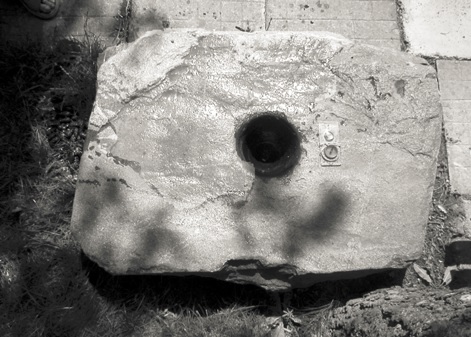


They are only in exceptional cases smaller than 60 x 70 cm and never exceed 100 x 120 cm. Stones thickness (height) is also very similar and varies between 25 - 35 cm. Several stones found in-situ protrude above the ground plane from 5 - 15 cm. The diameter of the upper part the bowl is rarely less than 15 - 16 cm and is never more than 23 - 24 cm. The bowls dept varies between 9 and 21 cm.


The stones are usually found on farms: near houses, barns and cattle sheds or inside them, quite often at the base of the building. Often there are 2 to 3 or even 4 to 5 stones with narrow bottomed bowls preserved in every village, for example Montviliskis, Vaiduloniai, Vileikiai. Today most of these stones are used as decorations. Sometimes these stones are used in churches for storing holy water, like in Dotnuva. But it seems that they were once used as corner stones, usually placed under the northern or north western corner of the house. 

Up until the seventeenth century it was customary to build wooden buildings without diging foundations. A layer of stones was placed on the ground and then the wooden house frame was built on top of it. Corner stones were the most important of all as they were placed under the main four supporting vertical beams. The bowl in the corner stone was usually oriented towards the inner side of building. 


The archaeological investigation which was carried near 9 of these stones dated them to the period 16th - 17th century. However, excavation near the Montviliskis stone uncovered two holes of about one meter in diameter full of ashes, cattle bones and potsherds dated to 2nd millennium AD as well as potsherds from the period 16th - 18th century. The bones were all of young animals, indicating that they were sacrificed in a "first fruits" kind of sacrificial fertility ceremony.

There are ethnographic records from Lithuania which show that in the past, when the corner stones were placed in the ground, a special blessing and sacrifice ceremony was performed.  The hole in which the corner stone was to bi placed was dug first. Then the owner of the house would step into the hole and would drink some vodka and then all the workers working on the house would do the same and then they would share some food and continue working. The corner stones were marked with wax crosses and money was placed next to or under them. It was believed that god lived in them. Not only that, but it seems that the stones with narrow bottomed bowls were used as family altars.

At the beginning of the 17th century Jesuits described the stones with narrow bottomed bowls calling them "Deiviu akmenys" meaning "Goddess stones".
The report  from the 1600 says: In stores big stones are kept. They are dug into the ground, with the flat faced facing up. They are covered with straw. They are called "Deyves" (Goddesses) and are faithfully worshiped as the protectors of cereal and cattle.
The report from 1605 says: Some very uneducated village people due to our efforts got rid of the bad habit of worshiping one stone which they thought to be the god of granary, fruitfulness and happiness of home.

Even though it is not specifically stated that the sacred stones were "bowled", there is much in common between the stones described by Jesuits and stones with narrow bottomed bowls: their location in farm buildings, the fact that the top face of the stone was flat, the stones had the function of the cereal, cattle, happiness provider.

There are legends about the stones with narrow bottomed bowls which state that in the old times they were used as mortar stones for milling, grating or pounding. In Veriskiai, the local legends states that the stone was used by the Devil to grind tobacco.

Some stories preserved by old people talk about holy water being stored in the stones and that before that people used to pour milk into the hole for the grass snake, the houses snake, the incarnation of the house protector spirit in Balto Slavic religion.

In the 17th century Jesuits recorded the existence of a god called "Pagirinis", meaning "The one who lives under the quern, under the mortar stone" basically "The one who lives under the stone with narrow bottomed bowl". Knowing this it seems that the most probable function of the stones was as an altar to the god (goddess) protector of home. Another 17th century Jesuit report states that the god "Pagirinis" sometimes comes out of his corner in a shape of a grass snake, but that it spend most of his time buried in the soil, which is kept in a clay or wooden dish or without a dish under the quern (mortar stone, the stone with the narrow bottomed hole).

So this is very interesting. We have:

1. a corner stone
2. which is shaped like an ancient mortar stone
3. which was used as a fertility cult altar.
4. which is referred to as a "Goddesses stone"
5. which is the home of the male deity whose name means "The one who lives under the quern, under the mortar stone"

In some parts of Serbia the " thick wall" made of stone which supports the house is called Baba.


In Bulgaria thick logs which are put under log cabin corners to support the house are called "bа́bka". This gives additional meaning to the Serbian proverb that says that "the house stands on a woman". I wrote about it in the post "Baba - the main column, pole that supports the house". It seems that baba was any supporting structure on which the house stood. 

In Serbian and in other Slavic languages the word Baba also means wich, goddess,  and not just any goddess, the Mother Earth. So it is not surprising that the above corner stones from Lithuania were called "Goddesses" stone. They are basically Baba's stone, as Baba, Mother Earth,  was the fertility goddess to which Lithuanians prayed to. Interestingly

The name of the male deity which is believed to live under the corner stone in Lithuania shows that that these stones were once actually used as grinding stones, as I postulated in my post about bullaun stones.

The fact that the mortar grinding stone was used as a fertility altar dedicated to the Mother Earth is not surprising at all either. A hole in the ground is where the plant seed is planted. A hole (vagina) in the lying woman is where human seed is planted. So a horizontal lying stone with a hole (mortar) is already suggestive enough. Mortar grinding stone and pestle even more. So much so that the mortar and pestle became the symbol of male and female genitalia in Hinduism (Yoni and Lingam).

This is a so called "wet" grinder mortar and pestle from India from this great blog post about making stone ground chutney


And this is Yoni and Lingam 


The union of sky and earth produces (releases) cereal seeds which are then poured into the mortar and pounded into flour with pestle in a motion which greatly resembles coital movement of penis (Lingam) inside vagina (Yoni) which produces (releases) human seeds which are poured into the vagina.... Do you see the link here? The fact that in the Baltic tradition milk was poured into bowl of the corner stone "for the snake to eat" confirms this, milk being symbolic replacement for sperm, milky white liquid containing human seeds. Once the cereal seeds are pounded into the flour flour is made into bread which is bake inside the bread oven which looks like the belly of a pregnant woman. And that bread oven is in Serbia called baba. Ovens were in old Slavic houses placed in north-eastern or north-western corner, just like the Goddess stones. 


The belief that the house protector snake lives in the house foundation does not only exist in the Baltic countries. It is wide spread in Slavic countries and it exist in Serbia too. In Serbia the house protector snake is believe to live in the house heart (stone oven) or the house foundations (the layer of stones which supports the wooden house frame, corner stones originally). It is believed that this snake is the spirit of the founder of the family, some other very distinguished ancestor, or the first male ancestor who died in the house. Either way this snake is the symbol of the male ancestor, just like Lingam. So we have a mortar stone (Yoni) which houses (in a bowl) snake (Lingam)...

And this is it, the story about Lithuanian co called "stones with narrow bottomed bowls". I hope you enjoyed it. Until the next time, stay happy.

References

"Aukštaitiški aukurai" by Vykintas Vaitkevičius
"Studies into the Balts’ Sacred Places" by Vykintas Vaitkevičius
"Pojmovnik Srpske kulture - baba" - Etnografski institut SANU

Thursday, 18 December 2014

Bullaun stones

In my post about eating acorns, I said that people had to invent quite a few things in order to move from eating acorns as occasional snacks to eating acorns as staple starch food. One of these acorn eating inspired inventions was a grinding stone. In archaeology, a grinding slab, or grinding stone is a stone artifact generally used to grind various materials into usable size crumbs, though some grinding slabs were used to shape other ground stone artifacts. Some grinding stones are portable; others are not and, in fact, may be part of a stone outcropping. The grinding slabs or grinding stones work through crushing and scraping actions produced by the motion of the movable part, pestle, over the static part, mortar. Any matter which is softer than the material from which the mortar and pestle are made and which is not viscose, will be crushed or scraped into progressively smaller bits. The longer you apply the grinding motion the finer the bits become. Grinding stones  are made of large-grained materials such as granite, basalt, or similar tool stones.

There are two general types of grinding stones: saddle and cup (conical) grinding stone.

This is an example of a saddle grinding stone from Ojibwe tribe from the Great Lakes area USA:


This is an example of a cup grinding stone from Mariposa county in California USA:


This is an example of a combined saddle and cup grinding stone. The hole in the rock was used like cup grinding stone and the flat surface around it was used like a saddle grinding stone.


On the next picture you can see a large boulder communal grinding stone. These types of grinding stones are also a combination of the saddle and cup grinding stones with multiple conical grinding holes surrounded with flat surfaces used as saddle grinding stones. Here is a great example  of a communal grinding stone from Yosemite national park:
In the book entitled "Indians of the Yosemite Valley and Vicinity Their History, Customs and Traditions" you can see the picture of the same grinding stone with pestles still in the holes. These are rude mortars and pestles for grinding acorn meal. The holes have been worn in the granite by constant use.


In this great documentary film called Kumeyaay story "Life Under the Oaks"Kumeyaay people talk about gathering, processing and eating acorn while using one of the boulder communal acorn grinding sites.


For thousands of years Native American women all over America ground acorns, nuts, and later maize (corn) with grinding stones like the ones shown on the above pictures. Here is a picture of  an old Indian woman preparing acorn meal from "The Algonquian Confederacy of the Quinnipiac Tribal Council" website.


On this picture from the Journal of San Diego History you can see that acorns were also ground using saddle grinding stones.


So you can see that Native americans used both cup (conical) and flat saddle grinding stones for grinding acorns. 

As I said in my post about eating acorns I believe that the invention of the grinding stones was a byproduct of the invention of the acorn breaking and leaching process. The people trying to quickly leach acorns for food needed to first shell the acorns. Breaking the acorn shell and separating the acorn from the shell is the most difficult part of acorn food preparation. Acorns have an elastic shell that resists slow sideways pressure. The best way to break the acorns shell is to put the flat end (the side that used to have the cap) on a firm surface and hit the pointy end with a stone. This process of breaking the acorn shells often resulted in broken and crushed acorns. I believe that people leaching acorns would have gathered whole and broken acorns and leached them together. And they would very quickly notice that the crushed pieces leached quicker, and that smaller the bits are the quicker the leaching is. So people would start crushing all the acorns before leaching. While crushing the acorns, people noticed that just whacking the acorns with a stone scattered the bits everywhere. But if they gently broke the shell, took the acorn out, placed it on a flat stone, and then pressed the acorn with another stone and moved the pressing stone in a scraping, grinding motion over the acorn, all the bits would stay on the bottom flat stone. I believe that this is how grinding was invented. 


This is the grinding motion used for grinding on a saddle grinding stone:


People who were crushing and grinding acorns soon noticed that if the mortar stone had a cup like hole, then you could crush the acorns and grind them coarsely quickly without bits flying everywhere. People also realised that if the mortar stone had a cup like hole, they could use rotating grinding motion which is also much more efficient.


This is the grinding motion used for grinding on a cup grinding stone:


As I said in my post about the acorns in archaeology, the earliest grinding stones are all associated with the acorn eating cultures. At the moment the earliest dated grinding stones were found in Upper Paleolithic sites in China (found to have been used for grinding plant food including acorns) and in Mesolithic sites in Morocco and Levant (found to have been used for grinding plant food including acorns). But I firmly believe that even earlier ones will be found. Also the latest paleobotanical data actually confirms that the food traces found on the grinding stones found in a lot of early "agricultural" sites were actually of acorns, which meant that the grinding stones in these societies were primarily used for grinding acorns. 

But once the grinding stone was invented as a tool for grinding acorns, people quickly realised that it can be used for grinding other things. Ethnographic evidence and ancient historical texts show that a wide range of foodstuffs and inorganic materials were processed using grinding stones (or as they are also known as, querns or mortars), including nuts, seeds, fruit, vegetables, herbs, spices, meat, bark, pigments, temper and clay. Grinding stones were also widely used in grinding metal ores after mining extraction. The aim was to liberate fine ore particles which could then be separated by washing for example, prior to smelting. Also, finely ground ore requires smaller fire to be heated and melted which makes it easier and faster to transform it into molten metal in primitive smelting pits. The earliest example of use of mortars in metallurgy can be found in Vinča culture where grinding stones were used for grinding cinnabar ore. One of the earliest uses for grinding stones was probably for the manufacturing of ochre and other pigments. You can read how this was done in this great article entitled "How to paint a mammoth".

In my post about the acorns in archaeology, I said that I could not find any mention of acorns in archaeological material from Ireland and Britain. This makes these two places the only two places in Europe where acorns were not found in archaeological sites. Does this mean that people in Ireland and Britain did not eat acorns when everyone else in the northern hemisphere did? I don't think so. We know from ethnographic and historical records that people in both countries ate acorns during hard times even in relatively recent times. This means that there is no chance that acorns were not consumed by people in Ireland and Britain during Mesolithic and Neolithic time.

As I said in my post about how oaks repopulated Europe, oaks reached Eastern Britain by 7500 BC. Oaks reached Ireland very soon afterwards. I believe that oaks were brough into both Britain and Ireland by hunter gatherer groups exploring the western coast of Europe in dugout canoes and I gave detailed explanation why I believe that to be the case in my post "how did oaks repopulated Europe".

We know from the archaeological records that the first humans arrived around 9,000 years ago (7,000 BC). This dating is based on the material recovered from the Mount Sandel Mesolithic site which is the earliest Mesolithic settlement found in Ireland. Storage pits found at the site are of the same basketed dug in storage pits type found in other acorn eating cultures in Evroasia at that time and later. So there is a strong possibility that the Mount Sandel people also ate acorns. At the time when Mount Sandel people lived in Ireland, the island was predominantly covered in a blanket of woodland. Oak and Elm were well established, with Scots Pine growing on the lower slopes of some uplands. There were two major woodland types namely, mature deciduous Oak Woods in the lowlands and valleys with an abundance of ferns, mosses and liverworts, and the Pine Forests on poorer soils with ling heather, grasses and bracken occurring in the ground layer. Some birch woodlands would have also existed on poorer soils. Other species such as Rowan would have flourished in natural openings in the forest canopy, along with whitebeam, holly, ivy and honeysuckle. These forests were home to animals, some of which are extinct in Ireland today, such as brown bear, wolf and boar, while others, such as fox, pine marten and stoat, still occur. The forests covered most of Ireland apart from exposed coastal areas, lake edges and the more exposed mountain tops. Alder and ash were still uncommon in Ireland 8,500 years ago but they expanded to become common around 500 years and 2,000 years later respectively. 

These early inhabitants were Mesolithic hunters, fishers and gatherers. And as we see in all the other major Mesolithic cultures, settled hunter gatherers living in well established mixed oak forests all ate acorns and other nuts as their staple starch food. Why would the Irish Mesolithic hunter gatherers be an exception? Why would they ignore the most abundant and the easiest to get food source which was everywhere around them? Well I don't think they did. And here is why:

Have a look at these three pictures:


No these are not acorn grinding stones from Native American acorn eating cultures archaeological sites. These are bullaun stones found in Ireland. This is what official archaeology has to say about bullaun stones:

A bullaun stone (Irish: bullán) is the term used for the depression in a stone which is often water filled. Natural rounded boulders or pebbles may sit in the bullaun. The size of the bullaun is highly variable and these hemispherical cups hollowed out of a rock may come as singles or multiples with the same rock.
Local folklore often attaches religious or magical significance to bullaun stones, such as the belief that the rainwater collecting in a stone's hollow has healing properties. 

Ritual use of some bullaun stones continued well into the Christian period and many are found in association with early churches, such as the 'Deer' Stone at Glendalough, County Wicklow. The example at St Brigit's Stone County Cavan still has its 'cure' or 'curse' stones. These would be used by turning them whilst praying for or cursing somebody. In May 2012 the first cursing stone to be found in Scotland was discovered on Canna. It has been dated to circa 800. The stones were latterly known as 'Butterlumps'.

St. Aid or Áed mac Bricc was Bishop of Killare in 6th-century. At Saint Aid's birth his head had hit a stone, leaving a hole in which collected rainwater that cured all ailments, thus identifying it with the Irish tradition of Bullaun stones.

Possibly enlarged from already-existing solution-pits caused by rain, bullauns are, of course, reminiscent of the cup-marked stones which occur all over Atlantic Europe, and their significance (if not their precise use) must date from Neolithic times.

Now am i the only one who sees similarity between the acorn grinding stones from North America and bullaun stones? There are thousands of bullaun stones scattered throughout Ireland. If any of them was found in North America, they would have been immediately classified as acorn grinding stones. How is it possible that "we still don't the precise original use of these stones"? As I said already Ireland was once covered with mighty oak forests and people who lived in these oak forests must have eaten acorns like all the other oak forest dwellers did. And if we find the same type of hollowed stones in Ireland that we find in North America, and if in North America these stones were used for grinding acorns, then these Irish stones must have been used for the same purpose. 

I believe that bullaun stones were not classified as acorn grinding stones primarily because until very recently we did not realise how ubiquitous consumption of acorns was in the northern hemisphere. Maybe its time to re-evaluate the bullaun stones and reclassify them as acorn grinding stones. I also believe that the earliest examples of bullaun stones probably date to Mesolithic and Neolithic time and that they predate the arrival of agriculture to Ireland..

As you could see from the pictures of grinding stones from North America, people used both cup, conical and saddle grinding stones originally for grinding acorns and then later for grinding grains. Apart from bullaun (conical) grinding stones, in Ireland we also find saddle grinding stones. 

This is a saddle grinding stone from the bronze age ~1500-500BC from Ovidstown, County Kildare.


This is a saddle grinding stone from the bronze age from Grange county Meath.


Saddle querns were used into the 20th century in Ireland, as you can see on this picture kept in the Ulster Folk and Transport museum. Compare this picture with the picture of the old Native American woman grinding acorns using saddle grinding stone. I love this woman's face. She looks more Native American than the actual Native American woman on the above picture.


This is a list of all the Irish bullaun stones as recorded in the National monument service database. As you can see they are found all over Ireland in huge numbers.


Ireland is not the only place in Europe where we find bullaun stones. As far as I know they are also found in Cornwall, France, on the Swedish island of Gotland, Lithuania, Germany, Belorussia...I was recently made aware of the existence of many bullaun type grinding slabs in the Levant of which the earliest were dated to 11,000 BC. I am preparing an article about these grinding stones and will publish it as soon as it's finished. 

These are grinding stones found in so called "court houses" in Cornwall.


These are grinding stones from Cornwall dated to late Neolithic early Bronze Age.


This is one of many old hollowed stones from the Baltic. They are called bowl stones and are, like in Ireland and in Slavic countries, regarded as sacred. The place where the stone is located is used as a place of worship. The diameter of this stone is about 60 cm and a depth - about 15 cm. In the past people considered the accumulated water as sacred and thought that it had healing properties. In the past the stone used to be called the stone of god.


You can see many more of these stones if you run this search. Here are some of them. This one is called "Lielais Daviņu Akmens" which means great stone of giving, offering, great altar. It seems that the stone was linked to harvest rituals.


This stone stands on a hill, where an old oak forest grew until the seventeenth century. The hill was a site of a pagan temple. 


For information about these stones in English look at the pages 27 - 33 of the book "Studies into the Balts’ Sacred Places".

I was just made aware of an article about an interesting half-made bowl-stone from Baltic region. On its top part there's a circular groove of a similar size as the usual bowls on other stones, as if someone had intended to gouge out a bowl there too but stopped half way through the process of gouging the hole. 


We can deduce though that this is how these bowl stones were actually made from their name in Lithuanian. Lithuanian word for bowl is dubuo, dubeni akameni...These words come from Slavic root dub meaning wood but also to gouge. This second meaning comes from the time when utensils were made by gouging bowl like holes in pieces of wood and later stone. In Southern Slavic languages Dubiti means to gouge and Dubeni, Dubeno means gouged, with a gouged hole, bowl in it...Dubeni kameni in South Slavic languages means gouged stones, bowl stones...

This is an example of the "pierres à cupules" or cupped stone from france. This is a communal boulder grinding stone.


This is a bullaun stone from Leistruper forest Westphalia Germany (taken by Oliver Reichelt).


These are just two of many bullaun stones from Belorussia. In Belorussia these stones are also regarded as sacred and the water accumulated in them is considered to have healing properties. In Belorussian these hollowed stones are called "valun" which in Slavic languages means both a boulder and a grinding stone. I believe that this name holds the key for understanding the original purpose of these stones and proves how ancient they truly are. But I will talk about this in one of my next posts....


Bullaun stone , situated on the location of a destroyed ancient chapel.
Izhorian Plateau, St. Petersburg region, NW Russia.


This is duben kamen, well, called zdenac from Dinara mountain region in Croatia:


This is a picture of the central hole with the reflection of the mountain top:


Bullaun stones Serbia. Unfortunately I don't know exact location...I also have information about similar stones in Makedonia.


If anyone has any examples of similar stones from Europe please let me know and send me a link to the pictures so that I can update the post to keep it relevant. 

In the end there is something I would like to draw your attention to. 

This is a prehistoric bullaun stone mortar and pestle:


And here is how it must have been used to grind Acorns:


And here is a bullaun stone mortar and pestle I have in my kitchen:

I use it to grind plant food, in the same way our Upper Paleolithic and Mesolithic and Neolithic ancestors did. People are extremely conservative when it comes to tools and will use something that works until they find something that does it better. As it seems, when it comes to grinding plant food, mortars and pestles are still the best tool for the job all these thousands of years later.

I hope you had fun reading this post. If you did, please plus it. It would mean a lot to me. Thank you and stay happy.