The most famous of the Lake Onega petroglyphs, Russia, made c. 4000BC, is a large anthropomorph known locally as "The Devil" (Rus. Bes), which was intentionally positioned around a large crevice so that it divides the figure in two...
Now ethnographers think that this was done to explicitly associate "The Devil" with the underworld, the gap in the rock being "the opening" to this other world...BTW, as you can see, "The Devil" was later Christianised by the addition of a large cross carved next to it...
The local legend says that "...long time ago the Devil and his Wife lived on Lake Onega, and made their presence known through the strange pictures on the rock. But then came the Incarnate Christ and the True Faith, and crosses were carved over the evil pictures..."
"...The evil spirits tried to escape, but they wanted to take with them a memory of their home, a boulder. However, as they took off from the rock with petroglyphs, they fell in the lake together with the boulder, and drowned in a place where today stands Porshen Islet..."
The cross carved next to the "Devil" can be typologically dated to the 14th or 15th century AD, and it is believed that the crosses were made by the monks of the nearby Greek Orthodox monastery of Muromsk, located c. 20km south-east of the carvings...
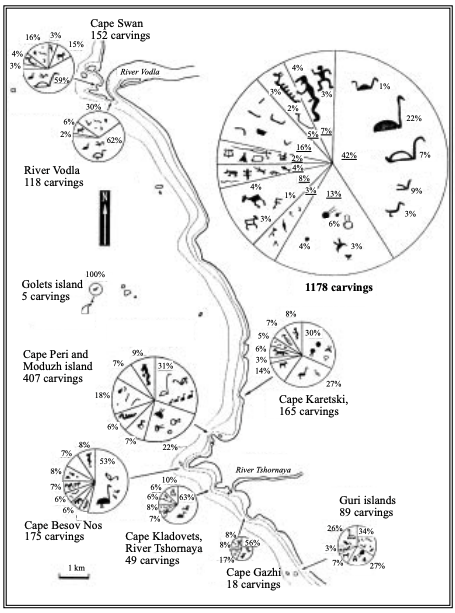
In the paper "Some Statistics About Rock-Carvings Of Lake Onega" we find this chart showing distribution of rock-art sites and motifs at Lake Onega. And it turns out that these petroglyphs most commonly depict swans and other water birds...Why?

"Northern Archaeology and Cosmology" suggests that:
"...Lake Onega swans appear to emerge from [the Underworld through] the cracks in the rock...or, alternatively, to disappear [into the Underworld] through "openings" formed by cracks in the bedrock..."
Interestingly, the only two images carved on the bedrock of the Lake Onega which were Christianised are "The Devil" and a swan...Why would Christian missionaries think that it was necessary to try to Christianise a depiction of a swan?

Well...To understand this we need to turn to local legends...According to Antti Lahelma, the author of this paper: "Strange swans and odd ducks: interpreting the ambiguous waterfowl imagery of Lake Onega,
"...they contain key for understanding the meaning of these petroglyphs.
Although today the language spoken at the Lake Onega region is mostly Russian, its traditional inhabitants were Finno-Ugric speaking Karelians, Vepsians and (possibly) Saami...
These peoples have been in contact with and influenced by Christianity since the Viking Age (9th–11th centuries AD) at least, when they fell within the sphere of influence of the Kievan Rus...
Nominal conversion to Orthodox Christianity occurred in the course of the 11th and 14th centuries, when the Karelians and Vepsians were subject to the city-state of Novgorod...
But it took a very long time for Christianity to take deeper root in Karelia and many aspects pre-Christian ritual and belief survived in the region until recent times...
Antti Lahelma argues, and I agree with him, that the people who carved these images into the rock shores of the Lake Onega 6000 years ago, were direct ancestors of the today's Carelians...
And he argues that the local population has managed to preserve the meaning of these images in their folklore...And interestingly, the central role in this folklore is played by migratory water-birds...Including swans...
In the traditional religions of Uralic peoples, water-birds were believed to be able to travel between the worlds, our world and the Otherworld...
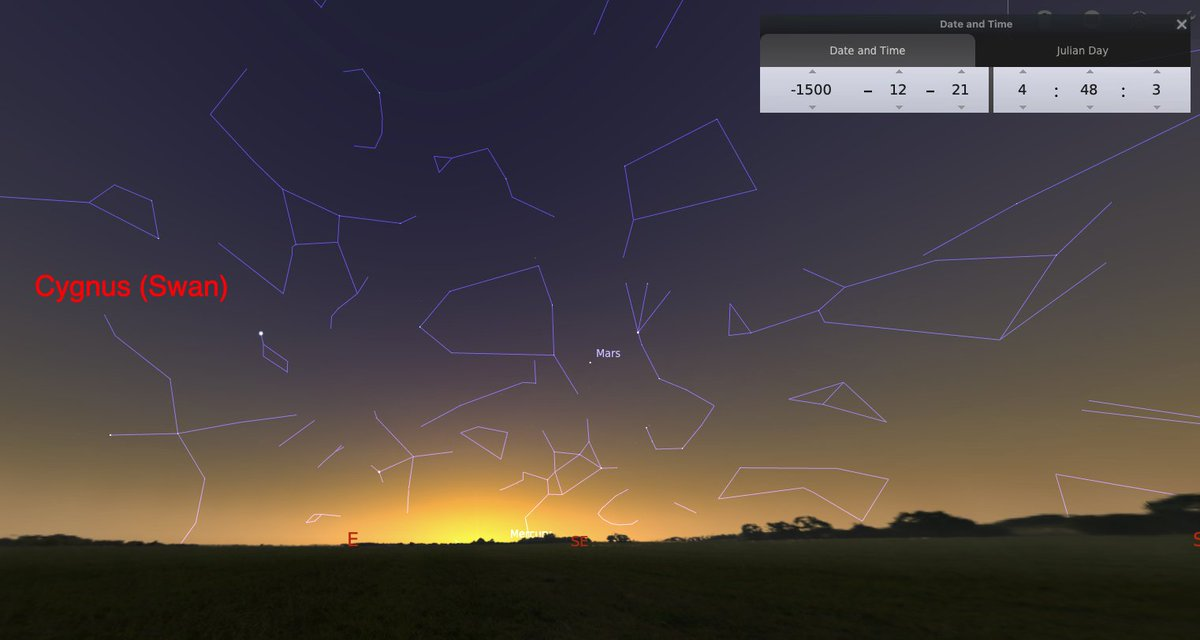
A belief manifested in the common Finno-Ugric cosmological concept of a "Land of Birds", an island located beyond the horizon at the south-western end of the Milky Way, which is in most Finno-Ugric languages called "Pathway of the Birds"...
Many ethnographers believe that this is an essential element of Proto-Uralic cosmology and thus may date as far back as 5000 BC – or the time when the earliest rock carvings at Lake Onega were made...
The notion of swans and ducks as "soul-birds" is found among the Vepsians of the southern Lake Onega region. In traditional Vepsian burial laments, for example, the human soul is often described as a bird...
And at some old Vepsian and Karelian cemeteries, wooden bird-sculptures representing the soul of the deceased can still be found on top of the Christian cross."
End of what Antti Lahelma had to say about that...
Cool right?
What's even cooler is that this is not a special Fino-Ugric belief...The same belief that migratory birds go from our world to the Otherworld in the autumn, and come back from the Otherworld to our world in the spring is also found in Slavic folklore...
Slavs believed in Iriy, a mythical place, a paradise, where "birds fly for the winter and souls go after death". Spring sun was believed to come from Iriy...I wrote about it in these posts: "Irij", "Leto", "Nav", "Bird wedding", "Julenek"...
Also this
Serbs have an interesting name for Milky Way: "Jovanova struga", meaning "Jov's river, river in the sky". And in Serbian tradition, it is this river that a soul needs to cross to reach "The other world"...You can read more about it in my post "Jovanova struga"...
I think that this belief was once most likely found in the belief systems of all the people living in the continental areas of the Northern Hemisphere, where the arrival of the birds from the south signalled spring and life, and their departure was a sign of autumn and death...
For this reason several Uralic peoples, including the Nganasan, Enets and Dolgans, have special rites for welcoming migratory ducks and swans in the spring...
But so do the Slavs...
I talked about Macedonian ritual welcoming of the returning migratory birds in the spring called "Letnik" in my article "Leto"...
I talked about Eastern Slavic custom of welcoming the returning migratory birds in the spring in my article "Inviting spring"...
Kurds celebrate the same thing...Every year in February, in Merîwan, they welcome the return of the storks to Kurdistan. Storks fly south each late summer and return to their breeding grounds in February, towards the end of winter. It‘s common in Kurdistan that the people greet the storks with songs and dance.
Ancient Greeks celebrated the return of swallows. I talked about it in my post "Heralds of spring"...
Anyway, how can all this help us understand the meaning of the Karelian swans appearing from and disappearing into the cracks in the rock? Back to Antti Lahelma...
According to him, in Finnish-Karelian shamanistic folklore, cracks in the rock would appear to be the archetypal entrances to the Lower World. The expression used for "falling in trance" in Finnish folk poetry can be literally translated as "falling into a crack" in the ground...
Given the above discussion on Finno-Ugric bird-mythology, it seems probable that many of the images of swans at Onega are to be understood as symbols of the soul, or as messengers between the worlds of humans and spirits...
Swans entering a crack or emerging from one appear to symbolise the passage of the soul – of a deceased person or a shaman – between This World and the Otherworld...
Interestingly, in the paper "Birds and burials at Ajvide (Gotland, Sweden) and Zvejnieki (Latvia) about 8000–3900BP" by Kristiina Mannermaa we can read that we actually have archaeological evidence that Neolithic people of the far north most likely connected waterbird (migratory birds) with the soul...
"The location of waterbirds’ wings or parts of them near the hands of the deceased, and the deposition of bird depictions in burials indicate that waterbirds might have been perceived as some kind of guiding spirits for the journey to the afterlife"...
Soooo...Another example of how ancient our folklore could actually be...
But this is not the only example...It was Slavic animal folklore that helped me discover animal calendar markers which seem to be behind all animal mythological symbols starting from Early Neolithic...
I proposed that this calendar system was developed during the transition from hunting and gathering to farming. And people then used these animal calendar symbols to mark important agricultural events in their area...
Like "The rains arrive when when wild goats begin to mate". "We should sow grain when wild goats begin to mate". "The flood arrives when wild cattle starts to calve". "We should harvest grain when wild cattle starts to calve"...
But this animal calendar was developed not by farmers but by hunters-gatherers, who knew the lifecycles of the animals and plants around them in depth...
Question: do we have any proof that hunter-gatherers used this hypothetical animal calendar?
Answer: I think that the petroglyphs at "Besov nos" are an example of the use of such calendar by Neolithic hunter-gatherers in Karelia...6000 years ago...
And I will here explain why I think so...
The people who lived in Neolithic Karelia lived mostly off hunting (elks, waterbirds) and fishing (wales, sturgeons, salmons, eels, catfish)...I believe that the composition with the "Devil" at its centre actually depicts the local hunting and fishing calendar...

More specifically, I believe that this is symbolic depiction of the period between snow melt (Mar/Apr) in the spring and the snow fall (Oct/Nov) in the autumn...This is the climatic chart for the Republic of Karelia...

This is symbolically depicted as the time between the arrival (Mar/Apr) of the swans (pointing up) and the departure (Oct/Nov) of the swans (pointing down)...

This is also what is what is depicted using this symbol found in local Karelian cultures from Neolithic until today: two swans looking in the opposite directions...

The swans depicted on these petroglyphs are whooper swans...

The whooper swans later became known as The Singing swans of the sun god Apollo...
I talked about it in my post "Singers of Apollo"...
That swans were seen by ancient Karelians as solar animals, can be seen from the fact that they were depicted together with snakes, also solar animals...

Snakes are probably one of the only truly solar animals.
They are in our world when sun is in our world, during the day and during the warm half of the year. And they are in the underworld when sun is there too, during the night and during the cold part of the year...I talked about it in my posts "Enemy of the sun", "The chthonic animal", "Bactrian snakes and dragons", "Dragon who stole rain", "Letnitsa treasure"...
But just like both swans and snakes are solar animals, they are also chthonic animals...Because they both follow sun to the Underworld during the winter...
That ancient Karelians saw swans as solar birds, can also be seen from the depiction of a swan with the sun around its neck. Was swan seen by the ancient Karelians as the bringer of the sun?

BTW, Bes, The Devil, is most likely the old Sun God. See the solar year symbol next to its head?

Also his head is right where summer solstice is supposed to be...This would explain why swan image was the only animal image that was Christianised together with Bes...
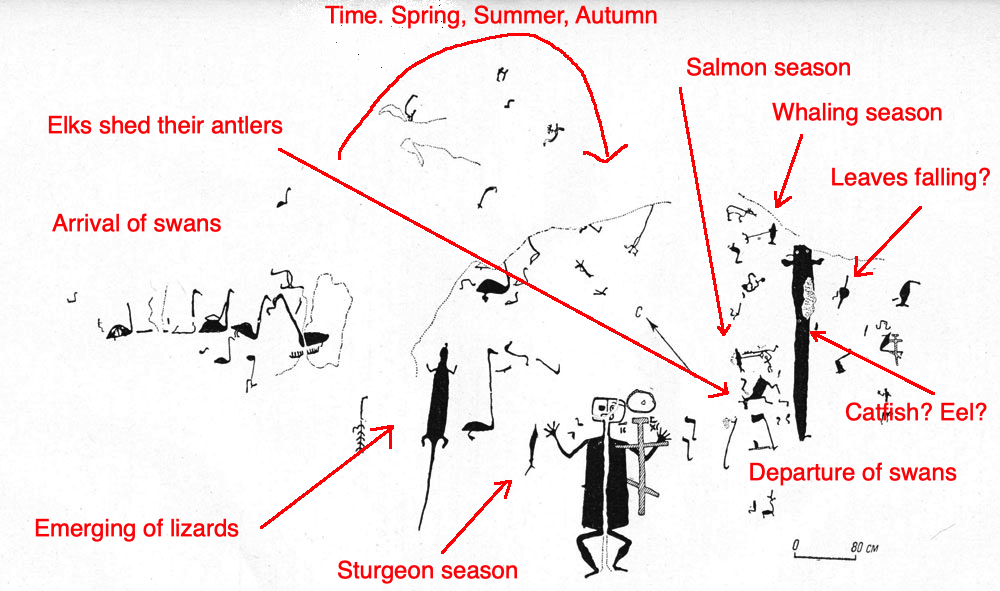
If indeed this is a calendar...Here is the full pic with annotations...

I will then go and explain where each depicted animal fits between the arrival and the departures of the swans and the sun...
Swans to the left of the "Devil" (spring) are all mostly pointing up (arriving from the land of the dead, winter) and the swans to the right of the "Devil" (autumn) are all mostly pointing down (going back to the land of the dead, winter)...
The most prominent animal depicted in the spring half of the composition is a common lizard, also pointing up, symbolising emerging of lizards from hibernation in the ground in the spring...And their mating season in Apr/May...

The second most prominent animal depicted in the spring half of the composition is an Atlantic sturgeon...These are huge migratory fish, which live in the sea and spawn in rivers. In the northern populations spawning starts in May and early Jun with a peak in Jul...

Here's spring part with dates...

But what about the other, autumn side of the composition? Do we find the same thing there? Well on the other side we see wales, salmon, catfish (or eel), elk and swans...And a birch leaf...
The Elk rut (mating season) takes place in Sep/Oct when the males, with full set of antlers, put on elaborate displays and sometimes fight to gain access to females.

After the mating season ,males drop their antlers to conserve energy for the winter. A new set of antlers will then regrow in the spring...

This makes Elks without horns symbols of the end of summer and beginning of winter...And winter itself...As can be seen from elk hunting scenes from the area depicting hunters on skis leaving long line like tracks behind them pursuing elks leaving hoof prints behind...
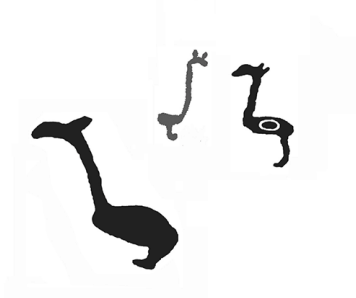
BTW, this also explains the strange moose without horns-swan petroglyphs found in the area, which Antti Lahelma gave as an example of one of the petroglyphs that local folklore has no explanation for...

Swan symbolises sunny, warm part of the year in Karelia (Mar/Apr-Oct/Nov) and moose without horns symbolised dark, cold part of the year (Oct/Nov-Mar/Apr)...
So together they are a symbol of the solar year...See the solar year circle in one of the swan-moose depictions?
Atlantic salmon run in the White Sea area is May-Oct with spawning happening in Oct...However, the kind of Salmon that was depicted on Lake Onega petroglyphs was now (almost?) extinct lake salmon, the landlocked subspecies of the Atlantic salmon...

And according to the "Salmon of Lake Onega" by YU. A. Smirnov, salmon run of the lake salmon of the Karelian lakes is also May-Oct, with spawning taking place Jun/Jul/Aug/Sep/Oct depending on the river...
What about whales? Beluga whales gather every summer in the White Sea, not far from the Karelian coast. But only from mid-June to mid-August, and only in the absence of rough sea...

Bowhead whales were also once abundant in areas adjacent to the White Sea. And according to this article "Commercial Whaling in the Arctic Ocean" the whaling season in the Arctic was Aug-Oct...
So beluga whales were possibly the smaller whales depicted being hunted from a single boat. And the bowhead whales were possibly the large whales depicted on the petroglyphs being hunted from multiple boats...

Interestingly, the whaling season is also the season when elks have antlers...Which explains images like these: elk with boat like antlers...

And boats with elk like heads on their prows...Cause the sailing season in the White Sea started when elk started growing their antlers (Apr/May)...And peaked when their antlers were fully grown (Aug/Sep/Oct)...

Remember Phoenician ships with horses heads on their prows? Cause the sailing season in The Eastern Mediterranean started when wild horses started to mate...And ended after the horse mating season was over...I talked about this in my post "Trojan horse"...
This is an amazing pic by Sergey Semenov of Lake Onega islands. The forests of Karelia are a mix of evergreen firs, pines and deciduous aspens, alders and birches...

Birches are the most common deciduous tree in the area. Their leaves start to grow in Apr and fall off in Nov...

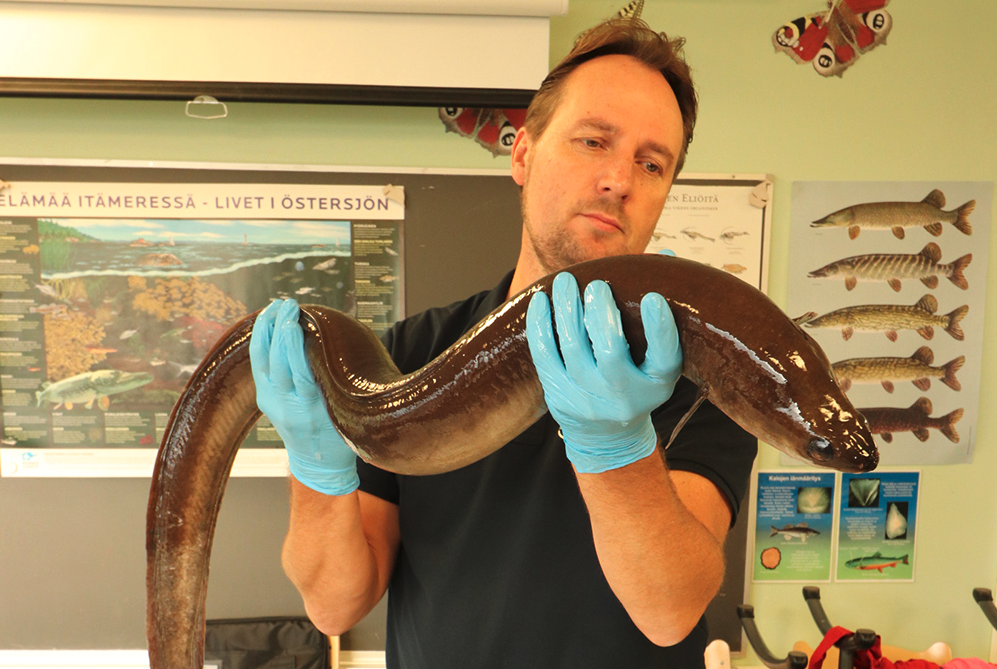
Finally what is this elongated big black thing in the middle of all this? It looks like a fish, and to me it looks most like a Wels Catfish...But it could (with a stretch 🙂) also be a European Eel...Why would either of them be depicted in the autumn half of the calendar?
In "Empirical observations of the spawning migration of European eels: The long and dangerous road to the Sargasso Sea" we can read that adult European eels begin their spawning migration from European rivers and coasts during the autumn of each year, predominantly Oct-Dec... So if you wanted to set up eel traps in your rivers, this was the time to do it...

Wels Catfish are true giants, who spends most of the year in deep water. Except during spawning which takes place in the shallows. According to "Silurus glanis (wels catfish)", Spawning commences when temperature reaches 18-22ºC. Which in Karelia is in Jul/Aug...

Males make nests out of the plant material found around, at a depth of 30 – 70cm. Females then deposit the eggs into the nest "and the male then guards the eggs for the next 2-10 days"...Which means that Jul/Aug is ideal time to catch these huge fishes...
So, autumn: Salmon spawning (Jul-Oct), Catfish spawning (Jul/Aug), Beluga Whales hunting season (Jun-Aug), Elk mate (Sep/Oct) drop their antlers (Oct/Nov), Bowhead Whales hunting season (Aug-Oct), Swans departing (Oct/Nov), Eels migrate (Nov), Birches leaves fall (Nov)...

It looks like it all fits...Right?
To read more about ancient animal and plant calendar markers, check the posts related to animal calendar markers, and then check my twitter threads I still didn't convert to blog post...I am 12 months behind now...