Showing posts with label Shu. Show all posts

Saturday, 19 September 2026

Sacred Ibis

Sacred Ibis - Fresco from the Temple of Isis at Pompeii, built at the beginning of the 1st c. BC. Currently in the Archaeological Museum in Naples...

Is the Sacred Ibis holding ripe grain in its beak? Why?

Animal calendar markers to the rescue...I know, again, boring...

For some reason Ancient Egyptians worshiped this bird and even depicted God Thoth as an Ibis...Why? 


Animal calendar markers...Oh shut up...All you see are animal calendar markers everywhere! No one else does! 

Well, maybe today that is true...But in the past others did too:

In the 1891 "Living animals of the world vol 2" we can read:

The naturalist Brehm says on this subject [why Ibis was sacred]:

"When the Nile, after being at its lowest ebb, rose again, and the water assumed a red tinge, then the ibis appeared in the land of the Pharaohs..."

"...as a sure guarantee that the stream, the giver and preserver of life, which the people in their profound reverence raised to the rank of a god, would once again empty the well-spring of plenty over the thirsty land..."

"...The servant and messenger of an all-bounteous Deity commanded of a necessity a reverence of a poetic and distinguished character, by reason of its importance: he too must be a god."

See 🙂 deified animal calendar markers...

But animal calendar marker for what time of the year? If we look at the available data for the nesting season of African Sacred Ibises, we can see that depending on the area, nesting takes place between Mar and Aug...

The naturalist Brehm says that Sacred Ibis arrived just after Nile reached its lowest level and started to rise again...So if we want to determine when ibises used to arrive to Egypt, lets have a look at the Nile water level chart...

As you can see the Nile starts to rise in Apr/May...Is this the time of the year that the Sacred Ibis is an animal calendar marker for? I think so. In another book, 1829 "Cassell's book of birds" we can read this:

"...According to our own observations, this species is now but rarely seen in Egypt, and was never met with by us below eighteen degrees north latitude; it, however, occurs regularly in South Nubia and the Soudan, where it arrives at the beginning of the rainy season..."

And this is the climate chart for Kharoum, capital of Sudan. You can see that the rain season starts in Apr/May...Very cool, right?

So if Sacred Ibis was indeed a deified animal calendar marker for Apr/May, why was the Sacred Ibis from the temple of Isis in Pompeii with a ripe grain in its beak?

Because grain harvest time in the Nile River Valley starts in Apr/May...

Soooo...Kudos to naturalist Brehm, whoever he was, for being on the right track...

One more interesting thing that Brehm said:

"When the Nile, after being at its lowest ebb, rose again, and the water assumed a red tinge..."

I talked about Red Nile in my post "White calf"...

And one more interesting thing. Apart from dressing up as an Ibis, Thoth also liked dressing up as a Baboon...Why? Remember my posts about Tefnut?


Tefnut was the deity of moisture in Ancient Egypt. One day, she got pissed off 🙂 with Egyptians for taking the piss 🙂 and not giving her enough kudos, and pissed off 🙂 to Nubia...

Sun god Ra, Tefnut's father, missed his daughter and so he sent Thoth (god of wisdom) as his emissary to ask her to return home.


For some weird reason, Thoth, disguised himself as a baboon (!!!) and went looking for Tefnut (???)

To understand why Thoth disguised himself as a baboon, and why Tefnut followed Thoth back to Egypt, you need to know that "Tefnut" (moisture) was married to her twin brother "Shu" (wind), and that together they mean "wet wind" = eastern monsoon...I talked about this first in my post "Menat"...

And baboons peak mating season is at the beginning of the monsoon season in East Africa...Which starts in Mar/Apr/May. And it is this monsoon that feeds the Nile flood...I talked about this in my post "Baboon"...

Oh and guess what? Thoth, our Ibis/Baboon cross dresser was also identified with Shu, the monsoon wind...And when depicted as Shu, Thoth was just like Shu depicted carrying ostrich feathers on his head. Why?

Well ostrich mating season begins in Mar/Apr and ends in Aut/Sep. During that time male ostriches become aggressive, fight with each other for harems and make loud booming mating sounds...While the Nile is rising...

Soooo....Hope this was interesting...At least a bit...I promise my next post is not going to be about animal calendar markers...🙂

That's it. To read more about ancient animal and plant calendar markers, start here…Then check my twitter threads I still didn't convert to blog post...I am way way behind...

Sunday, 8 March 2020

Menat


Have a look at this object.


This is a "menat" (a musical instrument/amulet) which consists of this strange phallic thingy to which a bunch of beads were attached to.


This instrument/amulet was worn by the Holy Cow Hathor/Mehet-Weret. In fact Menat was another name for Hathor. 


The above one, was made between 664 and 380 BC. On top of it we see the lion headed goddess Tefnut (another face of Hekhmet, another face of Hathor) on the left, with a solar disc and cobra on her head, and her husband-twin brother Shu on the right, with ostrich feathers on his head. 

Tefnut carries the solar disc and the snake because the sun's heat, represented by a snake, is the strongest at the end of July beginning of August, during Leo. 

But why is Shu carrying ostrich feathers on his head? 

Well ostrich mating season begins in March or April and ends sometime before September. During that time male ostriches become aggressive, fight with each other for harems and make loud booming mating sounds...

This is exactly the period when rain season starts in Ethiopian highlands. We see increase in rainfall starting from March, and then the arrival of the full blown monsoon starting from April/May/June, depending on the season...


So at the top of the Menat we have wind and moisture producing monsoon. 

This monsoon empties on Ethiopian highlands during the ostrich mating season. The rain water accumulates in the catchment area of the Lake Tana, the largest lake in Ethiopia, and it flows out as Blue Nile...


It then flows down towards Egypt as the Great Flood...

I think that the circular bit at the bottom represents the Great Flood. The circle is the summer sun which fills the Nile with water...

What is interesting is what is depicted inside the circle:

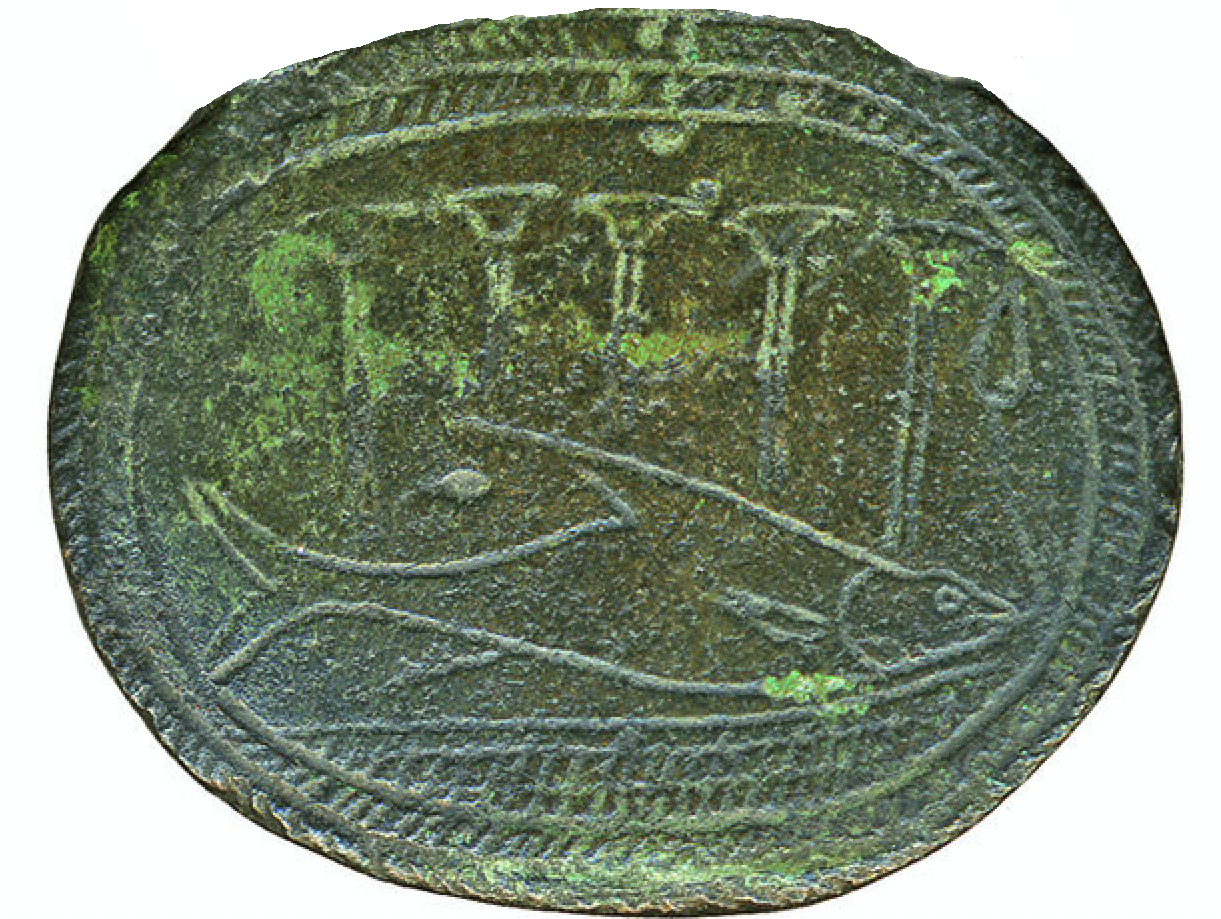
A strange looking fish with a huge dorsal fin, swimming at the bottom of the river or lake, near a flowering papyrus marsh. 


The strange fish is not just a bad fish doodle. It is a very precise depiction of a  Labeobarbus bynni, the Niger barb, Nile barb, a relatively large fish, up to 82 cm in total length and with a distinctive top fin. It is found all over the Nile river. 


This was one of three main fish species caught and eaten by Ancient Egyptians, together with Nile perch and Nile tilapia.

This fish was not chosen randomly. The Nile barb spawning (mating) season is March-April, right at the time when the first rains start falling in Ethiopian highlands. And flowering papyrus? 

So why was papyrus so important? As I explained in my post "Holy Cow" the main papyrus flowering season is April...Right at the time when Nile Barb spawns (swims along the bottom burying eggs into the gravel)


Another interesting detail on this Manet is the "squatting figure of the ram-headed sun god" (according to the official description) figure just above the circular part. 


The description alludes at Amun. The god of wind and the creator god. Following Amun's ascendancy during the New Kingdom, he was hailed as "The Self-created One" and "King of the Gods" who had created all things, including himself. But I don't think this is Amun. Before there was Amun, there was another ram headed god. Another creator god who created everything including other gods. Khnum. 


He was one of the oldest Egyptian deities. And guess what: he was venerated as the god of the source of the Nile ðŸ™‚ Is this cool or what? I talked about this good in my post "Khnum" and there I explained why he was depicted as a "ram" (???) headed deity. 

The horizontally twisted horns show that we are dealing with a ram of the species "ovis longipes palaeoaegyptiacus".


This was the earliest type to be domesticated in Egypt, but became extinct sometime in the New Kingdom. Nevertheless, the shape of the horns was preserved even in later depictions of Khnum. Now here is the interesting bit. We have no idea what this "ovis longipes palaeoaegyptiacus" was or whether it was even a sheep or a goat. Regardless, the only two potential candidates, for the place of the "ovis longipes palaeoaegyptiacus" both have their young during April. The time when the first rains, represented by Tefnut and Shu, arrive to Ethiopian highlands. Right when papyrus flowers and right when Nile barb spawns...

Tefnut and Shu, the creators of all life...


Interesting artefact indeed ðŸ™‚