Showing posts with label Dog Star. Show all posts

Saturday, 19 August 2023

Dog rider

Goddess Isis, "who was connected with water", riding on a dog and holding a sistrum, from the Iseum temple from Savaria, Pannonia Provincia (Hungary).


The dog is Sotis, Sirius star constellation. 


During New Kingdom period Isis took attributes of the Goddess Hathor, the Holy Cow...

One of them being sistrum which was sacred to Hathor...

Sistrum was a sacred instrument whose handle was shaped like a papyrus flower with Hathor's head...

Papyrus was sacred to Hathor...Because the flowering of papyrus announces the beginning of the annual Nile flood. I talked about this in my post "Holy cow":

Shaking of sistrum was supposed to resemble sound of the papyrus flowers shaken by the arriving Hathor (Flood)...

BTW, the reason why Hathor, the Holy Cow is depicted emerging from flowering papyrus, is because wild cattle calving season starts in Apr/May, right when papyrus start to flower...I talked about this in my posts "Lotus and papyrus", "Cow and calf ivory" and "Goddess on a horse"...

The link between papyrus and sistrum was pretty explicitly depicted on this chalice depicting a sistrum with Hathor's head on top of a papyrus flower handle and more papyrus flowers growing out it. 1070–712 BC. Currently in the Met Museum... 

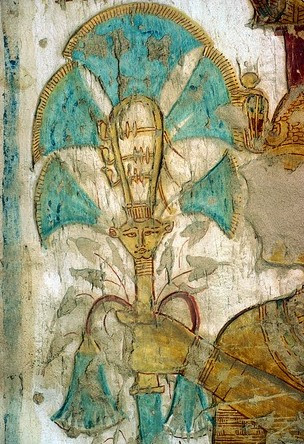
And on this wall painting, from the KV1 tomb of the Twentieth Dynasty pharaoh Ramesses VII, depicting a sistrum with papyrus flowers growing out of it...


So Isis, "who was connected with waters" is carrying sistrum, sacred to Hathor, "who was linked to the Nile Flood"... But why is Isis riding on a dog? Cause the annual Nile flood peaks during Dog Days, end of Jul, beginning of Aug, when Sirius, Dog Star rises with the sun...


Why is the week around the end of Jul, beginning of Aug called Dog days? Why is Sirius called Dog Star? Cause natural old dog breeds mating season starts at the beginning of Aug...I talked about this in my post "Dog days"...


So Isis, "associated with waters" holding sistrum and riding on a dog...

BTW, did you know that Ishat (fire), the Canaanite goddess of fire and drought, was known as "the bitch of the gods"...Jul/Aug, the "Dog days" is the hottest and driest time of the year in Canaan...Same dog symbol, different hydrology, different meaning of the symbol...I talked about this in my post "Anat"...


Now interestingly, in Zoroastrianism, the Dog Star or Sirius, which is known as "Tishtrya", is also the Yazata (Divinity) of rainfall/fertility...Very strange considering that Jul/Aug is hottest and driest part of the year in Persia too...Well...I talked about this in my post "Tishtrya"...


This linking between Sirius and rain season is much better suited to India, where Jul/Aug, Dog Days, is he peak of the Monsoon Rain Season...No wonder then that in Indian mythology we find "Bitch of the gods" linked to water...I talked about this in my post "The bitch of the gods"...


To read more about ancient animal and plant calendar markers, start here…then check the rest of the blog posts related to animal calendar markers I still didn't add to this page, and finally check my twitter threads I still didn't convert to blog post...I am 9 months behind now...

Saturday, 6 November 2021

The bitch of the gods

Figurine of spotted dog, Pakistan, Indus Valley, Chanhu-Daro, about 2600–1900 BC. currently in the Museum of Fine Art Boston 


In Indian mythology we find these 3 sisters: 

Saranyu "Wet Monsoon Wind", peaks Jul/Aug 

Sarasvati, "Monsoon Flood", also peaks Jul/Aug

Sarama, "The Bitch Of The Gods"????

Monsoon peaks Jul/Aug, during "Dog days" when "Dog star", Sirius, rises with the sun...I talked about this in my post "Tishtrya"...

Interesting right? "The Bitch Of The Gods" helps Indra (the rain god) to recover his stolen cows (euphemism for rain clouds)...

BTW, Indra rides on a white elephant. Indian elephants mating season peaks in Jul/Aug, Dog Days, peak of the monsoon season...


I talked about this in my post "Musth"...

Also interesting is that "The Bitch Of The Gods" is the mother of the two dogs that belong to Yama (the god of death). The dogs which guard the entrance into the underworld...


This is super interesting...Pariah dogs, the old dog breeds, mate during autumn (Aug,Sep,Oct) starting from Jul/Aug, Dog Days. Gestation lasts 60+ days, so pups are born (Oct,Nov,Dec)...

I talked about this in my post "Dog days"...

Guess what happens in Oct/Nov? Mating season of water buffalos begins...Which is why water buffalo was used as an animal calendar marker for Oct/Nov...


Now water buffalo is a very interesting animal calendar marker, because it is found in both Mesopotamia and India, where because of the opposite climates, it has opposite meaning...


In Mesopotamia, Oct/Nov is the beginning of the rain season, so there, water buffalo is a positive symbol associated with water...I talked about this in my post "Buffalo licking jar"...

In India, Oct/Nov is the beginning of the dry season, so there, water buffalo is a negative symbol associated with drought. I talked about this in my post "Mahishasuramardini"... 

So...."The Bitch Of The Gods" which marks Jul/Aug, the beginning of the mating season of the old breed Pariah dogs, gives birth to the dogs of Yama, the god of death, who rides on a water buffalo, right at the beginning of the mating season of water buffalos...

And these dogs guard the entrance into the land of the dead...Which is in the places where we have wet (fertile) and dry (infertile) season, associated with the dry season, which in India begins in Oct/Nov...

Which is where we find Yama Puja, which marks the border between Kharif (wet) and Rabi (dry) season in India. 


I wrote about this in my post "Kharif and Rabi season" about this amazing Indus Valley civilisation vase which depicts these two seasons using animal calendar markers...

Interesting...

BTW, one of the two Yama's dogs was called "Sharvara" which means "Spotty" 🙂

That's it...

To read more about ancient animal and plant calendar markers, start here…then check the rest of the blog posts related to animal calendar markers I still didn't add to this page, and finally check my twitter threads I still didn't convert to blog post...I am 9 months behind now...

Saturday, 23 October 2021

Tishtrya

Why is Sirius called "The Dog star"? Maybe because during Bronze age and Iron Age, the heliacal (before dawn) rising of Sirius coincided with the mating season of the ancient, semi-wild "pariah" dog breads? Period known as Dog days...

I talked about this in my post "Dog days"

Now interestingly, in Zoroastrianism, the Dog Star or Sirius, which is known as "Tishtrya", is also the Yazata (Divinity) of rainfall/fertility...

In one myth, he appears as a mighty white horse with golden ears/tail, and he faces off against the div Apaosha (who represents "drought") who takes the form of a black horse. They fight for 3 days + nights until Apaosha drives Tishtrya away.

Tishtrya then complains to Ahura Mazda that he was weakened because humankind did not give him his due of proper prayers and sacrifices. Ahura Mazda then himself offers sacrifice to Tishtrya. Strengthened by this, Tishtrya again takes on Apaosha and ultimately defeats him, and finally rains start falling on Earth and nourishing it.

Very very interesting. And very very strange, as in Persia, dog days, are the hottest and driest part of the year


Yet the above myth clearly identifies Tishtrya, Sirius and rainy season, as the old summer, hot, bright half of the year (white horse with golden ears and tail) and Apaosha, drought season, as the old winter, cold, dark half of the year (black horse)...

Which fits the climate in India...Where the maximum rainfall is during dog days, Jul/Aug, when Sirius, The Dog Star, rises with the sun, the white horse with golden ears, tail...


So, I believe that this legend originates in India, where it perfectly describes the local Indian climate. It is in India where we find the white horse being an avatar of the sun god Suria...I will write more about this soon...

Also, in Indian mythology we find Sarama (सरमा), the "dog of the gods" or "the bitch of the gods", who first appears in the Rig Veda, where she helps the king of the gods Indra (the rain god) to recover divine cows (common euphemism for rain clouds)...

Oh by the way, Indra rides on a white elephant...


Why? Cause the peak of the Elephant mating season coincides with the peak of the monsoon season (Jul/Aug)...


I talked about this in my post "Musth"...Oh did I mention that this is also the beginning of the natural dog mating season, the dog days, when Sirius rises with the sun, the white horse?

Oh guess what. Sarama (the bitch of the gods, Sirius, The Dog Star) is related to Sarasvati, The Great Flood, and Saranyu, the wet monsoon and the wife of the Sun God Surya....

Tripple goddess...Of prosperity...

You can read more about this in the article "Indian great goddess" by Stella Cramricsch...

By the way, horse is a solar symbol, because the fertility of horses is governed by the sunlight. So the natural mating season of horses starts in Apr, peaks on Summer Solstice and ends in September...


Spanning the hot sunny part of the year...I talked about this in my posts "Trojan horse", "Unicorn" and "Re'em"...

So Tishtrya, the dog and white horse, perfectly describes hot, sunny part of the year...And in India, rains arrive when Sirius rises in the morning, with the sun (white horse) and drought arrives when Sirius rises in the evening, with the moon (black horse)...

I believe that this legend was then brought to Persia, where it had to be adjusted to suite the opposite Persian climate. 

That this indeed could be the case, can be seen from the most commonly accepted etymology of the name Apaoša. In 1960's it was proposed that this name was annually an antonym of an unattested derivative of *pauša- "thriving". This explanation, which is also supported by Old Indic póṣa with the same meaning, is today well accepted. Avestan apaoša- thus originally meant "not thriving"...

And this is how the story was adjusted for Persian climate:

Apparently, this legend has been interpreted to be a mythological conflation of a seasonal and astronomical event: 

Tishtrya (Sirius) decides to battle with Apaosha (drought) - Sirius rises with the sun in Jul/Aug, during the hottest and driest time of the year. 

Tishtrya is battling with Apaosha - For the next few days, Sirius is visible at dawn as a glimmering star. 

Tishtrya loses the battle with Apaosha - Sirius disappears from the sky as it is now rising after the sun. 

Tishtria goes and complains to Ahura Mazda. Ahura Mazda offers sacrifice to Tishtrya - Ahura Mazda is another name for Ninurta, The God of Rain, The Archer...Who rains in Oct/Nov...I will write more about this soon...

Tishtrya again confronts Apaosha, and this time wins - The winter has arrived. Sirius is now visible in the night sky. Rain season starts in Persia...

This now fits the Persian climate. Except they forgot to change the colors of the horses. The rains arrive when Sirius rises in the evening, with the moon (black horse), not in the morning with the sun (white horse)...

This is one of the important bits about animal calendar markers. It allows us to determine origins of the myths like these...

PS: In Canaanite religion, we find goddess Ishat, whose name means "fire", and who was the goddess of fire and drought...So obviously the goddess of sun's fire...She was also known as "The bitch of the gods"...

Ishat is a servant of Yam/Mot, the gods of summer, hot dry half of the year, and she is the enemy of Ba'al, the storm God, the god of winter, cool, wet half of the year. This is climatic year in Levant...


And the middle of the hot dry half of the year, Jul/Aug, is the hottest and driest part of the year...When the fire, flame (heat) of the sun scorches the land and turns it into this: Mot's hell, the seat of Mot, the god of death, the burning summer sun...

I love the fact that Ishat (fire), the goddess of fire and drought, is known as "the bitch of the gods"...In Slavic folklore, the hottest part of the year, end of Jul beginning of Aug, is knows as "kresovi" (fires)...This is also the mating season of the old Canaan dogs...The dog days...

Interesting, right?

The bitch of the gods gets around...

That's it...

To read more about ancient animal and plant calendar markers, start here…then check the rest of the blog posts related to animal calendar markers I still didn't add to this page, and finally check my twitter threads I still didn't convert to blog post...I am 9 months behind now...

Monday, 11 May 2020

Dog days


Ahhh. I always wandered why the Egyptian "Dog days" were located on the solar year at the hottest part of the year, the end of July, beginning of August...So I looked at the Ancient Egyptian dog breeds...

First thing I found out that the Ancient Egyptian loved hunting dogs. 


And that their word for "hunting dog" was "Tesem". And that it was written in hieroglyphics using the image of a prick-eared, leggy dog with a curled tail from the early Egyptian age...


There were three main types of dogs in Ancient Egypt: pariah dog (basenji), two kinds of greyhound-like dogs and a molosser-type dog....And the one shown on Tesem hieroglyph is definitely the "pariah dog" known in Egypt as basenji.


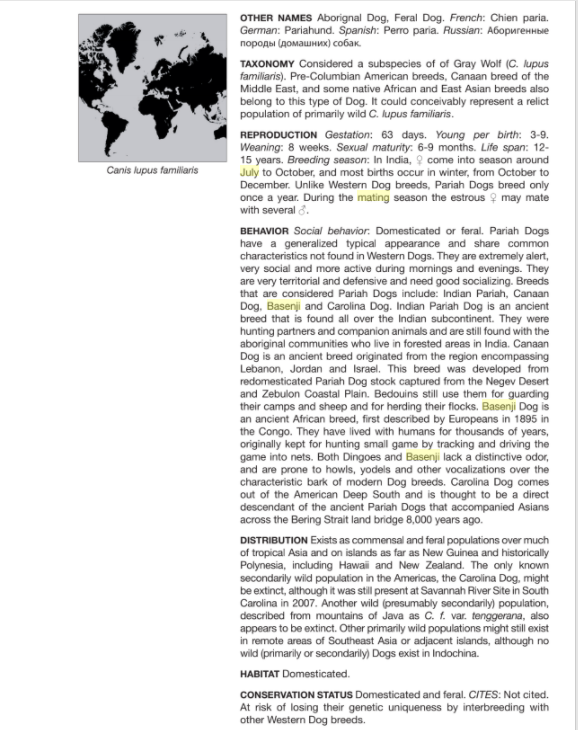
The "pariah dog" is the name given to the half wild dog species still found around the world. They are the closest we still have to the old wild dogs...And they have preserved one important characteristic of wild dogs: They have one breading season...

And guess when that breeding season starts? You guessed correctly. During dog days, end of July beginning of August, the hottest part of the year in the Northern hemisphere...Here is the page about the "pariah dogs" from Princeton "Canids of the world".


Basenji dogs are close cousins of Canaan dogs also known as Egyptian desert dogs, Bedouin Sheepdogs and Palestinian Pariah Dogs...


For the Egyptians the sight of these doggies dogging must have been a very pleasing sight indeed. Because the start of the Basenji breeding season coincided with Nile flood maximum...


I talked about this in my post "Holy cow". 

No wonder then that it is the Dog headed god Set who "defends Ra from the Serpent of Chaos Apep". The serpent is the symbol of sun's heat. And the dog days mark that maximum. After that the northern hemisphere starts cooling (the serpent is dying)...I talked about this in my post "Apep". 


Of course Set (Dog) is helped in his valiant fight against Apep (The Dragon) by Bastet (Lion, Cat). No wonder. Dog days fall in the middle of Leo...And Leo is where it is because it marks the beginning of the mating season of the Eurasian lions...I talked about this too in my post "Apep". 


And that's that...

Oh almost forgot. The time when in Ancient Egypt the Pariah dogs started getting frisky and when the Nile flood arrived, at that same time, Sirius, the brightest star in the night sky, was also rising...Is his why the star was eventually, when Greeks, who called that part of the year "Dog days" arrived to Egypt, called The Dog Star? The star that rises during Dog Days? The days when Pariah dogs are mating? 

This link between this ancient dog breed, Dog Days and Dog Star seems to have once been widespread. North America, China, India, Mesopotamia, Ancient Greece, Rome...Finally Egypt...I think this is a very interesting theme which requires more research and which will most likely point at the common prehistoric system of symbols and beliefs linked to the common dog breed, with common single breeding season, dog days, found in all these areas... 

If we look at the oldest known depictions of dogs, they all show Pariah dogs. 

Prehistoric rock art found in Saudi Arabia shows humans hunting with Pariah dogs on leashes. These pictures could be at least 8,000 years old, making them the earliest art depicting dogs. 


Before the discovery of this rock art from Saudi Arabia, it was was believed that the oldest depictions of dogs were the ones found on pottery shards from Tepe Sabz in Iran, which are almost 8000 years old. They depict the same Pariah dog breed... 


The domestication of dogs happened at the European edges of the Eurasian steppe. 30,000 years old dog fossils from Palaeolithic sites in Belgium, the Ukraine and Russia are the earliest proof we have of canids which are different from wolves...
The earliest proof of dogs actually being part of human society are the remains of a dog found buried with two humans, dating back 14,700 years, in Germany... 

So, it seems that the dogs spread throughout the world from Europe. And because domesticated dogs stay with humans, they must have spread with the humans who originally domesticated them...Which haplogroup was responsible for the dog diffusion? Was that dog the Pariah dog? Did Pariah dog always have a single mating season which started at the same time (July-August)? And is it during this expansion of the Mesolithic-Neolithic hunters and their Pariah dogs, that the link between the mating period of Pariah dogs (Dog Days) and the Dog Star - Sirius was forged in all these places around the world?