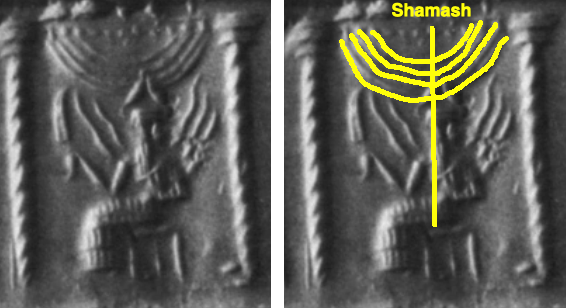
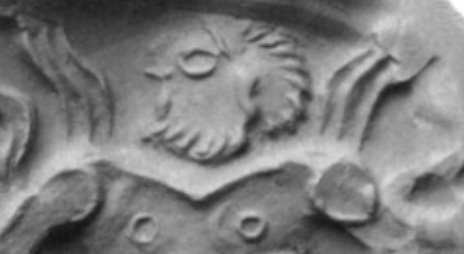
3,000 BCE Sumerian Stamp Seal with Impression Tree of Life with Rampant Goats. Mesopotamia. Chicago. Oriental Institute Museum...

This "Tree of Life" looks a lot like Hanukah Menorah...So maybe I should look into it???
Ok First...I got this image and the info years ago and I added it to my notes where it lay until two days ago when I decided to use it as an illustration for this article. Unfortunately, I can't find this image using the Oriental Institute search any more...Searching the net, all I could find was a bigger picture of the same seal in a display cabinet, next to what looks like a top of a plaque (?) with a depiction of a Sumerian deity with characteristic horned headdress...

Because I couldn't find any direct link to the data about this object on the Oriental Institute Museum website, I have to put a big question mark about the data I posted about this seal. I would be grateful if anyone can give me more info about it, where is it, what is it exactly. Thank you.
Anyway...
If this "Tree of Life" was an ordinary looking tree, like this 2600 BC one found in the Sumerian Queen Pu-abi's tomb, I would say Ibex animal calendar markers marking Ibex mating season which overlaps with rain season which supports (the tree of) life...I talked about it in my post "Shell plaque with ibexes"...

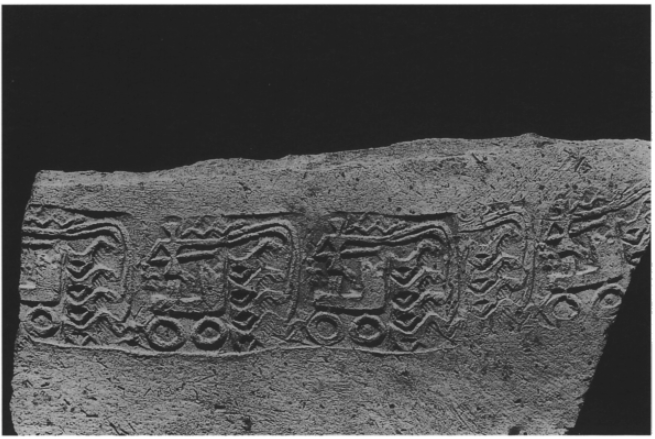
But is the shape of that Tree of Life a coincidence? I started digging around and I found this: A 13th c. BC pottery shard from Lachish, an ancient Canaanite and Israelite city in the lowlands of Judea, mentioned in the Hebrew Bible. O look, Temple Menorah! Flanked by Ibex goats! Pic from Western Asiatic Tree-Goddesses by Irit Ziffer

Soooo...
This is the reconstruction of the menorah of the Temple in Jerusalem, created by the Temple Institute of Israel. Menorah is widely recognised as a symbol of Hebrew culture...

But what was Menorah supposed to have been the symbol of originally?
Apparently Yahveh himself gave the instructions how to make the original Menorah to Moses:
Hammer a lamp out of one piece of pure gold. It should have a base and shaft, with 3 branches on one side and 3 on the other, ending in cups shaped like almond flowers...
The menorah was made and placed in the antechamber of the Temple sanctuary, over against its southernmost wall...Its cups were lit daily from fresh, consecrated olive oil and burned from evening until morning...
There is a story in Talmud that says that although all the lamps were filled with the same amount of oil, and the central lamp was lit first, all the other lights would run out of oil by the morning, except the central lamp which continued burning oil all through the day too...
This miracle, according to the Talmud, was taken as a sign that the god dwelt among Israel and the central lamp was actually called the lamp of god...
Most people associate Menorah with the winter holiday of Hanukah. The Menorah lit during Hanukah though has 4 branches on each side...Apparently, the Talmud states that it is prohibited to use a seven-lamp menorah outside of the Temple...Hence eight-lamp Hanukah Menorah...

But apparently this is not why the Hanukah Menorah has 8 branches. There are two stories explaining why Jews celebrate Hanukah when they celebrate it (end of Nov/Dec beginning of Dec/Jan, basically mid winter), and why they light Menorah with 8 branches during this celebration...
The first one states that this is to commemorate the recovery of Jerusalem and subsequent rededication of the Second Temple at the beginning of the Maccabean revolt against the Seleucid Empire in the 2nd century BC...
According to the Talmud, there was only enough consecrated olive oil left to fuel the eternal flame in the Temple for one day. Miraculously, the oil burned for eight days, giving the Jews enough time to press more fresh oil...Hence Hanukah and 8 branch Menorah...
But there is another story, also from Talmud, that says that when Adam, during his first winter, saw the days growing shorter and shorter, he feared that God was angry and planned to destroy the world...
So what did he do while he waited for the end of the world? He feasted for eight days and nights 🙂 Then the light began to grow longer. What did Adam do when he realised that the world was actually not going to end? He feasted for eight days and nights of course 🙂
The next year, Adam celebrated both the eight days of darkness (before winter solstice) and the eight days of light (after winter solstice). The Talmud gives this story as the explanation for the Roman winter solstice festival of Saturnalia...
But Talmud scholars, like Prof. Moshe Benovitz, believe that "The ritual of candle lighting on Hanukkah developed from Roman custom of lighting lights during the Solstice festival of Saturnalia, most likely during the reign of King Herod"...
Prof. Benovitz also says that it was only later that 8 days of Hanukah and the 8 branches of Hanukah Menorah were connected to the Maccabees, in the form of the miracle of the oil...
Implying that this was just a Roman fashion adopted by the Jews during Roman occupation...
This would mean that lighting of candles over Hanukah (winter solstice) has the same ritual significance as burning of the Yule log during Christmas (winter solstice)...It is a ritual rekindling of the sun's fire...
"The ancient fire-festival of the winter solstice...has survived...in the custom of the Yule log...[once]...widespread in Europe, it seems to have flourished especially in England, France, and among the South Slavs"...From "The Golden Bough"...

I talked about it in these articles:
"Yule log in English tradition", "Yule log in French tradition", "Yule log in South Slavic tradition", "First footer"...
And this foreign custom was later absorbed into Judaism through Maccabees oil miracle story...Hmmmm...I definitely agree that lighting of the Hanukah Menorah is a winter solstice ceremony. But I would disagree that the Jews learned how to worship sun from the Romans...
I would argue that the original Maccabean Menorah lighting ceremony, which took place in the Second Temple of Jerusalem, was performed on winter solstice too. Deliberately...
In fact, I would argue that the whole Maccabean revolt against the Seleucid Empire in the 2nd century BC was timed to start at "auspicious time", so that lighting of the Temple Menorah can lit in the rededicated temple on winter solstice...
Which would mean that Hanukah is NOT a Jewish festival commemorating the recovery of Jerusalem and subsequent rededication of the Second Temple at the beginning of the Maccabean revolt...It is the same winter solstice ceremony Maccabeans performed themselves...
And it is definitely NOT a Roman import...
Do I have any proof for this?
Weeeell...Remember the Talmud story about the central light of the First Temple Menorah, which was the only light that burned through the day...Just like The Sun, does...The God light...
Knowing the link between Menorah Hanukah and the Sun, the fact that the central candle of the Hanukah (Solstice) Menorah is called Shamash (The name of the old Akkadian sun god), and that this candle has to be lit first, and then used to light all the other candles, shouldn't be a surprise any more...

Of course, we are told that the name of the central Menorah candle, shamash, means "attendant" or "servant"...That could be so...Hebrew is written without vowels...So שמש (sh-m-sh) can be interpreted in different ways, depending which vowels are inserted...Any one means servant?
However, when we look at the Hebrew Old Testament, what we find as the translation of the word שמש (sh-m-sh), is this:
Strong’s H8121, שמש shemesh, a concrete noun meaning, “sun, sunrise,” from an unused primitive root meaning, “to be brilliant.”
Out of 134 times that this word appears in the text
119 times shemesh is translated as “sun.”
9 times it is translated as “sunrising.”
2 times it is translated as “east side.”
1 time each it is translated as “window,” “eastward,” “west,” “westward.”
Like: And take heed, lest you lift your eyes to heaven, and when you see שמש (the sun), the moon, and the stars, all the host of heaven, you feel driven to worship them and serve them, which YHVH your God has given to all the peoples under the whole heaven as a heritage. Deu 4:19
And so it is pretty clear that the central light of the Hanukah (Winter Solstice) Menorah, Shamash, represents The Sun, The True Light which lights up everything else...
Here is another interesting scripture excerpt featuring שמש (the sun):
Then he removed the horses that the kings of Judah had dedicated to שמש (the sun), at the entrance to the house of YHVH...and he burned the chariots of שמש (the sun) with fire. 2 Kin 23:11
Remember this? My article "Boaz and Jachin" about the (First) Temple, built on a Threshing Floor (also used as solar observatory), and "oriented" (made to face east). A "House of God" made to face the "House of (Sun) God"...

And do you remember this? My article "The sun god from the first temple" about the solar cult from the First Temple? In it, I asked: was Helios the Sun God of The First Temple who rode in a horse pulled quadriga?


I talked about this in these two articles: "Sun god from Tell Brak", "Shamash playing with solar horse"
So I think that the Sun God that Josiah says the Jews worshiped in the First Temple was no other than Shamash himself...

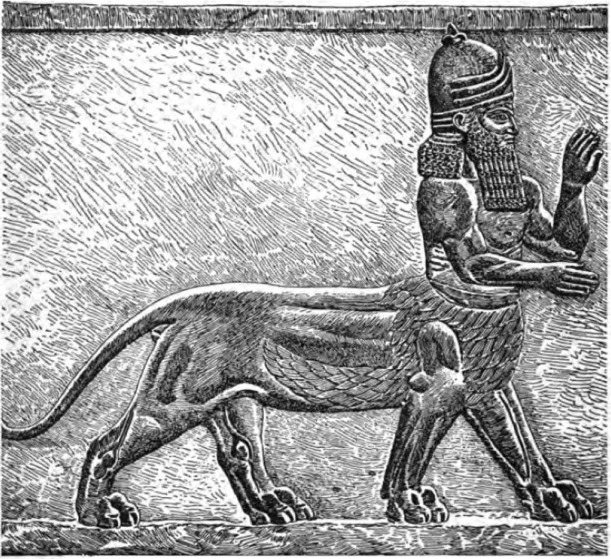
Interestingly, the quadriga of the sun god Shamash rode on was not originally pulled by horses but by but "kungas", a specially bred hybrids between female domesticated donkey and a wild male Syrian wild ass...Basically a fancy donkey...Pic: Male Syrian wild ass...

Kungas were so highly regarded, that "they were deemed especially suitable for drawing the chariots of kings and gods"...
Kings and gods...Kings and gods...Why did Jesus have to ride into Jerusalem on a donkey/ass again? To prove what?
People would say: He was't proving anything. He was fulfilling a scripture prophecy.
"Rejoice, O people of Zion! Shout in triumph, O people of Jerusalem! Look, your king is coming to you. He is righteous and victorious, yet he is humble, riding on a donkey— riding on a donkey’s colt." Zechariah 9:9
Except he didn't ride on a donkey to show he was humble...He rode on a donkey, cause donkey was the ride of kings since Sumerian times...And he and his "revolutionary" pals new it...And when I say revolutionaries...I talk about religious revolutionaries...Or maybe counter-revolutionaries...Not everyone in Judea liked what Josiah and his followers did...
And even though Jesus says: "My Kingdom is not an earthly kingdom. If it were, my followers would fight to keep me from being handed over to the Jewish leaders. But my Kingdom is not of this world." John 18:36
There is no way that him and his followers weren't aware of the significance of the fact that donkey was originally the mount for God/King...Shamash...
But I am digressing...This is all really cool so far. But I don't think that this was the (only) original meaning of the Menorah that Yahveh told Jews to make "in a shape of a blossoming almond tree" and which should be lit only by freshly pressed olive oil...
Sure the fact that this Menorah was a lamp made from pure gold hints at the solar aspect of this symbol...But Menorah was a lamp shape like a tree. The Tree of Light? Sure...The Tree of Life too? Let's see what plant calendar markers can tell us...
In Levant, almond trees are the first trees to bloom each year...They blossom in Jan/Feb. At the end of winter, beginning of Spring...I don't think Yahveh chose the Menorah tree randomly...

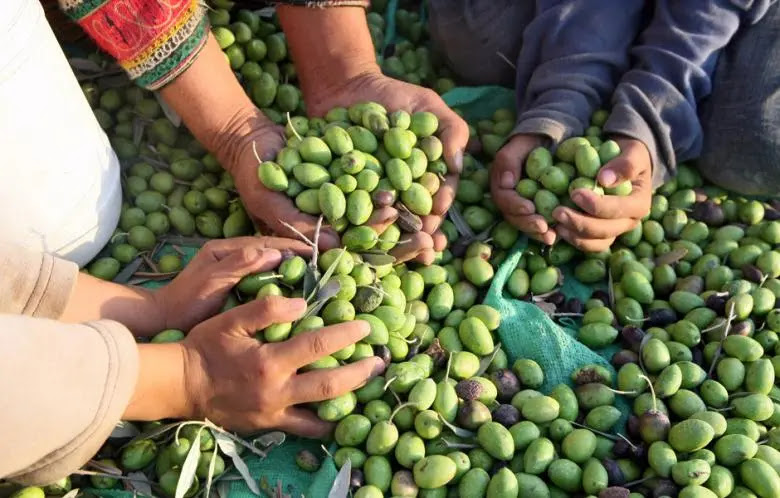
In Levant, olive harvest season is Oct/Nov/Dec (in the past even Jan). It starts at the end of autumn, beginning of winter...Oil is pressed right after all the olives were harvested...So in Oct/Nov/Dec...I don't think Yahveh chose the Menorah fuel randomly...
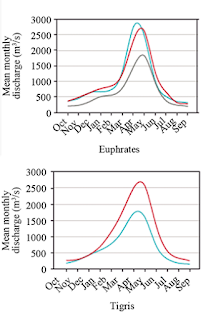
Here is why I think Menorah could be a complex calendar marker...This is climate in Levant...You can see that the climatic year is divided into two halves, the hot, dry summer (Apr/May - Oct/Nov), and cool, wet winter (Oct/Nov - Apr/May)...

In Levant, it is the rain that falls during the winter that supports "The Tree of Life", that makes life possible...And the wettest time of the year Levant is between the harvesting of olives and blossoming of almonds, peaking right around winter solstice...

And as I said at the beginning of this article, there is one other thing that happens in Levant, Mesopotamia between Oct/Nov and Jan/Feb, peaking around winter solstice: mating of wild ibex goats marked by wild loud buck fights...This is why Ibex was in Levant, Mesopotamia associated with winter, rain and the tree of life...

The mazal (constellation) for Tevet is gedi (goat), Capricorn...Capricorn, Tevet, ends when wild Ibex goats stop mating, and almond trees start blooming in Levant, in Jan/Feb...Soon after that the rains stop, and shamash שמש (the sun) god, who disappeared in Oct/Nov comes back...
Sooooooooo....What should we make out of all this? Was Menorah deliberately shaped like a tree of life, because it was originally just burned during the winter, rain season, Oct/Nov - Jan/Feb, during the time when Sun, Shamash, was absent, to symbolically replace his light?
Don't know...I will leave it all this info here. It might be useful to someone for something...
Oh, and Merry Christmas and Happy Hanukah...
To read more about ancient animal and plant calendar markers, start here…then check the rest of the blog posts related to animal calendar markers I still didn't add to this page, and finally check my twitter threads I still didn't convert to blog post...I am 9 months behind now...