Showing posts with label celtic. Show all posts

Tuesday, 10 January 2017

Wrach

In Cornish and Welsh the word "wrach" means old woman, hag, witch. Fraic as in the placename Leitir Fraic is said to be an old obsolete Irish word for a woman. In Serbian, the word "vrač" pronounced "vrach" means doctor, physician, shamanistic priest, witch doctor, magician, warlock. The verb "vračati" means to cast spells, to divinate, to perform any magical action. The word is found in all Slavic languages. 

In Serbian villages the role of "vrač" was usually performed by a woman who was then called "vračara", feminine form of "vrač". Vračara was the healer, midwife, amulet maker, spell caster, fortune teller, and basically keeper of "magical" and other ancient religious traditions and taboos. Some of the rituals preserved as part of this folk magic are remnants of ancient Vedic, Greek, Roman, Celtic, Old Slavic, Turkish... religious rituals which accumulated in Serbian culture...

Vračara was usually an old woman who received her "magical" knowledge from her mother who got it from her mother who got it from her mother...Vračara was quintessential witch...But witch which was part of the community. The good witch. The real ones never charged for their services. They did their what they did because it was their calling. 

Vračara was most likely to look something like this. Basically your typical Serbian baba (grandmother, old woman, hag, "wrach"):


The tradition of vračara was suppressed during Christianity, when vračara was seen as part of the old pagan belief system. It was also suppressed during Communism when vračara was at best seen as part of the backward peasant culture and at worst as fraudster who was danger to society. It is today also suppressed as stupid dangerous superstition of which we Serbs should be ashamed... 

Despite centuries of suppression, village vračara managed to survive until recently. However today the tradition is dying out because the Serbian villages are dying out and crumbling to dust. And soon the Celtic "wrach", Serbian "vrač", the old village "witch" will disappear into the legend for ever...

Monday, 15 February 2016

Alps

The Alps (Italian: Alpi; French: Alpes; German: Alpen; Slovene: Alpe) are the highest and most extensive mountain range system that lies entirely in Europe, stretching approximately 1,200 kilometers (750 mi) across eight Alpine countries: Austria, France, Germany, Italy, Liechtenstein, Monaco, Switzerland and Slovenia. 


But these are not the only Alps in Europe. In The Balkans we find Dinaric mountains known also as Dinaric Alps. This mountain range stretches along the Eastern Adriatic coast across Albania, Serbia, Montenegro, Bosnia, Croatia and Slovenia. The highest peaks of the whole range are in the southern end which lies in Montenegro, Serbia and Albania. 


The English word alps comes from the Latin alpes which comes from Latin albus ‎meaning white. Latin albus, is said to come from Proto-Italic *alβos meaning white.

The official etymology says that we don't really know where the original word comes from.

Basically we have two theories.

First theory proposes a Proto-Indo-European root for the word Alps. It says that the Proto-Italic *alβos is derived from Proto-Indo-European *h₂élbʰos, *álbʰos, *albʰós ‎meaning white. Cognates include Umbrian ‎alfu meaning white, Ancient Greek ἀλφός ‎(alphós) meaning whiteness, white leprosy and Hittite alpas meaning cloud.

Second theory proposes non-Indo-European origin. According to the English Etymological Dictionary, the Latin Alpes might possibly derive from a pre-Indo-European word *alb "hill, mountain". This theory then proceeds to propose that this supposed  pre-Indo-European word is the root of many Albania mountain areas: Balkan Albania, Caucasus Albania and Scottish Albania (Alban). 

I would like to propose another theory: The word Alps comes from Gaelic and means "white stones, white cliffs, white peaks".

The first clue that the word Alps could be of a Gaelic (Celtic) origin can be found in a comment made by Maurus Servius Honoratus, a late fourth-century and early fifth-century grammarian, who in his time had a reputation of being the most learned man of his generation in Italy. He said in his commentary on Virgil (A. X 13) that: "all high mountains are called Alpes by Celts".

The second clue is the fact that in Latin the word "albus" is used primarily to mean "white" that is dull or matte which would mean more grayish white than bright shining white.

The third clue is the fact that in Ancient Greek the word ἀλφός ‎(alphós) means whiteness, white leprosy, lichen white, again grayish white, not bright shining white.


The fourth clue is that the German word Alp or Alm (meaning "seasonal high mountain pasture", from Old High German alpa, alba) was originally identical to the name of the Alps (German Alpen) itself.

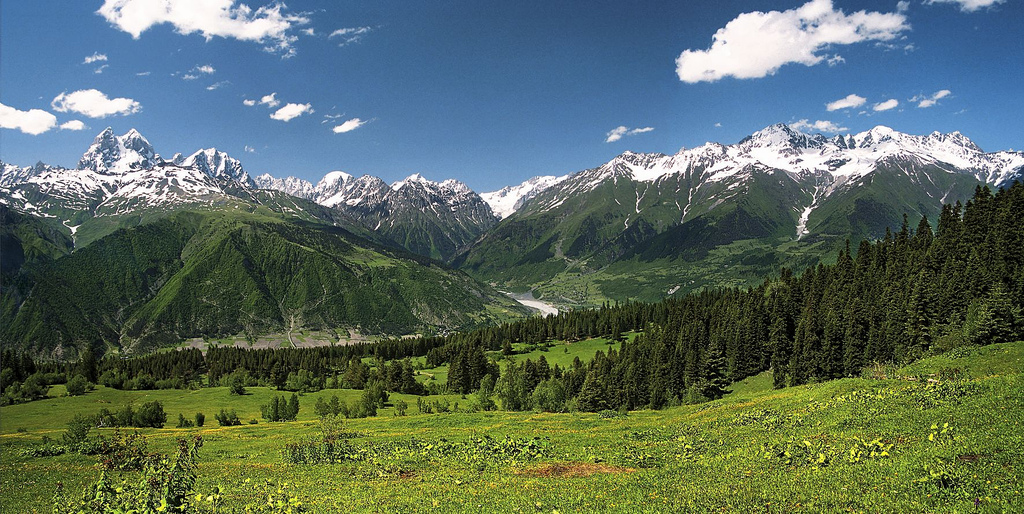
Have a look at these two pictures.

Alps (grayish white rocks towering over green high mountain pastures)


Dinaric mountains (Alps) (grayish white rocks towering over green high mountain pastures)


So what does this have to do with Gaelic?

In Gaelic we have this cluster based on the root word ail - stone, rock:

aill, -e, pl. id., and ailltreacha (Aran), f., a cliff, a rock; cf., an Áill, the "Naul" Co. Dublin (also faill, f., bárr na faille, the top of the cliff).
ailleort - high-rocked; from ail, rock
aill-bhruachach - having steep or rocky brinks. 
ailleadóir- cliff-climber.
ailbhinn - flint, precipice; from ail - rock.

From the same root ail - large stone, rock we have this word:


ailp, pl. alpa - a protuberance, a huge lump, a high mountain; a stout person

In Gaelic we also have this word:

bán - white which comes from Proto-Indo-European "bʰeh₂-" meaning - "white", "shining"

From these two words ail and bán we can make the construct: 

ail bán - alban - rock white - white rocks, white peaks, high mountains

What is also very interesting is that in Irish  the word "ailbh" means "flock, heard, drove".... Is this word derived from the fact that flocks, herds were driven up to the mountain pastures, ailban, alpen, alps, every summer? This is a high mountain pasture from Slovenian Alps.


In A.D. 875 Scotland was still known under its Roman name: Caledonia. Caledonia was in turn divided among the following lands: the Kingdom of Alban, the Northern Islands, and the Borders, which include the Kingdom of Strathclyde, Galloway, and the northern portions of the Kingdom of Northumbria. 


The kingdom of Alban lied mostly along the great Grampian Mountains. These are highland pastures lying under the great Grampian Mountains:


This is a picture of the highland pastures under the Matterhorn peak, Valais Alps, Switzerland.


Do you see any similarity? High pastures with grayish white rocky peaks?

Alba is the Scottish Gaelic name (Pronounced Alpa) for Scotland. It is cognate to Alba (gen. Albann, dat. Albainn) in Irish and Nalbin in Manx, the two other Goidelic Insular Celtic languages, as well as words in the Brythonic Insular Celtic languages of Cornish (Alban) and Welsh (Yr Alban) that also, in modern practice, are the Goidelic and Brythonic names for Scotland; although in the past they were names for Britain as a whole, related to the Brythonic name Albion. The term first appears in classical texts as Ἀλβίων Albíon or Ἀλουΐων Alouíon (in Ptolemy's writings in Greek), later as Albion in Latin documents. Historically, the term refers to Britain as a whole. Is this name derived from the appearance of the white cliff of Dover, which is the first thing anyone crossing the Channel and approaching Britain would see? So when Gaels first approached Britain, and they was the white cliffs, they would have probably named the land they were about to land on "ail bán" = white cliff land. And if later a Greek traveller crossing into britain asked the Gaelic speaking natives what was the name of this new land (pointing at the white cliffs), they would probably tell him "ail bán" = white cliff? And hey presto, we have a name for this new land of white cliffs...(Thank you Tim for pointing this to me)


Gaelic speakers in Scotland used Alba (dative Albainn, genitive Albann, now obsolete) as the name given to the former kingdom of the Picts which lied along the Great Grampian Mountains, which is full of white greyish white rocky peaks covered in snow. Did the name originally just mean "white peaks", "the land of white peaks"? Not too many of those in Ireland, so it must have been some sight for the invading Gaels. So a fitting name for the new foreign land...

In the High Medieval period Alban became re-Latinized as "Albania". This latter word was employed mainly by Celto-Latin writers, and most famously by Geoffrey of Monmouth. It was this word which passed into Middle English as Albany, although very rarely was this used for the Kingdom of Scotland, but rather for the notional Duchy of Albany.
So is Gaelic ail bán - Alban - rock white - white rocks the root of the word Alpen, Alp? What is the relationship of this phrase and the Latin albus, Ancient Greek ἀλφός ‎(alphós) and Hittite alpas? Are they related at all? Is the Gaelic phrase the root of all these other words? Or is all this just a coincidence?

Is it possible that by the early Iron Age, the expression "ail bán", or some of the dialectal versions of this expression, entered Ancient Greek and Latin from Gaelic, or some other dialect of Celtic languages, in the meaning of white cliffs, white rocks, white peaks? And is it possible that this is why Greeks and Romans named the region lying along the Greater Caucaus - Albania?

Caucasian Albania (Latin: Albānia, Greek: Ἀλβανία, Albanía, in Old Armenian: Աղուանք Ałuankʿ (Aguank), Parthian: Ardhan, Middle Persian: Arran; Georgian: რანი, Rani); is a name for the historical region of the eastern Caucasus, that existed on the territory of present-day republic of Azerbaijan (where both of its capitals were located) and partially southern Dagestan. The territory lies on the southern part of the Greater Caucasus range.


Caucasian mountains (grayish white rocks towering over green high mountain pastures)


-ia is a word-forming element in names of countries, diseases, flowers, from Latin and Greek -ia, which forms abstract nouns of feminine gender. In paraphernalia, Mammalia, etc. it represents the Latin and Greek plural suffix of nouns in -ium or -ion. 

So Albania is Alban + ia = ail + ban + ia = the land, country of white clifs, white peaks = Greater Caucasus

And it is the same with the Balkan Albania, which only appeared in records in Early Medieval time. The highest peaks of the Dinaric range are found in its southern part which lies in Montenegro, Serbia and Albania. Viewed from the coast, you see giant rocky peaks covered with snow looming over green pastures. So was Albania used here just as a name for the land of white cliffs, white peaks?


Let me know what you think about all this. 


Friday, 20 November 2015

From knee to knee


In this post I would like to talk about the word "knee" and the special meaning that this word has in Serbian and Irish language and culture. 

The word knee has these meanings in English:

1, The joint or the region of the joint in the middle part of the leg between the thigh and the shank.
2. A piece of timber or metal formed with an angle somewhat in the shape of the human knee when bent. Any knee-shaped item or sharp angle in a line, "the knee of a graph", an inflection point.

The etymology of the word knee says that the word knee comes from Middle English kne, from Old English cnēo, from Proto-Germanic *knewą, from Proto-Indo-European *ǵnéwo-, a thematic derivative of Proto-Indo-European *ǵónu. Compare Hittite genu, Latin genū, Tocharian A kanweṃ (dual), Tocharian B kenī, Ancient Greek gónu, (knee), gōnía (corner, angle), Old Armenian cunr, Avestan žnum, Sanskrit jānu.

It seems that all Indoeuropean languages have words for knee which come from the root "kn, gn". Well all except Slavic and Celtic languages where the words for knee come from the root "kln, gln".

In Celtic languages the words for knee are:

Old Irish: glún
Irish: glúin
Scottish Gaelic: glùin
Breton: glin
Welsh: glin

In Slavic languages the words for knee are:

Old East Slavic: колѣно ‎(kolěno)
Belarusian: кале́на ‎(kaljéna)
Russian: коле́но ‎(koléno)
Ukrainian: колі́но ‎(kolíno)
Old Church Slavonic: колѣно ‎(kolěno)
Bulgarian: коля́но ‎(koljáno)
Macedonian: колено ‎(koleno)
Serbo-Croatian: koljeno, koleno, kaljen, kalino, kolino, golino
Slovene: koléno
Czech: koleno
Polish: kolano
Slovak: koleno
Slovincian: kʉ̀ɵ̯lanɵ
Lower Sorbian: kóleno
Upper Sorbian: koleno

A possible cognates are also:

Lithuanian: kelys, kelénys =  knee
Latvian: celys = knee

But it is not just the root of the Celtic and Slavic words for knee that is the same. In Gaelic and South Slavic languages the word knee has additional meanings appart from the "joint in the middle part of the leg" and "something bent in a shape of a knee". These meanings are:

Serbian (koleno, koljeno, kaljen, kalino, kolino, golino): generation, step in descent, offspring, family, clan, race, house

Gaelic (glúin): generation, step in descent, step in pedigree

Serbian: Tri kolena = Three generations
Irish: Trí ghlúin daoine = Three generations of people

Serbian: Markovo prvo koleno = The first descendant(s) of Marc
Irish: An chéad ghlúin ó Marc = The first descendant(s) of Marc

Serbian: Oni su braća u trećem kolenu = they are related in the third degree; they are second cousins.
Irish: Is iad an treas glúin iad = they are related in the third degree; they are second cousins.

Serbian:

poklon - bending, bowing, gifting, gift
klanjati se - bend, bow, prostrate, kneel in front of someone
klečati - kneel
pokoljenje = Po + koljeno = generation 
oni su iz istog kolena = They are from the same klan
on je od odlična koljena = He is from a great stock, clan
nakolenče - baby boy which is placed on the brides knees (lap) during the wedding ceremony to ensure that the first child is a boy.

Irish:

bean ghlúine = woman knee = midwife


Again we see strange similarity between the Slavic and Celtic languages and cultures.

What is very interesting about the above meanings of the word for knee in Celtic and Slavic languges is that this can shed a new light on the etymology of the Irish word "clann".

Serbian: Oni su iz istog "kolena" = They are from the same "clan"

The Irish word "clann" meaning children, family, offspring, followers, plant comes from Middle Irish: clann, Old Irish clann (alternative form cland). The official etymology says that this is a borrowing from Old Welsh plant, from Latin planta meaning plant, shoot, twig, sprout.

This is all great except that we need to explain how the Slavic word koleno with its meanings fit into all this. Is it possible that the Irish words "clan" (children, family, offspring, followers) and "glúin" (generation, step in descent, step in pedigree) and the Serbian word "koleno, koljeno, koleno, kaljen, kalino, kolino, golino" (generation, step in descent, offspring, family, clan, race, house) all come from the same root "kln, gln" meaning knee? In this case "clan" would be just a specialisation of the word "glúin". We can see that in Serbian we have both koleno and golino, so it is possible that the Irish also retained both "k" and "g" variant of this word.

In Serbian we also have these words: član, čljan, člin, člen, čljen, šljen, Sijan, Síjén, cjen, iklân, ikljen. These are all dialectic versions of the same word  which means "member, part, generation" and are directly linked to the notion of group, family, clan. They all also come from the same "kln" root as "koleno" (knee, bend, generation, step in descent, offspring, family, clan, race, house).

What is interesting is that this link between the knee and the generation, step in descent, offspring, family, clan, race, house can also be found in Sanskrit, Ancient Greek and Latin:

Sanskrit: jānu = knee and janas = race, class of beings
Ancient Greek: γόνυ =  knee and γένος = offspring, descendant, family, clan, nation, race, gender, any type or class
Latin: genu = knee and genus = birth, origin, kind, type, class, species (of animal or plant), race (of people), set, group (with common attributes)

I was just made aware that the same link exists in Basque, Finish and Saami languages too:

Basque: In Basque the word for generation (belaunaldi) is also formed with "knee" (belaun). It can be used directly with "belaun", too, as in "belaunez belaun" (from generation to generation)

Saami: The word for knee and generation is also the same in all Saami languages, cf. the phrase "Aerpien maahtoe boelveste boelvide" (ancestral knowledge from knee to knee/ from one generation to the next) in South Saami.


Finish: The semantics of 'generation' and 'knee' are also connected in Finnish (related to Saami). The word for generation, 'sukupolvi,' is suku (family) + polvi (knee), and the word for 'to descend from (genealogically)' is 'polveutua,' a verbalised form of the nominal 'polvi.' The verb is strictly used for genealogical descent, not physical descent of any kind.

Oh and then there is this


But this link only becomes visible through Slavic and Celtic words for knee and their meaning.

But where does this link between the knee and generation, step in descent, offspring, family, clan, race, house comes from? 

The English word genuine comes from Latin genuinus ‎(“innate, native, natural”), from gignere, from Old Latin genere ‎(“to beget, produce”), from genus meaning birth, origin, kind, type, class, species (of animal or plant), race (of people), set, group (with common attributes). The related word is gens which means Roman clan, related by birth or marriage and sharing a common name, tribe; people, family. 

The English etymological dictionary says something interesting though about the etymology of the word genus. It says that there is a possibility that the etymology of this word could come "from Latin genu "knee," from a supposed ancient custom of a father acknowledging paternity of a newborn by placing it on his knee."

So is this where the link between the knee and the offspring, the next generation, family, clan, race, house comes from? In Irish the word clann doesn't mean any children. It means paternally acknowledged, legitimate children. Was this custom of acknowledging that the child is yours by placing it on your knee once widespread among the Indoeuropeans? I believe so. During the tribal expansions and wars a lot of men died. This left a surplus of "available" women both from the victorious tribe and from the subdued tribes. Judging by the current paternal genetic map of Evroasia, the victorious warriors used this situation to their advantage, having sex with as many of these women as they could. This was done partially out of lust, but mostly as way of claiming the dead warriors' property. The one who lay with a women laid a claim to her and her property. The final seal of ownership was stamped by the acknowledgement of the children produced from such unions. And that acknowledgement was done by father placing (laying) the child on his knees.  

My offspring, my next generation, family, clan, race, my "koleno", "glún", "clan", "gens" are the the children that sat on my knees. I acknowledge them and I give them my name. And I take their property as mine too.

Another clue why there is a link between the knee and generation, step in descent, offspring, family, clan, race, house can be found in Serbian saying that the knowledge and tradition are passed "sa kolena na koleno". This literally means "from knee to knee" but it also means from one generation to the next generation, from grandparents and parents to their grandchildren and children. 

One of my favorite childhood memories involve sitting on my parent's or my grandparent's knees and listening to their stories. My mother, a primary school teacher, told me fairy tales and taught me how to read using old battered "Bukvar" (Alphabet primer). My father, technical education teacher, told me stories about strange animals and strange faraway lands and taught me how things are made and how they work. My maternal grandmother, who was a housewife, told me stories about saints and taught me how to say prayers and curses and how to cook jams and preserves. My maternal grandfather, who was a baker, told me stories about the war and taught me how to make bread and cakes and play card games poker and tablić. My paternal grandmother, who was a housewife, told me stories about vampires and karakondžulas and other mythical creatures and taught me everything there is to know about farm animals, how to make cheese and how to feed silkworms. My paternal grandfather told me stories about the wild animals and birds and plants and taught me how to recognize animal tracks, how to make animal traps and how to hunt using a hunting rifle,  how to use farm tools and how to make brandy and wine. 

This is the way the knowledge and tradition was passed in the past. And this is how the family bond was built and preserved. 

After all these years, the stories that I heard while sitting on my parents' and my grandparents' knees are still as fresh and as clear as if I heard them yesterday. And the things that I learned from them as a child I still remember today. And when my son was born, I held him on my knees and I told him some of the old stories that were passed down to me through time "from knee to knee". And I added few new ones of my own. I hope one day he will have children of his own and will sit them on his knees and tell them some of the stories that he heard from me, and a lot of nice stories of his own...

Sunday, 31 May 2015

Knobstick

This is a knobstick. 

A knobstick is a wooden walking stick which has a knob for a handle. The stick is commonly the length of a walking stick (distance from the floor to one's wrist with elbow slightly bent).  

A knobstick can also be used as a club or a cudgel. The heavy knob can be used for striking as well as parrying and disarming an opponent. The use of knobsticks as weapons has a particularly long tradition in Ireland. 

In Ireland, the knobstick is called "shillelagh". There are two etymologies for this word. 

First one is that it is an anglicization of the Gaelic "Sail Éille" which means a "heavy walking stick with a strap". Many shillelaghs from last few centuries have a strap attached, similar to commercially made walking sticks, to place around the holder's wrist. Hence the name. 

The second one says that the word shillelagh comes from the name of the barony of Shillelagh which was famous for its oak forests. The quality of its oak cudgel was supposedly such that the word “shillelagh” by antonomasia became synonymous with the Irish stick, regardless of its material. 

However the earliest names for these types of sticks were "Cleith ailpín", which just means a stick with a knob, a knobstick, or "bata" which means any stick, club. As a matter of fact, the name "shillelagh" is by and large an Irish American word, never used by Irish country people.The most common words used in Ireland were a Blackthorn, an ash plant or in Irish camóg (crooked stick), buinneán (sapling).

Here you can see various types of the Irish shillelagh sticks. You  can see that the ones on the left have straps attached to them and are specifically made as weapons, looking more like batons than walking sticks. The ones on the right are the traditional old style knobsticks. 


Shillelaghs were traditionally made from blackthorn (sloe) wood (Prunus spinosa) or oak. Wood from the root was prized as it was less prone to cracking during use. The bark was peeled and the wood was smeared with butter or lard, and then placed up a chimney to cure, giving the shillelagh its typical black shiny appearance. Some shillelaghs were hollowed at the knob end and filled with molten lead to increase the weight beyond the typical two pounds; this sort of shillelagh is known as a 'loaded stick'. In Ireland the stick fighting using shillelagh knobsticks was called "bataireacht" or "boiscín". In Irish the word "bata" means stick so "bataireacht" literally means stick-fighting. The other name used for knobstick fighting, "boiscín", is a bit more difficult to translate. The Irish phrase "babhta boiscín" means fencing bout, where the word "boiscín" means fencing and the word "babhta" means bout, a short period of intense activity. So the word "boiscín" means fencing, stick fighting, but ultimately carrying and using a knobstick. But we also have the Irish word "bóisc", which means to boast, to show of. I believe that "boiscín", carrying and using a knobstick, and "bóisc" to show off, to boast are related words with related meanings. The reason why I believe that this is the case will become obvious soon. 

We have the written records that the Irish have used various sticks and cudgels as weapons of self-defence for centuries. 

The earliest reference to shillelaghs can be found in the Ulster Cycle’s mythological tale "The Destruction of Da Derga’s Hostel". The owner of the hostel had a sword but his warriors were described as such:

“Thereafter Da Derga came to them, with thrice fifty warriors, each of them having a long head of hair to the hollow of his polls, and a short cloak to their buttocks. Speckled-green drawers they wore, and in their hands were thrice fifty great clubs of thorn with bands of iron.”

Gerald of Wales says in his "The Topography of Ireland" written in the 12th century, that the Irish: "carry axes, borrowed from Norwegians and Ostmen, as others carry walking sticks and that they grab these axes one handed". 

In the St. Canice’s Cathedral in Kilkenny, on the side of the tumb of James Shortals, are carved figures of St. Peter, Paul, James, Thomas, Bartholomew and John. 


Each saint carries a book, presumably a Bible and a weapon. St James carries a knobstick. 


Thomas Gainsford says in his "The Glory of England" written in 1618, that the Irish warriors: "wear trousers, mantle, and a cap of steel; they are curious about their horses tending to witchcraft; they have no saddles, but strange fashioned pads, their horses are for the most part unshod behind: they use axes, staves (walking sticks), broad swords, and darts.”

By the 18th century "bataireacht", the knobstick fighting became increasingly associated with Irish gangs called "factions". Irish faction fights involved large groups of men (and sometimes women) who engaged in melees at county fairs, weddings, funerals, or any other convenient gathering. Historians such as Carolyn Conley, believe that this reflected a culture of recreational violence. Two or more groups assembled to fight using mostly rocks and sticks, very often resulting in the death of many participants. Interestingly even though it caused death, the practice of faction fighting was considered good fun and in fact people brought to justice for killing people in faction fights were often exonerated. But not all of these fights were done with playful intent; in fact many were done to settle feuds and political or religious tensions especially in the North. This is why James S. Donnelly, Jr argued in his "Irish Peasants: Violence & Political Unrest, 1780", that "faction fighting had class and political overtones".


By the early 19th century, faction gangs had organised into larger regional federations, which coalesced from the old Whiteboys, into the Caravat and Shanavest factions. Beginning in Munster the Caravat and Shanavest "war" erupted sporadically throughout the 19th century and caused some serious disturbances. 

As the faction fights became increasingly repressed and other sports such as hurling were promoted, bataireacht as a sport (I love this), slowly faded away by the turn of the 20th century. Although still documented sporadically, it has become mostly an underground practice saved by a few families who still handed down their own styles. 

You can read more about the shillelagh stick fighting in the excellent book Shillelagh: The Irish Fighting Stick by John W. Hurley and in the stick fighting martial arts blog written by Maxime Chouinard in the article What is Irish stick fighting? Pearson’s Magazine, 11 (January 1901) published a whole ilustrated tutorial on knobstick fighting.

At the end of this part about the Irish knobsticks, here is probably the most important bit of information:

Folklorist Padraic Colum says in "A Treasure of Irish Folklore" that the shillelagh stick was a badge of honor for those who carried it. When they were very young, Irish boys were exposed to the traditions of the bata, and when they came of age, to carry a stick was viewed as a passage into manhood. 

Why this is so important will become clear when I start talking about Slavic knobsticks.

Now here is a question: was this type of stick ever used anywhere else or was this a specific Irish type weapon

Well sticks, together with stones, were the earliest weapons used by people. Battle club is a common weapon found in every part of the world. A knob stick is just a stick with a knob at the top which makes it heavier and increases the power of the strike. 

This is an Oceanic battle club:


This is an Australian Aborigine battle club called waddy. 


A waddy is a heavy club constructed of carved timber. Waddies have been used in hand to hand combat, and were capable of splitting a shield, and killing or stunning prey. In addition to this they could be employed as a projectile as well as used to make fire and make ochre. They were also used for punishing those who broke Aboriginal law. 

Then we have the Native American ball headed war club. No one knows when the ball headed war club first appeared. It was in common use in the early 16th century and was popular with the war-like tribes of the American eastern seaboard, eventually spreading to the Great Lakes region and northern Canada all the way to the Great Plains west of the Mississippi.

It has been speculated that the wide adoption of this weapon was the result of the fact that it was relatively easy to manufacture, in that it required little or no metal, and because it was unspeakably effective.

The better clubs were carved from a naturally curved hardwood root burl, sapling or tree branch. This insured that the wood grain would curve in parallel lines though the handle and into the ball itself, avoiding the pitfalls of cross grain which could weaken the club and cause it to break at an ill-timed moment. Hornbeam (Iron Wood), a hard dense timber that was strong and was resistant to impact forces, was the most preferred material, even over such stalwart choices as Ash, Maple, Oak and Hickory. In battle, a dedicated blow from the ball of the club could easily break a limb or crush a skull.


In Southeastern Africa we find a battle walking knobstick called "knobkierie".


A Knobkierie, also spelled knobkerrie, knopkierie or knobkerry, is a form of club used mainly in Southern and Eastern Africa. Typically they have a large knob at one end and can be used for throwing at animals in hunting or for clubbing an enemy's head. The knobkierie is carved from a branch thick enough for the knob, with the rest being whittled down to create the shaft.

The name derives from the Afrikaans word knop, meaning knot or ball and the Nama (one of the Khoekhoe languages) word kierie, meaning cane or walking stick. Knobkieries were an indispensable weapon of war, particularly among southern Nguni tribes such as the Zulu (as the iwisa) and the Xhosa. Knobkieries are still widely carried, especially in rural areas, while in times of peace it serves as a walking-stick. The head, or knob, is often ornately carved with faces or shapes that have symbolic meaning. Like this one from Tanzania.


Knobkierie is carried in the left hand by the middle, a certain length projecting above and below the hand, and used for parrying. Both portions above and below the hand are made use of. So the knobkierie is used in the exact same way as shillelagh. Apparently these knobsticks are also called initiation sticks and are only allowed to be carried by men as they are a symbolo of manhood.


Battle clubs later evolved into battle maces. mace is a blunt weapon, a type of club or virge that uses a heavy head on the end of a handle to deliver powerful blows. A mace typically consists of a strong, heavy, wooden or metal shaft, often reinforced with metal, featuring a head made of stone, copper, bronze, iron, or steel.

These are two examples of Medieval European battle maces with iron heads:


The war mace, was started being used in the Roman army from the 3rd century AD. What is interesting is that at the same time when the battle maces start being used by the Roman army, a Roman villa was built in what is today a village of Nennig, in the Saarland, Germany. Its atrium contained beautiful floor mosaics. One of the mosaic panels depicts two people fighting each other using Irish style knowbsticks and whips. 


These are not gladiators as gladiators did not use knobsticks and whips as weapons. These are normal gladiator weapons:

Arcus: Bow and Sagitta an arrow
Contus: (Pike or lance)
Acinaces: Single edged cavalry sword 
Fascina: Tridents, harpoons
Gladius: Sword
Gladius Graecus: Leaf shaped sword
Hasta: Spear for thrusting
Iaculum: Casting net 
Lancea: short javelin, or spear
Parmula: Small, light shield
Pilum: Long, heavy throwing spear
Plumbatae or martiobarbuli (lead-weighted darts)
Pompeianus: Sword
Pugnum: Small shield used for thrusting
Pugio: Dagger
Sagitta: Arrows
Semispathae: Half-swords
Sica: Short, curved sword or scimitar
Spatha: Long broadsword
Verutum: Short, light throwing spear

The Roman Centurion carried the vitis or vine staff which was a swagger stick about three feet in length originally made of grape vine. The vitis stick was first introduced at about the time of the Punic Wars, and was a distinction, symbol, of rank. It is often prominently featured on sepulchral monuments for dead or missing centurions as a sign of their status. Such monuments show the cudgel in a variety of forms - sometimes straight with a rounded top, sometimes knotted, and sometimes sinuous.


Here is a picture of two Roman plebeians fighting with what looks like vitis sticks (from Roman cloaks and other outwear collection):


So the sticks on this Roman fresco could have been Roman vitis sticks. However the shape of the sticks on the fresco is not the same as the shape of the vitis sticks. So I am not sure if this is the same weapon or not. In any case there are still question to be answered: Who are these two people depicted on a third century Roman mosaic from Germania who were fighting each other using shillelaghs and why are they fighting? Was this "settling a dispute" in a traditional way or some kind of ceremony or sport? But the main question is why were vitis sticks introduced int the Roman army around the time of the Punic wars? Is the introduction of these sticks a result of the increased number of non Latin soldiers in the Roman army, who brought with them the knobstick as the status symbol? And if so who were these soldiers? Celts?


Were knobsticks used by Germanic tribes as weapons? I don't know whether Germanic  people used these types of knobsticks, but I know that Slavs did. These are some examples of the knobstick heads from Russian literature. 


We know that Slavs used these knobsticks as weapons. But we also know that they used them as ceremonial sticks, as symbols of power. How do we know this? Because of this 9th century fresco from the Balkans:


This is a fresco entitled "Bogumils expel St Naum" from the monastery of St Naum from Ohrid Makedonija. Saint Naum (Bulgarian and Macedonian:Свети Наум, Sveti Naum), also known as Naum of Ohrid or Naum of Preslav (c. 830 – December 23, 910) was a medieval Bulgarian writer, enlightener, one of the seven Apostles of the First Bulgarian Empire and missionary among the Slavs. He was among the disciples of Saints Cyril and Methodius and is associated with the creation of the Glagolitic and Cyrillic scripts. Naum was among the founders of the Pliska Literary School and is venerated as a saint in the Orthodox Church. But on this fresco he is not venerated. He is being chased away by the Slavic elders wielding knobsticks. This is a drawing based on the fresco on which it is much easier to see what is going on:


Here is the same scene depicted on an icon "Bogumils are expelling St Naum" from "Чаусидис Н. Дуалистички слики, с. 427":


I love the bandannas worn by the Slavic elders. Early Slavic Ninjas...:) The Slavic elders were known as "starac" or "djed" both words simply meaning the elder, the grandfather, the ancestor. They were the carriers of the power in the old Slavic social structure organized around the family, extended family (zadruga), clan (rod) and tribe (pleme), all linked through direct paternal descent and relation. Bogumil priests were also called "djed" meaning elder. Who were Bogumils, and were they even Christians is still a mystery. Bogumils are believed to have been the early Slavic Christians. But it is much more likely that they were, what was known in Medieval Serbia as "poluverci", meaning "half believers". What this means is that their faith was basically a mixture of old Slavic faith with a thin veneer of Christianity applied on it. What we do know about Bogumils is that they fought against East Roman Hellenization of the Balkans. They also fought against the destruction of the old tribal social order which was based on kinship and respect of the elders, and which was forcefully being replaced by the new feudal social order based on power. 

You can see that the elders are all wearing the same clothes and all carrying the same stick. And that the stick is exactly the same type of the knobstick that we can see St James carrying in the St. Canice’s Cathedral in Kilkenny. Are these knobsticks just weapons or are they ceremonial sticks? I believe that they are both weapons and ceremonial sticks. Do we have any proof that knobsticks were used as ceremonial sticks. Well we do. The proof for this lies in the Irish and Serbian languages. 

In Serbian we have these two words:

budžiti - to stick something stick like into something tight, like a penis into vagina
budža - knobstick, but also anything that sticks out, that can be stuck into something else, like a penis. Also someone important, someone who is sticking out...

The Noric language, or Eastern Celtic, is an unclassified Continental Celtic language. It is attested in only two fragmentary inscriptions from the Roman province of Noricum (one in Grafenstein, Austria, the other in Ptuj, Slovenia), which do not provide enough information for any conclusions about the nature of the language to be drawn. However, the language was probably similar to the other Celtic languages near to it, such as Gaulish. Due to the scanty evidence it is unknown when it became extinct.

The Ptuj inscription, discovered in 1894, is written right to left in a northern Italic alphabet and reads:

"ARTEBUDZBROGDUI”

This is interpreted as two personal names: Artebudz [son] of Brogduos. The name Artebudz may mean "bear penis" (compare Welsh arth "bear" and Irish bod "penis")...

Or "budz" could be Serbian "budža" meaning penis but also a battle club or an important person??? 

In Brittany we find "Penn Bazh" which is exactly the same as the Irish knobstick:


Penn Bazh was and still is used as a weapon. Pen Bazh literally means head stick where the word "bazh" means stick, basically Celtic "budz" or Serbian "budža"Interestingly the English word "bash" meaning "to strike violently," and which was first attested in the 1640s, could come from the same root as Breton "bazh". The etymological dictionary says that this word is perhaps of Scandinavian origin, from Old Norse *basca meaning to strike.  Cognates are Swedish basa "to baste, whip, flog, lash," Danish baske "to beat, strike, cudgel". Or the whole group might be independently derived and echoic. Well considering that none of the Norse words have further etymology, I would suggest that they are borrowing form Celtic and that all of them come from the same root "budža" meaning stick, knobstick, baton...

Further on, Irish etymology for the word "bod" says that it comes from: 
Middle Irish bot (“tail; membrum virile”), from Proto-Celtic *buzdos (“tail, penis”), perhaps from Proto-Indo-European *gwosdʰos (“piece of wood”).
Interestingly Serbian word "buzdovan" means a knobstick, battle club exactly like the word "budža". So we have two old Irish words found in Serbian both meaning the same thing: penis (knob), knobstick. 

First I have to say that a piece of wood isn't in any way related to virility and can not be the root for the word for penis. In my post about the old root word "bo" meaning to stab with something pointy, I explained that the most likely etymology for the word "bod" comes from the root "bo", "bod" meaning to stab, something pointy used for stabbing, poking. This seems a lot more plausible than the root being a word that means a piece of wood. In Serbian, the word for extremity, anything sticking out of the body, like a leg or an arm or a penis is "ud". The extremity used for "pricking", sticking (stabbing) into something (vagina) would be bud = boud = bo + ud = stab, prick + extremity = penis. Also horn is an euphemism for erect penis. In English we say someone is "horny" when they are aroused...Horned animals are symbol of virility. You can read more about the common Slavic and Celtic bo - vo words, which are the root of the words "budž" and "buzd" here.

In English the phrases "to be a knob" or "to be a dick" both mean that the person in question is showing off, is full of himself, is unpleasant, offensive or even abusive, and is showing disregard for other people's feelings. Like someone who has or thinks he has absolute power, superior worth and right over others. In Serbian when someone is important and has power over others, he is called a "budža" meaning a penis, a knob, a knobstick. This is not a derogatory term, but an expression of respect. Knobstick is here directly linked to importance and power over others. The knobstick is a symbol of power.  But when someone is important and has power over others, when someone is a "budža", he is also "neki kurac" meaning a penis, a knob. Like in the expression "on misli da je neki kurac" meaning he thinks that he is important, that he has power over others. This directly links a knobstick and knob, the power over others and reproductive power. This is completely natural and logical, because in clan based societies, where all the members of the clan are blood relatives, the oldest male member of the clan, the ancestor, the "Starac", "Djed", the actual oldest living ancestor of the clan is the one who holds the position of power over others. And not surprisingly he holds the knobstick as a symbol of this power. How old is this link between the knob (penis), knobstick and power? I believe that this is ancient. It is the simplest the most direct expression of the patriarchal power that you can get. I made you, you came from my penis, therefore I have power over you. Originally the elders probably held their penises as symbols of powers. In Serbian when someone is behaving like he has power we say "kurči se", meaning "he is showing off, he is being a dick" but literally "he is sticking his dick out" and "he is wielding his knob or his knobstick". Do you remember that I said that I believe that "boiscín", carrying and using a knobstick, and "bóisc" to show off, to boast are related words with related meanings. Do you see now how these two words are linked?

In Serbian the expression "ponaša se kao da je uhvatio boga za kurac" means "he is behaving like he has absolut power", but literally means "he behaves like he is holding God's dick". Serbs believed that they descend from god Dabog. That they were children of Dabog. Is the knobstick the symbol of the Dabog's dick? Is the person holding the knobstick symbolically holding "god's dick"? I believe so, but I will talk more about this in one of my next posts. 

So Slavs used these knobsticks both as weapons and as symbol of power that the ancestors have over their progeny. I believe that only "djed", "starac", the elder was allowed to carry the knobstick. I believe that this is the case because of these stećak standing stones from Bosnia: 


They are all adorned with the relief depicting the knobstick. I believe that this can only mean that knobsticks were a powerful religious symbols, and not just weapons because all the symbols so far found on stećak standing stones have religious meaning. So these stones could either be marking graves of the elders or could in some other way be linked to the ancestral religion in which the knobstick wielding elders played the main role.


And here is another proof that the knobstick was used as a ceremonial stick. This is the wall relief from Bayazid fortress (Armenian Դարոյնք, Դարենից (Daroynk, Darenits')). It depicts two Parthian priests, wearing Phrigian hats, of which one is carrying a knobstick. Obviously the knobstick is carried as a ceremonial stick and not a weapon.


The fortress dates to the time of the kingdom or Urartu. This is very interesting because several other things link Serbian and Ireland to this ancient kingdom. During the 4th century ad the fortress was the royal treasury of the Bagratid Armenian kingdom.

In Serbian the word "dar" means gift. This comes from the old Arian "da" meaning yes, to give, to allow, to approve. Darovnik, Darenica (pronounced Darenitsa) would in Serbian mean the place where gifts, treasure is kept, treasury... Interesting.


Now remember the Centurion's vitis stick? It is interesting that the Centurion's knobstick was linked to the rank, privilege and power...It wasn't just a weapon but a symbol. Even more interestingly the material from which the vitis stick was made was a grapevine root. Grapevine is an ancient symbol of kinship. This is because grapevine can propagate through cuttings making all the grape plants descendants of the same ancient grape root. This makes the grapevine root stick not just the symbol of power, but also the symbol of power based on ancient patriarchal clan hierarchy. The grapevine root is the symbol of the ancestor of "djed". Did Romans know this meaning of their vitis sticks? And is it a coincidence that the priest hierarchy in the medieval Bosnian church, the Bosnian equivalent of the Makedonian Bogumils, consisted of "djed" which means elder and "strojnik" which can mean any of these things: the commander, the controller, the organizer, the leader of the line of soldiers, the leader of the clan soldiers in the tribe army, the leader of the faithful? Is this a coincidence? 


I also believe that knobsticks were the original scepters, the symbols of powerA sceptre or scepter is a symbolic ornamental staff or wand held in the hand by a ruling monarch as an item of royal or imperial insignia. Sometimes, it could be used for showing a sense of divinity. What can be more of a simbol of power and divinity in a society which is based on patriarchal kinship and ancestor worship, than the knobstick?

So that is my story about the knobsticks. I hope you enjoyed it. I also hope you have some additional information about the subject that you can send me to improve my article. I believe that this is an incredibly important subject which deserves a serious study.