Showing posts with label Solar bull. Show all posts

Monday, 2 March 2026

Teshub killing snake

Neo-Hittite basalt stele depicting Teshub, the neo-Hittite storm god standing on a bull, 9-8th century BC, Hatay Archaeology Museum, Antakya, Türkiye. Photo: Carole Raddato

Why is Teshub standing on a bull? Why is he holding a snake in his left hand? Animal calendar markers can (again) help us answer these questions🙂:

Snake is a pure solar animal. It is in our world when sun is here (day, hot half of the year) and it is in the underworld when sun is there (night, cold half of the year)...


I talked about snake as the solar symbol in many of my posts...

This is why it is the main symbol of sun's heat. Since Sumerian times...


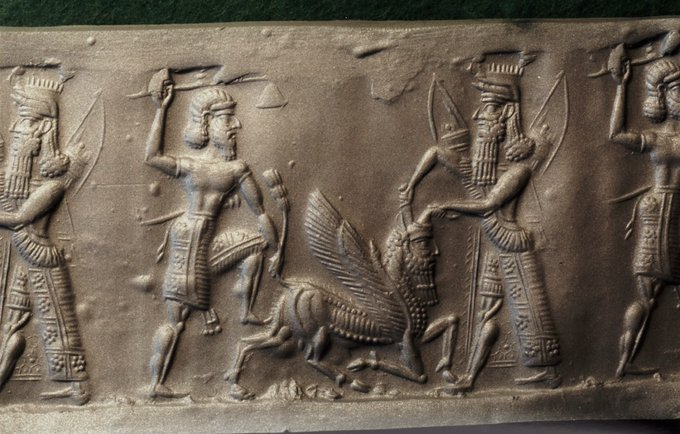
In Mesopotamia, summer lasted seven (hot) months...Which is why local dragon (dragon = symbol of summer), had seven snake heads (snake = symbols of sun's heat)...Oh, and look, we also have dragon killer(s) and the princess 🙂 I talked about this amazing seal in my post "Seven headed dragon"...

BTW, this is also by the beast of the apocalypse has seven heads...Full symbolic analysis of the Woman of the Apocalypse, described in Chapter 12 of the Book of Revelation can be found in my post "Apocalypse"...

Fire breathing dragon, the symbol of the destructive summer sun's heat which burns everything and brings drought (steals water), is just "an old snake", symbol of old sun's, late summer sun's heat, heat of the hottest time of the year...

This link between snakes and dragons is best preserved in Slavic folklore which help me to decipher snake and dragon mythologies in other parts of the world...They all turned out to have the same underlining solar snake root...

I talked about snake and dragon in Slavic mythology in my post "Scaring off the dragon" in which I talked about the fact that in the past, Bulgarian (and Serbian) farmers believed that droughts were caused by winged fire breathing dragon who "stole and locked up" the waters...

And so, to prevent the dragon from steeling the water, in northwest Bulgaria, on a certain date in Apr/May, Taurus, all the strong and healthy village men would gather at midnight, strip naked and walk the village land in ritual silence brandishing axes or cudgels to scare off the dragon...

It is interesting that they carried axes, just like Perun, the Slavic thunder god, but also like may other Eurasian thunder gods...The dragon slayers...

The main duty of all the thunder gods is to kill the snake/dragon and release the waters the dragon stole...Hence the thunder god Teshub depicted with a raised axe, about to kill the snake/dragon, and release the waters...

Sometimes the thunder gods were armed with spears instead of axes...Like the two dudes fighting the Sumerian dragon or like the Luwian Storm-God depicted on the Malatya relief conquering the dragon called Illuyanka. I talked about this relief in my post "Malatya relief"... 

So this is why Teshub is killing a snake (dragon)...

But why is Teshub standing on a bull? Taurus, Apr/May is the beginning of the thunderstorm season in Anatolia...


Taurus (Apr/May) originally had nothing to do with stars. It originally marked the beginning of the calving season of wild Eurasian cattle...

I talked about bull/calf as animal calendar marker in many of my posts...

Taurus, Apr/May also marks the beginning of summer, the hot half of the year...As depicted on this Neo-Assyrian seal, dated to 900 - 775 BC. Currently in the Morgan Library. I talked about it in my post "Assyrian bull and Pleiades seal"...


But in Turkey, because of its climate, bull is both symbol of the sun and thunder...Because the beginning of summer is also the beginning of the thunderstorm season...

The direct symbolic link between bull and snake/dragon can be seen on my favourite Bactrian seal depicts a snake with two heads: a snake/dragon (left) and a bull (right)...Symbolically equating snake/dragon (summer sun) and bull (summer starts in Taurus) and linking both with the sun's heat, symbolised by a snake body...I talked about this in my post "Bactrian snakes and dragons"...


Snake is an animal calendar marker in its own right too.

God most high...  

Snake: Apr/May, beginning of the main snake mating season, beginning of summer. 

Lion: Jul/Aug, beginning of the main lion mating season, end of summer.  

And in the middle, summer solstice, sun most high. I talked about this in my post "You will trample the great lion and serpent"...

Hence:

Azhi Dahāka? Aždaha? Zahak? Arimanius? Ahriman? Angra Mainiu? Nergal? Dragon? Lion? Sun. Destructive sun of summer, which causes drought and death. Summer which starts in Apr/May, when vipers start to mate...


I talked about this in my post "Snake god from Hatra"...

There is another interesting thing about snakes and thunder gods


Why is Hermes, the herald (voice) of Zeus, carrying a staff with two coiling snakes, given to him as a present by Apollo, the sun god?

Cause, as I already said above, snakes (solar animals) mate (coil) in Apr/May, (heralding) the beginning of the thunderstorm season...I talked about this in my post "Lyre of Apollo"...

So in Turkey, because of its climate, both snake and bull are animal calendar markers for the beginning of the hot season, and the beginning of the thunderstorm season...

Hence Thunder God Teshub, standing on a bull, about to strike a snake/dragon of drought with his thunder axe...I talked about the association between thunder and (stone) axes in my post "Thunder axe"...

To read more about ancient animal and plant calendar markers, which are at the root of all our mythologies, start here…Then check my twitter threads I still didn't convert to blog post...I am way way behind...

Sunday, 7 July 2024

Lapis lazuli water seal

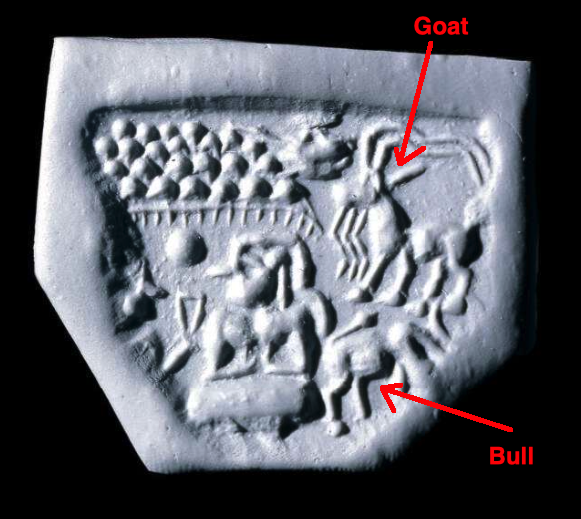
I would like to analyse the scene depicted on this Lapis lazuli seal, made between 2400BC and 2000BC in Eastern Iran. Currently in the British Museum

It is actually quite amazing...

So what is depicted on this seal? Well, I think that this is a calendar, which depicts the wet season in Eastern Iran, using animal calendar markers: Goat, animal calendar marker for Oct/Nov and Bull, animal calendar marker for Apr/May...Let me show you why...

This is the map of Iran. On it I circled Eastern Iran and I underlined the 4 main cities in the region: Mashhad, Birjand, Kerman and Zahedan...

These are precipitation charts for these 4 main cities in Eastern Iran...


You can see that the wet season in Eastern Iran starts in Oct/Nov and ends in Apr/May...

Mating season of Ibex Goats starts in Oct/Nov...Which is why Ibex became animal calendar marker for Oct/Nov. And cause this is when the rains arrive to Western Asia and Eastern Mediterranean, Ibex there became The Goat of Rain...

I talked about symbolism of ibex goats in many of my posts, like 

Europe:

"Pitys", "Goat in European culture", "Patera of Rennes"... 

Levant:

"The tree of life/light", "Lachish animal calendar"...

Mesopotamia:

"Feast plaque from Louvre", "Green pastures", "Problems with Abzu", "Relief from Dur Sharrukin", "Goatfish"...

Iran: 

"Flamingos from Susa", "Goat carrier", "Iranian goat of rain", "Strider", "A vessel from Tepe Hissar"...

In Iran in particular, Ibex Goat was the most depicted animal during Neolithic and Bronze Age...I talked about this in my post "Goat petroglyphs from Iran"...

So that's the Goat sorted...

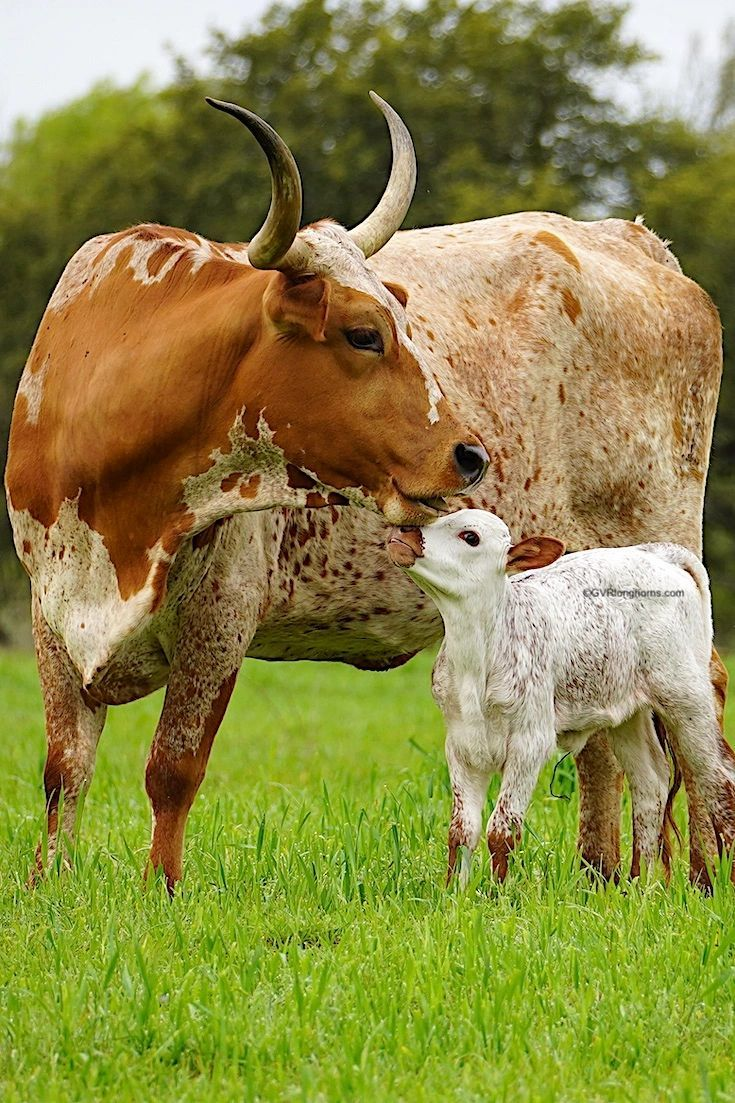
What about the Bull? Normally, as the animal calendar marker for Apr/May, the end of the wet season in Western Asian and Eastern Mediterranean, we find an Auroch bull or a calf.

You know, Taurus...Taurus here is "the old Taurus", an animal calendar marker, which only later became mapped to whatever constellation was rising with the sun during Apr/May, when constellations were first defined...

Taurus originally had nothing to do with stars. Taurus marked Apr/May, the beginning of the calving of Eurasian wild cattle. I talked about that in my posts "Ram and bull", "Cow and calf ivory", "Lotus and papyrus", "Bull carrying grannary", "Foundation peg of the goddess nanshe", "Cypriot stamp seals with cow and calf"...and many others...

I talked about this in my post "Feast plaque from Louvre" about this amazing object I discovered during the 5 hour long stroll I took with my son through the Mesopotamian section of the Louvre museum few years ago. 

Perforated votive limestone plaque, Mesopotamia (where?), ca. 2700-2650BC...


Now interestingly, the bull depicted on our Lapis seal is not Auroch...It's a Zebu...That's interesting. Zebu originates in India...From where it spread westward...I talked about this in this post "Zebu migrations"...

Because of its mating habits (it mates during the wet season in India), in the Indus Valley civilisation the zebu cattle was used as an animal calendar marker for the Kharif (wet season) Apr/May - Oct/Nov. I talked about this in my post "Kharif and Rabi seasons" about this amazing vessel from the Indus Valley civilisation...


So it seems that on our Lapis seal, it was the beginning of the mating season of Zebu cattle and not the beginning of the calving season of Auroch cattle, that was used as an animal calendar marker for the end of the rain season (Apr/May)...


Now let's see how my interpretation fits with the official description of the seal: 

Two figures faced each other, one holding a cup...The pattern above the figures "may represent rain clouds and rain"...Ibex goat and Zebu bull depicted to the side...

See...

Rain is on ancient artefacts often depicted using dots. I talked about this already in my post "Goat of rain from Andros" about the Neolithic relief depicting the goat of rain surrounded by dots (rain drops) from the Cycladic island of Andros in Greece

Knowing what we know about the symbolism of the goat and the bull, I am 110% convinced that the pattern above the figures represent rain clouds and rain. 

The makers of this seal even positioned one of the dots (rain drops) above the cup, to make it clear what the dots mean...

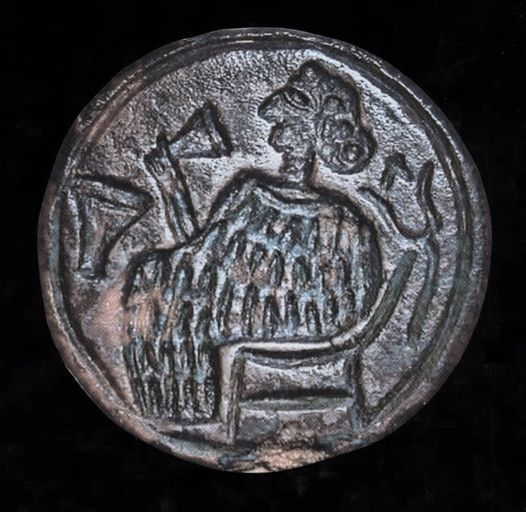
What about the "drinking from a cup" scene...Have a look at this: Seated female figure (goddess? ) drinking out of a very similar cup (goblet) sitting next to a tulip, bronze seal, late 3rd - early 2nd millennium BC, (BMAC), Afghanistan...

Now check the map of Iran. Our Iranian lapis seal was found in Eastern Iran...Next door to BMAC land...

In my post "Tulip goddess" about the BMAC Goddess with tulips seal, I explained that the goddess is the young spring earth, who just had her first period (snowmelt) and is drinking water (runoff)...

...while around here wild tulips flower everywhere...

The two main rivers from Eastern Iran, Atrak and Helmand, are both fed by the rain and snowmelt. Their water discharge starts suddenly rising in Oct/Nov, it peaks in Apr/May, and it suddenly drops to nothing in Jun/Jul...


Also, the fact that our seal from Eastern Iran was made from Lapis Lazuli, The Water Stone, also points to the intended meaning of the seal scene: rain, filling our cups with fresh water between the mating of Ibex goats and mating of Zebu Cattle...


I talked about this lapis as the water stone in my post "Solar bull"....


That's it. To read more about ancient animal and plant calendar markers, start here…then check the rest of the blog posts related to animal calendar markers I still didn't add to this page, and finally check my twitter threads I still didn't convert to blog post...I am 9 months behind now...

Sunday, 9 June 2024

Theseus

This is one of the most amazing objects I have seen in a long while...Roman sarcophagus depicting the legend of Ariadne, Theseus and Minotaur. Found at Capranica, near Rome, dated 130-150AD. Currently in Met Museum...

Why is this object so amazing?

Well, because, through animal and plant calendar markers, it shows us what the legend of Ariadne, Theseus and Minotaur actually means...

But to see this, we first have to correct one error that the carvers of the sarcophagus have made...

Here is the beginning of the description from the Met page and the error:

"On the lid...winged erotes drive chariots drawn by animals associated with the four seasons: bears with spring, lions with summer, bulls with fall, and boars with winter" 

Hmmmmmmm...

Bull has always been associated with summer (May/Jun/Jul). Summer even starts in Taurus...

Taurus, an ancient animal calendar marker marking the beginning of the calving season of Eurasian wild cattle...I talked about this in many of my posts, like "Cow and calf ivory", "Lotus and papyrus", "Bull carrying grannary", "Foundation peg of the goddess nanshe", "Cypriot stamp seals with cow and calf"...

Lion has always been associated with autumn (Aug/Sep/Oct). Autumn even starts in Leo...Leo, an ancient animal calendar marker marking the beginning of the mating season of Eurasian lions...I talked about this in many of my posts, like "Sphinx", "Origin of griffins", "Two lions killing bull", "Lions of Delos", "Angra Mainyu"...

Well, saying this, if lion is depicted on its own, without a bull, it does represent old summer, the hot half of the year. Particularly if it's paired with an animal that represents old winter, the cold half of the year, like a boar. I talked about this in my post "Admetus"...


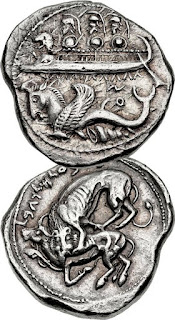
But if a lion is depicted with a bull, the bull is always the symbol for summer, and lion is always the symbol for autumn. And lion killing bull is the symbol for Jul/Aug, when autumn (lion) ends (kills) summer (bull). Like on this coin from Cilicia, dated to 361-334BC

I talked about this in many of my posts, like "Mystery seal", "Two lions killing bull", "Lion killing bull under date palm"...

As a matter of fact, once we swap the places taken by bulls and lions, every animal on the lid is an animal calendar marker, marking the mating or birthing season of the depicted animal, chronologically from left to right:

Leopard, mating Jan/Feb. A well known animal calendar marker for the end of winter, beginning of spring. I talked about this in many of my post, like "Oldest narrative scene", "Vessel from Tepe Hissar", "Harness ring from Luristan", "Elamite copper bowl", "Patera of Rennes", "Lod mosaic", "Leopard", "Furious maenad", "Maenads with hare", "Thyrsus", "Woman and pitcher"...

Bear, emerging from hibernation with cubs, Feb/Mar. A well known animal calendar marker for spring. I talked about it in these two articles "Overpowering" and "Khafajeh vase"

Then we have bull, Apr/May, which is, as I explained above, a well known symbol for summer. 

And lion, Jul/Aug, which is, as I explained above, a well known symbol of autumn.

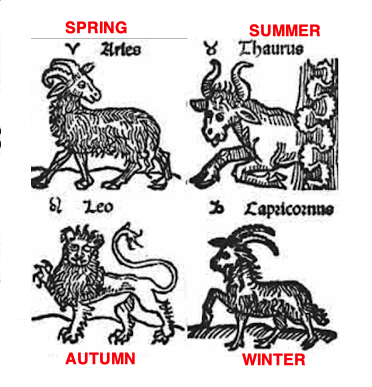
I talked about symbols of the seasons in my post "Symbols of the seasons"...

Then we have wild boar, mating Nov/Dec/Jan. A well known symbol for winter. I talked about this in many of my posts, like "Wolf vs snake", "Sirens", "Vettersfelde treasure", "Summer and winter BMAC seals", "Roast pig for Christmas", "Calydonian boar", "Abduction of Persephone", "Double headed eagle"...

And finally Ibex goat, mating Nov/Dec/Jan. Also a well known symbol for winter. I talked about symbolism of ibex goats in many of my posts, like "Pitys", "Goat in European culture", "Patera of Rennes", "The tree of life/light", "Lachish animal calendar", "Feast plaque from Louvre", "Green pastures", "Problems with Abzu", "Relief from Dur Sharrukin", "Goatfish", "Flamingos from Susa", "Goat carrier", "Iranian goat of rain", "Strider", "A vessel from Tepe Hissar"...

Between bull and lion is a date palm tree. This is very important for determining where this iconography comes from...Because it is in Mesopotamia that date harvest season starts at the end of summer (bull) and beginning of autumn (lion)...I talked about this in many of my posts, like "Date beer", "Lion killing bull under palm tree", "Adda seal"


Here is the sarcophagus lid with the corrected order of animals:

Now that we know that this front, from left to right depicts a solar year (spring, summer, autumn, winter) let's have a look at the front of the sarcophagus:

"On the front, four erotes bear seasonal garlands composed of flowers, wheat, grapes, pomegranates, and laurel."

No link between the plants and seasons of course. So here it is:

Flowers - flowers bloom in spring (kind of obvious 🙂)

Wheat - wheat is harvested in summer

Grapes - grapes are harvested in autumn

Pomegranates - pomegranates are harvested in winter

But what about laurels?

Until today, I didn't know that laurel berries are also harvested during the winter, in November...They're high in lauric acid, a potent antiseptic, and berry oil has historically been used a such...But I would expect to see some berries depicted among the leaves here and there.

So I thought that maybe these could be olive leaves, considering that olives are harvested in winter, starting from November...But I would expect to see some olives depicted among the leaves here and there.

Eventually I thought that these could be pinecones, also harvested during the winter, starting from November...But again I would expect to see small cones depicted on an evergreen branch here and there...

So the jury is out on this one, but regardless, any of them is a good plant calendar marker for winter...

So here is the sarcophagus with all the animal calendar markers ordered correctly and linked to seasons and all the plant calendar markers linked to seasons:

Now question: Why are Erotes depicted riding all these animal calendar markers and holding garlands of all the plant calendar markers? 

Cause of sex...Eros is sex personified. Human, animal, plant...And sex produces babies and fruit...

And all these animal calendar markers mark either mating or birthing season of the depicted animals. And all the plant calendar markers mark either flowering or ripening and harvesting seasons of the depicted plants...

But all of this I talked about before. To read more about ancient animal and plant calendar markers, start here…then check the rest of the blog posts related to animal calendar markers I still didn't add to this page, and finally check my twitter threads I still didn't convert to blog post...I am way behind now...

Finally...The big moment...The story of Ariadne, Theseus and Minotaur, how it is laid on top of this depiction of a solar year. Here is the description from the Met:

"Between the swags are three episodes from the myth of the Greek hero Theseus: 

1. Ariadne giving a thread to Theseus at the entrance to the labyrinth. 

2. Theseus slaying the Minotaur.

3. Ariadne abandoned on the island of Naxos, where she will be awakened by Dionysos and become his bride".

Now, I don't know if this is a coincidence, but Theseus kills Minotaur, The Bull-Man, right under the palm tree, which marks Jul/Aug, the end of summer symbolised by a bull...Basically the death of the Bull of summer...

Usually depicted as Lion (autumn) killing Bull (summer)

Also known as Killing of the Bull of Heaven...I already talked about it in these posts: "Killing of the bull of heaven", "Is that you Gilgamesh", "Assyrian winged dragon", "Winged superhuman hero", "Mystery seal", "Under the blazing Sun Sirius"...

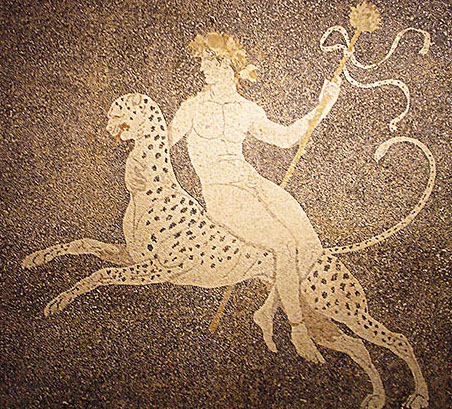
Let me answer my own question: I don't think that any of this is a coincidence...I mean the abandonment of Ariadne is depicted under the beginning of winter...At the time when Dionysus, the winter sun, arrives...Dionysus and Ariadne, Rhodes, 4th c BC, currently in the Louvre...

Few articles about the Dionysus, maenads and thyrsus and the significance of floral and faunal symbols associated with them and their link with winter: "Leopard", "Furious maenad", "Maenads with hare", "Thyrsus", "Woman and pitcher", "Patera of Rennes", "Lod mosaic"...

Knowing now how the Theseus legend is linked to the calendar, I would then venture to say that the 7 girls and 7 boys, sacrificed to Minotaur, are Pleiades...In Greek mythology they are known as 7 sisters. In Slavic mythology they are known as 7 brothers...So that fits...

The heliacal rising of pleiades, during the Greek Bronze and Early Iron Age, fell in Apr/May...In Taurus...So every year, 7 sisters/brothers, rose with the sun, and were swallowed by the summer sun at the beginning of the summer, symbolised by a bull...Swallowed by Taurus...

Theseus meets Ariadne, when he arrives to Crete as one of the sacrificial victims...The moment the sacrificial victims (7 brothers/sisters = Pleiades) enter the labyrinth, is the end of spring, beginning of summer (Apr/May)...In Taurus...

So Ariadne gives Theseus the sword with which he kills Minotaur during spring...Before he enters the labyrinth at the beginning of summer, Apr/May, in Taurus...Which is exactly where this scene is depicted on the sarcophagus...

So here is the story of Ariadne, Theseus and Minotaur with annotations...

I don't know how many times I asked this, but HOW AMAZING IS THIS??? There is no way in hell, that this is a coincidence...Whoever made this sarcophagus in the 2nd century AD was transmitting ancient knowledge, albeit a slightly garbled version of it...VERY OLD!!!

And this secret message remained hidden, in plain sight, until today...Well maybe someone else already figured all this out before me, and if so, please let me know...

That's it for tonight. My wife is nagging me to go to bed. Sweet dreams folks 🙂

PS: Just thought of something. In the story about Theseus, he: 

spring (seduces Ariadne)

summer (wonders around the labyrinth and kills Minotaur)

winter (abandons Ariadne to Dionysus)

What happened during autumn?

autumn (sailing away)...

Autumn starts in Jul/Aug...And according to Hesiod: 

"Fifty days after the solstice, 

when the season of wearisome heat is come to an end, 

is the right (best) time for men to go sailing"


I talked about this in my post "Trojan horse" and "Tetradrachm from Byblos"...

So that's that. I will finish this post with this coin from Cnossos (500—431 BC) with representation of Minotaur on the averse side and cross-shaped labyrinth on the reverse side with the sun in its centre. Remember summer, the sun dominated part of the year, starts in Taurus...I talked about the "solar bull" in many of my posts, like "Solar bull", "Menorah from Nippur", "Human bull hybrid", "Maran", "Theseus ring"...