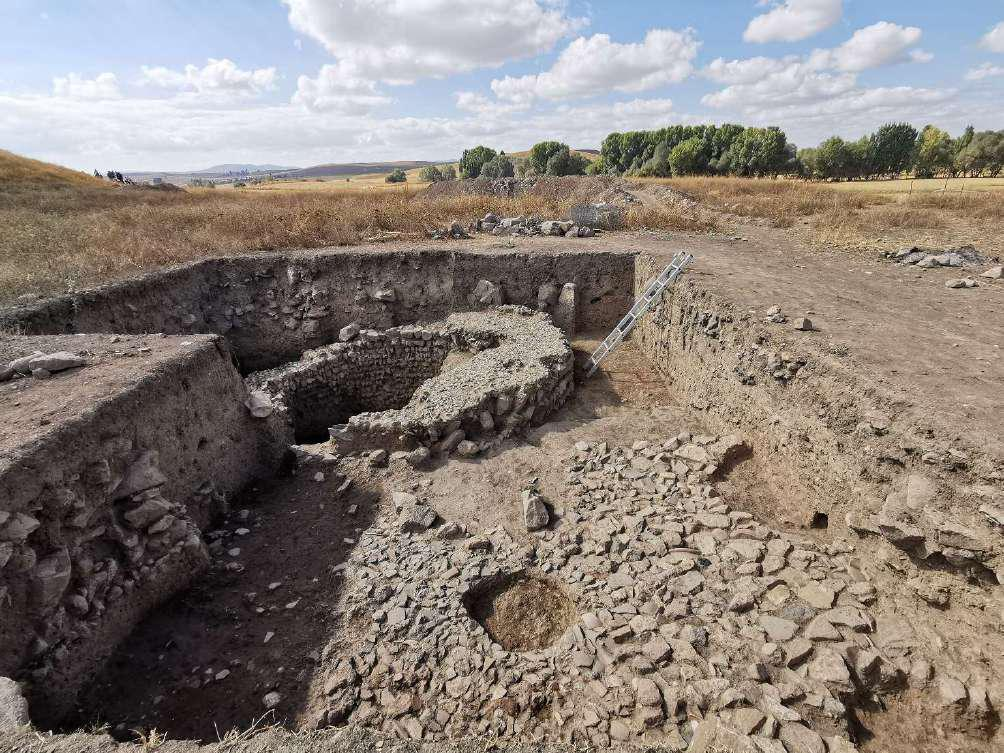
Phoenician dish (?), National Museum of Archaeology, Valletta, Malta. Pic by Merike Joosep.

It is "decorated" with a very interesting design: A wild goat, followed by a wild cat followed by a wild goat followed by a wild cat...
Is this just a meaningless "nice" design?
Well, of course, this is possible. Not every object has a "meaning". But let's play a game "what if the maker of this dish wanted to convey some message through the choice of animals and the way they were ordered"...It'll be fun...For me at least🙂...
The goat is an Ibex goat...In Fertile Crescent, which includes Levant, Ibex was the Goat (calendar marker) of Rain (season)...Because in Fertile Crescent, the start of the mating season of Ibex goats (Oct/Nov), coincided with the start of the rain season. I talk about goat of rain in many of my posts...

So the wild goat's identity is certain...

But the wild cat is not so easy to identify. The body shape could be that of
Asiatic lioness

Asiatic leopard

Asiatic cheetah

All three of these wild cats were common in Levant when Phoenician civilisation flourished there...
Depending on which cat is depicted, the meaning of the "decoration" changes...Why? Because if we want to look at the depictions of these animals as animal calendar markers, we need to know when they either mated or gave birth, cause this is what animal calendar markers marked...
Asiatic lions mating season started in Jul/Aug and spanned the whole of Autumn (Aug/Sep/Oct)...


Which is why autumn starts in Leo (Jul/Aug). And why lion is the symbol of autumn...You can read more about these four symbols of the seasons in my post "Symbols of the seasons"...

I talk about the use of lion as a mythologised animal calendar marker for Jul/Aug, the hottest/driest time of the year in Europe, Mediterranean, Western and Central Asia, in many of my posts...
So lioness would also be an animal calendar marker for Jul/Aug...
When I first saw this Phoenician dish, I was convinced that the wild cat was indeed an Asiatic lioness, because it has no spots of any kind...
Which would make the message encoded in the "decoration" of the Phoenician dish:
Goat (symbol for cool wet season) follows Lioness (symbol for hot dry season) follows Goat (symbol for cool wet season) follows Lioness (symbol for hot dry season) follows...
But then something caught my eye: the dots and circles...
Which look very much like cup marks...


I talked about this in my post "Lapis Manalis"...
Now apparently, dots and circles were used in the past to represent rain. I talked about this in my posts "Malatya relief", "Lapis lazuli water seal"
As I already said, Ibex goats have mating season which starts in Oct/Nov, the beginning of winter. And both Asiatic leopards and cheetahs have mating season which starts in Jan/Feb, beginning of spring...
Now if we look at the climatic charts for Levant again (it is pretty much the same all over Fertile Crescent), we can see that Winter (Ibex, Nov/Dec/Jan) and Spring (Leopard/Cheetah, Feb/Mar/Apr) is the cool, wet, rainy, green season in this part of the word...


Rainy season which can be symbolically depicted by "Ibex followed by Leopard/Cheetah among the dots with a green tree (of life) behind them"...
Just like on this 3200-3000 BC seal from Late Uruk/Jemdet Nasr Period...I talked about this in my post "Ibex and leopard"

Or even more explicitly on this vessel from Tepe Hissar, dated to 4500-4000 BC...Both Ibex goat and Leopard/Cheetah are actually ejaculating rain...I talked about this in my post "Vessel from Tepe Hissar"...

So is it possible that the animals on the Phoenician dish were depicted as silhouettes, and that the wild cats depicted with wild goats among the raindrops are not Asiatic lionesses but instead Asiatic leopards/cheetahs?
Just like on this Greek Hydria. Kerameikos, Athens, Archaeological Museum in Athens. 660-580 BC. Where we see a leopard paired with boar, another animal calendar marker for Oct/Nov, and lion paired with fallow deer, another animal calendar marker for Jul/Aug...I talked about it in my post "Sirens"...

In which case the message encoded by the maker of this amazing Phoenician object would be "rejoice, it's raining (wild) cats and (wild) goats" 🙂...
Anyway, we will never know, but I think musing over this was fun...At least it was for me...How was it for you? 🙂