Showing posts with label Persian mythology. Show all posts

Friday, 23 February 2024

Two lions killing bull

Pre-Achaemenid Silver Compound Zoomorphic Vessel. Silver, 8th-6th c. BC. Currently in the Miho Museum, Japan

This unusual vessel features a pair of rampant lions, interlocked forelegs on each other's shoulders, standing on a prone bull...

The lion that treads on the bull's head has a round opening in the back of its snarling mouth that serves as a spout. The second lion has a small circular hole in its head through which the vessel can be filled. This hole was once sealed with a now missing stopper...

Wow...Really cool...But what does this all mean? The museum page says: "The absence of any clear religious imagery suggests that this object has a political or dynastic symbolism"....I would beg to differ...🙂

Bull and Lion are two of the 4 most common symbols of the seasons:

Ram, marks lambing of Eurasian wild sheep

Bull, marks calving of Eurasian wild cattle

Lion, marks mating of Eurasian lions

Goat, marks mating of Eurasian wild goats

I talked about this in my post "Symbols of the seasons"...

Taurus (Apr/May), originally had nothing to do with stars. It is the ancient animal calendar marker marking the beginning of the calving season of the Wild Eurasian cattle...I talked about it in these (and many other) articles:  "Ram and bull" "Cow and calf ivory"...

Leo (Jul/Aug), originally had nothing to do with stars either. It is the ancient animal calendar marker marking the beginning of the mating season of the Asiatic lions. I talked about this in these (and many other) articles: "Lion radiating heat", "Mahishasuramardini"...

And here is something interesting that I only found out today: As opposed to the African lions, who live in mixed male female groups, Asiatic male lions live separately, in groups of (mostly) two, and they only mix with females during mating season. You can read about it in this Nature article...

Lion killing bull is an ancient (religious) symbol...More precisely, ancient deified calendar marker for the end of Jul, beginning of Aug. When autumn (Aug/Sep/Oct, starts in Leo, Jul/Aug) ends (Kills) summer (May/Jun/Jul, starts in Taurus, Apr/May)...

Silver vessel in the form of a lion killing a bull. Western Iran, 7th-6th c. BC. Exhibition "Splendours of the Ancient East: Antiquities from the Al-Sabah collection"...

We find this scene depicted throughout the part of Eurasia where Asiatic (actually Eurasian) lions once lived. So what is so amazing about Jul/Aug that it's animal calendar marker deserved to be deified? Check these two charts. What happens in Jul/Aug?


This is Nergal, the deified destructive "burning" sun, was depicted as a lion man, because Jul/Aug, Leo, is the hottest and driest part of the year in Mesopotamia...Talked abut him in my post "Winged superhuman hero"...

That lion killing bull was a calendar marker became crystal clear to me when I saw this: composite Bull-Lion, bronze, Iran, 1500-1000 BC. Currently in the Cleveland Art Museum. The meaning of this object is unknown. It is presumed that it has served as an object of worship in a temple or shrine...I talked about this object in my post "Bull lion"...

Worship of who? Shamash (Sun) of course...As Nergal, in Jul/Aug, the point when summer (bull) and autumn (lion) meet (one body with two heads)... 

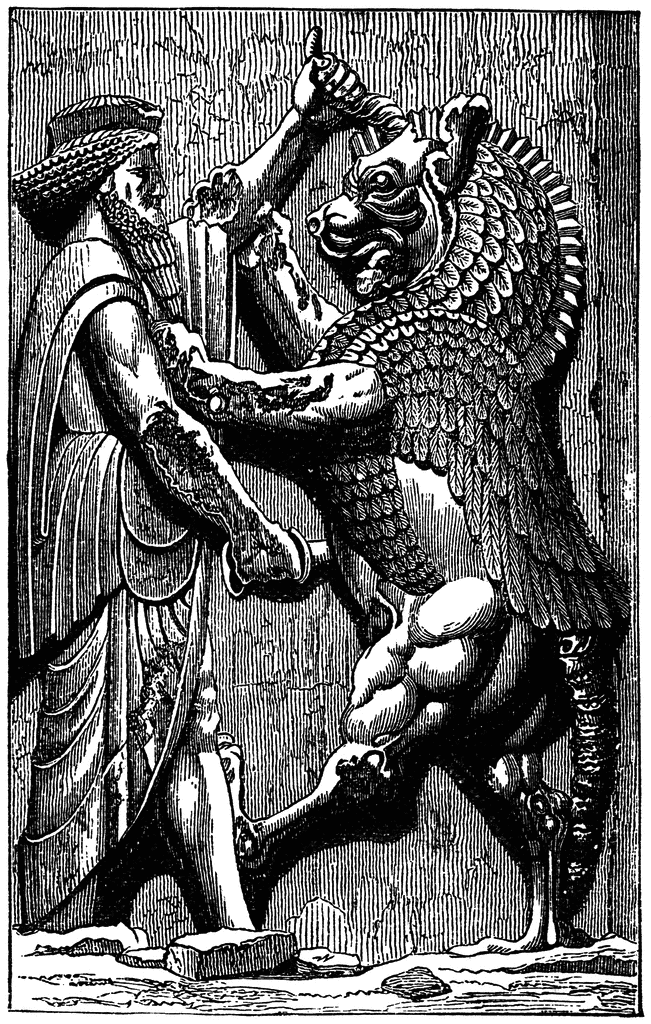
Now what is interesting is that for later Achaemenid Persians, Nergal, The Lion Man, became "Angra Mainyu", The Devil...I talked about this in my post "Angra Mainyu"

Which had to be killed...

Why were Persian kings so obsessed with killing lions? Well they were't really killing lions. They were symbolically killing dry season...Which starts in Apr/May, Bull, peaks in Jul/Aug, Leo and ends in Oct/Nov, Scorpio/Eagle...I talked about it in my post "King killing Angra Mainyu".


You can read more about the religious symbolism of the Lion killing Bull scene in these articles:

"Mystery seal", "Cypriot stamp seal with cow and calf", "Black basalt stone of Esarhaddon", "Angra Mainyu", "Bull leaping in Syria", "Lion killing bull under date palm", "Butt chewing"

And so...Just another lion killing bull scene, with a twist? 

To read more about ancient animal and plant calendar markers, start here…then check the rest of the blog posts related to animal calendar markers I still didn't add to this page, and finally check my twitter threads I still didn't convert to blog post...I am 9 months behind now...

Wednesday, 18 January 2023

The ear ring of god

I while back, Shamekh H posted this tweet: 

"There is a Persian idiom which literally translates as "to have the servitude ring of someone in one's ear" which means great loyalty to someone. Achaemenid officials in Persepolis reliefs have earrings while the king and princes don't. The rings seem signify such servitude and loyalty".

The idiom is used both in classic Persian poetry and in contemporary Persian. The 14th century Persian Poet, Hafez, used it proudly to denote his devotion to the sage leader of the magi (a mythical sage serving wine). Various forms of the expression are still used.

This is the conversation between me and Shamekh that ensued:

Me: As in chained (symbolically)?

Shamekh: Perhaps took pride in their loyalty.

Me: 🙂 Perhaps...

Shamekh: In Persian literature there are examples where this expression is used proudly. And in Persepolis reliefs it is almost more common among high ranking officials. The kings and crown Princes are never depicted with the earrings.

Me: You know the expression "servant of god"? Check this article "Angra Mainyu" (and linked articles) talking about lion symbolism and Persian kings being God's representatives on earth...

Shamekh: I will read it and I'm sure I will learn things from it. In my own tweet I was more concerned about the symbolism of a small ornament.

Me: Yes, but why would someone be proud to be servant of anyone...Maybe because they saw themselves as being servants of god himself...

Shamekh: I've got my personal impressions. But first, I have to read the article to learn things before I discuss my personal point. That way, I will be able to learn even more through the whole discussion.

Me: About the (ear) rings...

Me: Lutf 'Ali Khan, Drawing of Sasanian rock relief: Ardashir I (r. A.D. 224-241) and the Zoroastrian divinity Ahura Mazda at Naqsh-i Rustam, southern Iran, A.D. 1860 (drawing). Currently in The Met: Ancient Near Eastern Art


Shamekh: Thank you. I already had this in mind as part of my impression (that favoured your point of view). Last night in a yalda party I read your article and found it so deep and amazing. I Need to finish reading & start thinking. 

Shamekh: Moreover, devotion and strict loyalty seem to have been brave 'manly' attributes.

Me: Silver coin of Persis, via Parthian rule, c. 140 BCE. The second image is a bird of prey with a diadem in its beak. The symbol itself is said to represent "Xvarənah" (glory/power of royalty and God).

Me: It is interesting that it is an eagle giving the ring, considering the link between eagles, rain, (rain) gods...

Now Ganjajizz joined the discussion...

Ganjajizz: They used to say at the time during achaemenid era that the people were "slaves to the king" And the king rules by divine mandate (the just server of god; ahura-mazda). It is called "Farr", only given to the chosen/worthy...Farr or Xvarenah means "glory/fortune". Etymologically it is connected to light. Many mazdaen/zoroastrian Yazatas/Divinities possess it, such as Ahura Mazda, and Mithra (who is "the most endowed").

Shamekh: Since words with the same denotation can have opposing connotations, they can sometimes be mis-interpreted. The word 'slave' can be a too strong word here. And I agree that the concept of Farr or (فره ایزدی)  was part of ancient Iranian belief system.

Ganjajizz: Yes but that is the term some foreigners used iirc, I’m only making reference to that. What it really means is that people were loyal subjects, not literal slaves

Shamekh: I know. And that's how words can be misinterpreted across cultures.

Now King Typo joined the conversation...

King Typo: The Hebrews may have connoted ear piercing with servitude. I read that a slave who had completed his term could choose to stay on in perpetuity, at which point his ear would be nailed to his master's doorpost. Possible connection?

Shamekh: Possible connection, but in a most grotesque manner. Seems more relevant to a penal code dealing with runaway slaves.

King Typo: I believe it was done voluntarily, not as a punishment

Shamekh: I didn't know that. Thank you for sharing the information. These pieces of information serve as pieces of a puzzle.

Now Janaína joined the conversation

Exodus 21:1-6Deut 15:12-17

"If you buy a Hebrew servant, he is to serve you for six years. But in the seventh year, he shall go free, without paying anything. 3 If he comes alone, he is to go free alone; but if he has a wife when he comes, she is to go with him. 4 If his master gives him a wife and she bears him sons or daughters, the woman and her children shall belong to her master, and only the man shall go free.

But if the servant declares, ‘I love my master and my wife and children and do not want to go free,’ 6 then his master must take him before the judges.[a] He shall take him to the door or the doorpost and pierce his ear with an awl. Then he will be his servant for life."

Shamekh: Thank you so much for the reference

That's it. See! You can have really cool discussions on twitter...🙂 I want to thank all the people who contributed to this conversation for sharing their knowledge with the world...