Showing posts with label Lunisolar calendar. Show all posts

Sunday, 4 October 2020

Mas d’Azil goats

This is one of the most amazing artefacts I have ever seen...Carved from a sperm whale tooth, it depicts two climbing Ibex goats...Found in Mas d’Azil cave (Ariège, France), Middle or Late Magdalenian (13000-10000BC), Piette collection, Musée D’Archéologie Nationale...


"What's so exciting about this depiction of two goats?", I can hear you say. "I mean the cave was full of amazing animal depictions carved in bone...Like this horse head for instance"...


Well...Did you notice that under each goat, there are two groups of 6 incised lines? 12 in total...Why would they be there, I wonder...Could they be representing 12, 29 days moons (like this one depicted on moon shaped boar tusk), of the solar year? 

I talked about these early lunisolar calendars in my post "Calendar"

Hmmm, why would the notches be under Ibex goats depicting climbing a mountain??? Well...Ibex goats in Europe ascend to mountain tops during their mating season, which starts in December, and ends in January typically lasting around six weeks... 

I talked about this in my post "Goat".

Right in the middle of the mating periods of Alpine Ibex is Winter Solstice, 21st of December. And the day after the winter solstice is the beginning of the Capricorn (goat) period, which last from December 22 

If you wanted to have a proper calendar, then that calendar has to be lunisolar...It has to have a beginning fixed in a solar year from which you count your moons...Otherwise it begins to slip as 12x29 = 348, 17 days less than the full solar year of 365 days...

Winter solstice is one such event which occurs every year at the same time and which can be, and was, used as a lunisolar calendar anchor...To prevent your calendar from slipping, all you need to do is determine the day of the winter solstice, and then count 12 moons...

How do you do that. Well that is not really that difficult. 

You find a clear flat piece of high ground from which you can observe sunrises and sunsets. The observatory. You stick a pole into the ground to mark the observation spot. Then as the year passes, every morning and every evening you stand next to the observation pole and observe sunrise and sunset. As you are observing the sunrises and sunsets, you notice that the point where sun rises is not the same as the point where sun sets. The sun rises on the left side of the horizon, travels across the sky from left to right and sets at the opposite right side of the horizon. As days pass you realize that the point where the sun rises moves along the horizon. So does the point where the sun sets. You notice that the sunrise point moves during the spring further and further to the left and the sunset point further and further to the right. So the sun needs to travel longer across the sky and the day is longer and longer and hotter and hotter. Then at some point during the summer the sunrise and sunset points start moving in the opposite direction. The sunrise point starts moving to the right and sunset point starts moving to the left. They get closer and closer to each other, so the sun has to travel shorter distance between the sunrise and sunset and the day is shorter and shorter and colder and colder. 


The point when sun rises in the same place 2-3 days in a row is one of the solstices. Winter solstice if your nuts are frozen solid while you are watching the sunrise, summer solstice otherwise (if you are in continental Europe that is)...

Easy...

Then watch the skies carefully during the extra days after "the end of calendar", wait for the next winter solstice, rejoice and throw a wild solstice party, and then start counting moons again...I talked about these "extra days" in my post "The end of time"

But if you are not fussy and don't care about the exact time of the winter solstice, you can always rely on Ibex goats to start climbing to the mountain tops to start their mating season around the same time every year...All you have to do then is count 12 moons from then...

Soooo....This is why I was so excited when I saw this image...Is this a lunisolar calendar with the Ibex as the beginning of the solar year marker???

Saturday, 9 September 2017

Boaz and Jachin

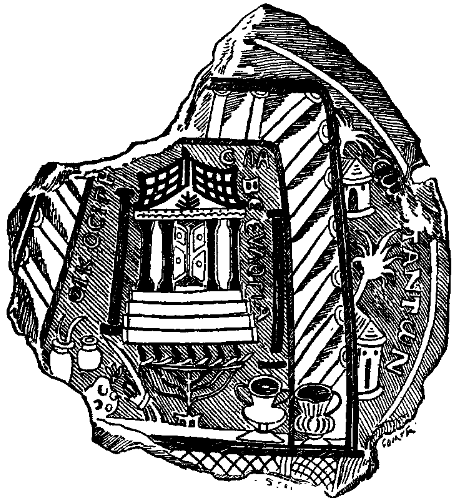
According to the Bible, Boaz and Jachin were two copper, brass or bronze pillars which stood in the porch of Solomon's Temple, the first Temple in Jerusalem.

This 3rd-century (AD) glass bowl depicts Solomon's Temple. Boaz and Jachin are the detached black pillars shown on either side of the entrance steps.


The function and the meaning of these two pillars remains a mystery, a mystery that I will try to solve in this post :)

This is an artist interpretation of the first temple based on the available descriptions. Boaz and Jachin are two dark free standing pillars located on the porch on both sides of the entrance.


The entrance and the porch was located on the eastern side of the temple. This means that the temple entrance and Boaz and Jachin faced the rising sun.


Why is this important for understanding of the meaning of Boaz and Jachin?

In the 2 Chronicles 3:1 we are told that "Solomon built the temple of the LORD in Jerusalem on Mount Moriah, where the LORD had appeared to his father David. It was on the threshing floor of Araunah the Jebusite, the place provided by David..."

So the first temple was built on a threshing floor. A threshing floor probably like this one from Croatia. Threshing floors are platforms where grain seeds were separated from chaff by trampling.


They were normally located on the higher slopes of the hills, or mountains, which were windy, as it was wind that blew away the chaff and helped the extraction of seeds.


Once the threshing floor is constructed it can be used for both threshing and as a solar observatory. What you are actually observing is the shadow made by the central stake or a standing stone. At the sunrise and sunset the shadow will be long enough to cut the circle at the oposite end. This is extremely precise way of marking the sunrise point. 

In 1950, Serbian ethnographer Nenad Janković published a book on folk astronomy called "Astronomija u predanjima, obicajima i umotvorinama Srba" (Astronomy in legends, customs and oral and written tradition of the Serbs). In it he expressed his great surprise at the ability of ordinary illiterate peasants to tell exact date and time without calendars and clocks. Professor Jankovic states that one of the main instruments used for these calendar and time calculations was the threshing floor. By looking at the shadow cast by the stožer, the central pole at sunrise, they were able to tell the date. And by looking at the shadow cast by the stožer, the central pole during the day they were able to tell the time. Threshing floor is a universal solar observatory, which at the same time can tell the date and the time. The main parts of this solar observatory were solar circle and its center, solar pole, stožer. Or if viewed from above, from heaven, the way Sun God would see it, a circle and a dot representing its center, solar pole, stožer. This is the symbol found all over the world and in Egypt it was the symbol of the sun, Ra. The below symbol is usually interpreted to mean sun disc, but I believe that it actually means sun circle, threshing floor and sun cycle observed from the threshing floor.


Greeks called the central solar pole, stožer of the sundial "gnomon" meaning the one which knows. This was because the central stake "new" the time and date. 

According to ethnographic research from the Balkan mountains conducted in the 19th century, threshing floor was the place where all the village meetings, celebrations and ceremonies took place.The ethnographers say that this is because threshing floors were the only flat smooth surfaces big enough to accommodate many people. But was this the only reason? Were threshing floors places where village meetings, celebrations and ceremonies took place because they were considered to be the sacred ground, the place where god lived on earth? I believe so. 

Were threshing floors the mysterious "sacred high places"? I believe so too. 

You can read more about threshing floors and their role in the solar worship rights in my post "Bogovo gumno - god's threshing floor".

In my post "Calendar" I explained why the ancient solar observatories were built and how they were used. The ancient solar observatories were built in order to determine the exact moment of the winter and (or) summer solstice. If you know one or both of these two points on the yearly solar circle, you can create fixed and repeatable lunisolar calendar which is necessary for in order to determine the exact timing of vegetative events during the solar year. 

So how do you determine the exact moment of the winter and (or) summer solstice?

You find a clear flat piece of high ground from which you can observe sunrises and sunsets. The observatory. You stick a pole into the ground to mark the observation spot. Then as the year passes, every morning and every evening you stand next to the observation pole and observe sunrise and sunset. As you are observing the sunrises and sunsets, you notice that the point where sun rises is not the same as the point where sun sets. The sun rises on the left side of the horizon, travels across the sky from left to right and sets at the opposite right side of the horizon. As days pass you realize that the point where the sun rises moves along the horizon. So does the point where the sun sets. You notice that the sunrise point moves during the spring further and further to the left and the sunset point further and further to the right. So the sun needs to travel longer across the sky and the day is longer and longer and hotter and hotter. Then at some point during the summer the sunrise and sunset points start moving in the opposite direction. The sunrise point starts moving to the right and sunset point starts moving to the left. They get closer and closer to each other, so the sun has to travel shorter distance between the sunrise and sunset and the day is shorter and shorter and colder and colder. 


This is extremely important observation if you depend on solar vegetative cycle for your survival. If the length and heat of the day depends on the position of the sunrise and sunset points, then determining how they move becomes imperative. You know that the days when the sunrise and sunset points change the direction of their movements, fall in the middle of the coldest and hottest part of the year. You are of course more interested in the turning point which falls in the middle of the cold dark part of the year. You want to know if, and this was for our ancestors very real IF, and when the sunrise and sunset points will start moving further and further away from each other, because that will mean that the days will start getting longer and hotter again. So you start observing the the horizon and you try to remember where the sun rose yesterday in order to compare it with the sunrise position today. But that is difficult and imprecise. It would be much better if you could mark the points of sunrise every day in some way and then observe the relative position of the sunrise points to the marks. So you decide to use stake, pole as marker. But it is difficult to mark the exact point of sunrise if the horizon is uneven. It would be much easier if the horizon is horizontal, smooth and elevated all around you so that the observation and marking of the sunrise points becomes more precise. So you decide to create an artificial horizontal smooth horizon which will mask the real horizon. You take a long enough rope, tie it to the observation pole and then walk around the observation pole. As you walk you mark a circle with the center in the observation pole.


You then dig a circular trench along the circle and pile up the the dug out earth on the edge of the circle to form the bank. You build a henge like this original earthen henge in Stonehenge. You can read my article about henges here.


Now when the sun rises it will be easy to mark the exact spot of the sunrise with a stake stuck into the elevated earthen bank. Every morning and evening you observe the new position of the sunrise point. If the sun does not rise at the point marked with the yesterday's stake, you move the stake to mark the new position of the sunrise. Then one day in the middle of the winter, the movement of the sunrise point will stop. The sun will rise at the same position behind the yesterday's sunrise stake. That day is the winter turning point, the winter solstice, the shortest day of the year. You mark this point with the permanent taller stake. So when the sun again rises behind this tall sunrise stake you will know that the winter turning point, the winter solstice, the shortest day has arrived again. You do the same for the day when the sun rises twice behind the same stake in the summer. That day is the summer turning point, the summer solstice, the longest day of the year. You mark this point with the permanent taller stake too. So when the sun again rises behind this tall sunrise stake you will know that the summer turning point, the summer solstice, the longest day has arrived again. 


Do you see how much the above henge looks like a threshing floor? If you were using threshing floor as a solar observatory, and if you marked the solstice points with two sticks your threshing floor would look like this:


Now if you know the position of the winter and summer solstice, the three stakes, the central stake, and the two solstice stakes can be used to determine the position of the true east. 


Which could be very useful if, for instance, you were building a temple that you wanted to orient towards the east. By the way do you know that to orient literally means to turn east?

So we have two sticks, stuck at the edge of the threshing floor, the ancient solar observatory, on top of which the first temple was built. Marking the sun's turning points on the horizon, one for winter solstice, the other for summer solstice. Between is east, the area of the horizon where sun rises. Two sticks mark the entrance into the house of Sun, the house of God. The sun gate...Right in the middle of this due east, the direction towards which the ancient Hebrew temple door was oriented, to welcome God (sun) in... Hence two pillars, Boaz and Joktan...

Knowing this, I don't think that the decision to build the first temple on a threshing floor was accidental. Threshing floors and other solar observatories were holy places for sun worshipers. And if the sun worshipers wanted to build a temple dedicated to the sun god, then building it on top of a threshing floor and orienting it towards the east and marking the points of the two solstices with two prominent free standing columns would be very logical thing to do indeed. 

But wait, am I saying that the first temple was dedicated to the sun god? Is there any indication that that this could have been the case? Actually yes...But more about this in my next post. 

Saturday, 19 November 2016

Fishes

In my post "Ram and Bull" i asked this question:

"Have you ever wondered why Aries (Ram) and Taurus (Bull) astrological signs are where they are on a solar circle?" 

Most people would answer this question by: "Because the constellations in the sky at that time look like ram and bull"!

But it turned out that these two astrological signs mark the lambing season of wild European sheep and the calving season of wild European cattle. These were extremely important events which occurred every year at the same time. 

Our henge building Central European ancestors developed lunisolar calendar (at some stage before 5th millennium BC). This calendar has a static starting point (winter solstice) and can be used to mark repetitive events on the climatic yearly solar circle. Once our ancestors had this calendar they were able to mark these important events of the solar year on the solar circle, and "predict" or "know" when these events are going to happen next year. They marked lambing season with the symbol of a sheep and probably called it "lamb" but it came to us as Ram. They then marked the calving seasons and probably called it "calf" but it came to us as Bull. 

After I published my post about Ram and Bull, my friend Tim Walker posted this comment: "Makes sense of course. But then it begs the question: Can we account for all the other zodiac signs in terms of old agricultural/season practices?".

Thank you Tim for asking the right questions. And, you gonna like this, I think I might have found another zodiac sign which was originally used to mark another extremely important seasonal practice. This sign is Pisces (fishes).

Pisces (♓) (fishes) - from February the 19th to March the 20th. 


The official explanation of the zodiac symbol of pisces says that: 

"...the symbol of Pisces shows the two fishes captured by a string, typically by the mouth or the tails. The fish are usually portrayed swimming in opposite directions; this represents the duality within the Piscean nature....Pisces is the Latin word for Fishes. It is one of the earliest zodiac signs on record, with the two fish appearing as far back as c. 2300 BC on an Egyptian coffin lid."

I believe that this is another zodiac sign which marks a very important natural event, which occurs every year at the same time. 

So what do you think, which natural event, which occurs every year at the same time, and which is so important that needed to be marked on the solar circle, would our ancestors mark with a fish? Actually two caught fishes swimming in opposite directions.

Any guesses?

This is Atlantic Salmon.


Atlantic Salmon is a native fish of the North Atlantic and once used to live in all the rivers which empty into the north Atlantic, North Sea, Baltic sea and Barents sea. Basically all the rivers in the area above the red line.


But today in Europe salmon is a rare sight. Over-fishing, pollution, dredging, building of dams, all of this contributed to quite sudden decrease in salmon population and disappearance of this magnificent fish from European rivers. Even in rivers which still have salmon, the numbers are so small that you would be forgiven to ask what is all the fuss about. But in the past, this is what salmon rivers used to look like during the migration of the adult salmon upstream. 


This is a picture of an upstream run of Coho salmon, a type of Pacific salmon which lives in the Alaskan rivers. But once this is what Atlantic salmon runs in European rivers used to look like too. 

Few animals have attracted as much attention through the ages as has the Atlantic salmon. This is because Atlantic salmon has been one of the most important seasonal food sources for the people living along the rivers which empty into the North Atlantic. They were caught in large numbers during their migration upstream into the upper reaches of their spawning rivers and streams. Their meat was a steady source of protein during the salmon season. And later on when people invented the way to cure fish using salting and smoking the surplus of fishes from the last autumn run was preserved and used during the winter. 

Salmon bones were found in the debris from the French caves dated to Paleolithic times. And twenty five thousand years ago Paleolithic man carved a life-size salmon into the ceiling of a cave in southern France near the Vézère River. This is the oldest known artistic representation of a salmon in the world and proof that even in Paleolithic salmon was a well known and important food source.  


Salmon has a very interesting life cycle. 


It spawns naturally in freshwater. Spawning typically occurs in the headwater and tributary streams of rivers, though it can happen anywhere in a river if the substrate is suitable. Atlantic salmon lay their eggs in October-November and hatch in February-March-April, depending on temperature. When they are 1-3 years old, in March-April-May, salmon leave rivers to migrate along the North Atlantic Drift, and into the rich feeding grounds of the Norwegian Sea and the greater expanse of the North Atlantic Ocean. After spending 1 to 3 years in the sea, mature salmon begin migration back to the same rivers and streams in which they had spawned. This return into the rivers and the swim upstream is called "salmon run". 

Now how do you catch salmon. Well in the past, during the large runs, there were so many fishes swimming slowly upstream and they were so tightly packed, that you could laterally pick salmons up out of the river using your bare hands. Locals in Alaska still do that during the Pacific salmon runs, as you can see in this video and this video. If you were a hunter gatherer, catching a lunch this easily will quickly make start paying attention to salmon and its migration patterns. 

But even though salmon is so easy to catch, if you want to catch a lot of salmon there are other easier way to do it. 

Our ancestors mostly caught salmon using fish traps called fish weirs like this one which were built on rivers and streams used by salmon:


The fish could then be picked out either by hand or by using fishing spears like this one: 


The fishing weirs were also used with basket traps. The fish would be funneled directly into a trap where it would get stuck. 


We know that these types of fish traps have been used in Europe for millenniums. The oldest fish traps found in Europe were found in Ireland and were used for catching salmon 8000 years ago. And they have been used until the beginning of the 20th century. 

Now every year a lot of preparatory work needs to be done in order to get ready for the arrival of salmon. 

Fish weirs need to be repaired and rebuilt. The winter floods could have dislodged the weir barrier or blocked the entrance into the weir. Fish baskets would also need to be repaired or made anew as the old ones probably fully or partially rotted away. New fish spears would need to be made too. 

And all this has to be done before the salmon run season starts. And when does the Salmon run season start? 

Salmon fishing in the Spring tends to be limited to the lower river unless a series of floods have encouraged them to progress beyond Durham. 

Well that depends on where you are in the Europe. The migrations of both smalts and adult salmon are triggered by the river water temperature and the river water volume. The migration normally starts after the first spring floods. 

In "The Baltic salmon (Salmo salar L.): its history, present situation and future" by Lars Karlsson’ & Östen Karlstrårn we can read that: "Salmon leave the southern Baltic in April-June, and set towards their home rivers in the Gulf of Bothnia (the northernmost arm of the Baltic Sea). Once they reach the river mouth they stay there for some time and gradually enter a new migration phase adapted to fresh water. Thereafter, they ascend the river in June-August."

In Finland and Northwestern Russia spring run starts in May or June.

In Sweden spring run starts in May. 

In Denmark spring run starts in April. 

According to "The Rhine: An Eco-Biography, 1815-2000" By Mark Cioc we can read that: "In Rhine river in Germany, which was once the main salmon river in Europe, spring run started as a winter run but peaked in March."

In the "Decline and fall of the salmon fisheries in the Netherlands: is restocking the Rhine a reality" we read that: "In the Netherlands, the most important months for the salmon fishermen on river Rhine were March to August."

According to "Atlantic Salmon: An Illustrated Natural History" By Rod Sutterby, Malcolm Greenhalgh. we can read that: "In river Loire, the river water temperature in the lowlands is too high during the summer so salmon start their run in the winter and finish their upstream swim in the spring, spring run peaking in March."

In "France’s implementation plan in line with NASCO’s recommendations concerning the protection, management and enhancement of the Atlantic salmon and its habitat" we can read that "The season for river salmon fishing generally runs from March to July."

The situation is the same in Pomeranian rivers, like Vistula, according to "The restoration of Atlantic salmon (Salmo salar L.) in Poland". In "Historical occurrence and extinction of Atlantic salmon in the River Elbe from the fourteenth to the twentieth centuries" by Jan Andreska, Lubomír Hanel we can read that: "George Handsch von Limus (1529-1578) wrote in his unfinished writings Historia animalis that in Litoměřice, Bohemia, salmon are mostly caught in the river Elbe, mainly in March, April and May, when their taste is the most delicious...According to the inventory from 1588 for the village of Nelahozeves (in German Mühlhausen an der Moldau) located on the Moldau River near Prague, the largest salmon migrated to this location in March and April. A frequency of migration increased until May...The first migrating salmon were recorded in Prague in 1875, 1893, 1908 in March. These were fish about 1 m long weighing 7.5-15 kg, silver in color with bluish backs and small black stars...". River Elbe (original Slavic Laba) used to be one of the longest salmon rivers in Europe. 

In "Recollections of fly fishing for salmon, trout, and grayling, with notes on their haunts, habits, and history" by Hamilton, Edward, M. D Published 1891, we read that: "Salmon begin ascending all the larger rivers in England, as early as February, but chiefly in March..." and "Thomas Faulkner ("Historical and Topographical Description of Chelsea," 1829), says that salmon fishing on the Thames begins on the 25th of March above London Bridge, and ends the 4th of September...".

In Scotland the spring run starts in mid February to mid March depending on the river. In "Status of exploitation of Atlantic salmon in Scotland" by Williamson R.B. we can read that: "Before 1950’s the catch of spring fish in February-April was sometimes more than 50% of the whole annual catch."

In Wales the spring run also starts mid February to mid March, depending on the river. 

In Ireland, a very small number of Spring Salmon start returning to rivers in January, but the proper salmon run doesn't start until February. The Fresh salmon, (Spring salmon, also known as Springers) will arrive into most of the rivers by mid February and start swimming upstream towards their spawning grounds. At the same time a lot of Spent salmon (Last Seasons Spawning Salmon, also known as Kelts), are making their way down stream and back into the sea and their feeding grounds. The main Fresh salmon season starts mid-March. From the middle of March the number of Springers entering the river and swimming up stream increases, while there is still a large number of Kelts going downstream. Saint Patricks Day “March 17th” is a traditional starting day of the proper Springer angling season. 

This is very interesting. It seems that the proper beginning of the salmon fishing season across all major European Atlantic salmon rivers used to begin somewhere between the middle of February and the middle of March. This is almost identical to the Pisces period which falls between February the 19th and March the 20th. 

So if you wanted to be ready for this amazingly important event, you had to know when it will arrive next time, so that you can repair the fishing and curing equipment and get ready. How would you do it? You would mark the event on your circular lunisolar calendar with an appropriate self explanatory symbol. And what symbol would be appropriate?

Every year salmon undertakes two huge migrations along the same river in two opposite directions. 

Smalt salmons migrate from rivers into the sea swimming downstream.


Adult salmons migrate from the sea into rivers swimming upstream.


And right during the period of Pisces, we have both Fresh Springer salmons entering the river and swimming up stream and the last years Spent Kelts salmons leaving the river swimming downstream.

Does this remind you of something?


Salmon the fish that swims in two opposite directions along the same river and that we start catching during the period of...Pisces.

Sooooo

Is it in any way possible that people would mark the beginning of the spring run of the Atlantic salmon, the fish which swims along the same river in two opposite direction, with two fishes swimming in two opposite directions? What do you think. 

O yea, the constellation. 

Here is the Pices constellation:


This is a typical salmon trap from central Europe:


Do you see any similarity?

And finally. Does anyone realize how important this is, from the point of view of the determining the origin of the Zodiac? Here we have three consecutive zodiac signs, Pisces, Aries and Taurus marking three extremely important cyclical natural events which occur in Central and North Western Europe: 

Pisces - Fishes - the beginning of the spring run of the European Atlantic salmon
Aries -  Ram - The beginning of the wild European sheep lambing period
Taurus - Bull - The beginning of the wild European cattle calving period

These zodiac signs could only have been invented in Europe where they have self explanatory meaning. So was zodiac invented in Europe? And more importantly when was it invented? And what about the other zodiac signs?

For the end, I give you this:

The above image of a salmon, which was cut into the walls of the Abri du Poisson cave in France and which was dated to 25kya is not just one of the oldest surviving images of a fish.

Over a period of 7 years, French researcher Chantal Jègues-Wolkiewiez visited 130 cave sites featuring paleolithic drawings, recording their solar alignments throughout seasons, and revealing that 122 of the 130 sites had optimal orientations to the solstitial horizons. Her example case “considered a salmon with a curved lower jaw, a characteristic of post-spawned fish. During the winter, the sunlight would fall specifically on this fish, concurrent with the season in which spawning occurs”...