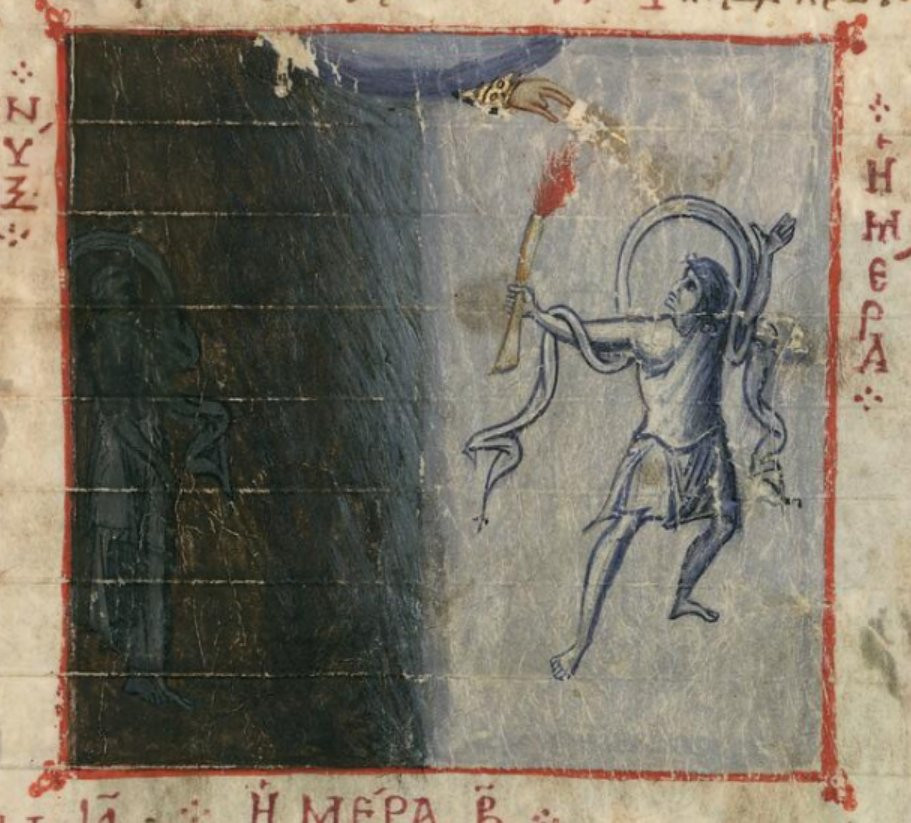
Night (ΝΥΞ) and Day (ΗΜΕΡΑ). Constantinople, 11th century AD. It is interesting that it is day that is holding a torch. You do know why this is interesting, right? Who is the torch bearer who announces the arrival of the sun (god) and who is being blessed by the (sun) god?
Showing posts with label Christian solar iconography. Show all posts
Monday, 5 May 2025
Sunday, 24 December 2017
Stilicho's sarcophagus
Solar and agricultural cult imagery on the Nativity scene depicted on the side of the so-called "Sarcofago di Stilicone" ("Stilicho's sarcophagus"), an Ancient Roman christian sarcophagus dating from the 4th century. It is preserved beneath the pulpit of Sant'Ambrogio basilica in Milan, Italy. Picture by Giovanni Dall'Orto.
Let's start with the base of the nativity scene:
Germanic tradition of burning of the Yule log, and its Slavic counterpart burning of "Badnjak" is the main part of Christmas. It represents rekindling of the fire of the sun, the birth of the new sun. So it is not surprising that swastika, the instrument for kindling fire is on this relief representing the birth of the son of god, or more precisely sun the god. Plus swastika was in Ancient Greece associated with the sun god Apollo, the young sun. So again we have the link between the sun, the fire and the birth of the son of god...
Are the symbols between Swastikas flowers or solar wheels with solar crosses, which divide the solar year in four parts with solstices and equinoxes?
You can read more about solar crosses in my post "Two crosses":
Now, what about the two baskets of seeds and two birds?
Well as I already explained in my post "Leto", birds, specifically migrating birds, are symbol of the solar year, specifically the part of the year dominated by the Father Sun. Their arrival announces the end of winter and their departure announces the beginning of the winter, the part of the year dominated by the Mother Earth.
But why do we have the two grain baskets framing the scene? And why is the left one spilling the seeds and the right one collecting them? Does this represent the time, between the sowing and reaping? Which is the life time of grain? Is Christ, the bread of life, actually in some way seen as grain?
After all grain, just like Christ, and the Sun, dies and gets reborn every year....
So why was all this solar and agricultural imagery placed around the nativity scene? Maybe the author tried to tell us something?
Anyway, what do you think about all this?
Friday, 23 June 2017
You will trample the great lion and the serpent
Have you ever heard of the Psalm 91 (Greek numbering: Psalm 90), also known as the Psalm of Protection?
The psalm starts with:
Whoever dwells in the shelter of the Most High
will rest in the shadow of the Almighty...
And goes on to proclaim:
...If you say, “The Lord is my refuge,”
and you make the Most High your dwelling...
...you will trample the great lion and the serpent...
This last bit, the verse 13, interpreted as a reference to Christ defeating and triumphing over Satan, was the origin of the iconography of "Christ treading on the beasts", seen in the Late Antique period, and revived in Carolingian and Anglo-Saxon art. The earliest and one of the most beautiful example of the depiction of the "Christ treading on the beasts" scene can be found in the "Basilica of San Vitale" in Ravenna.
The "Basilica of San Vitale" in Ravenna, Italy is one of the most important examples of early Christian Byzantine art and architecture in Europe. The church was begun by Bishop Ecclesius in 526, when Ravenna was under the rule of the Ostrogoths and completed by the 27th Bishop of Ravenna, Maximian, in 547 AD preceding the Byzantine Exarchate of Ravenna. The church is famous for its mosaics.
What is the meaning of the above image?
Christian doctrine says that Jesus is trampling on the lion and the snake because "these animals are symbol of the Devil". Hence he is trampling the Devil. But I believe that there is another, hidden meaning.
In my post "Three suns" I talked about the symbolic link between Snakes and the light and heat of the sun. This link was clearly preserved in Slavic mythology. Snakes come out of hibernation just before the the Spring Equinox. Snakes go back to hibernation just after the Autumn Equinox. So snakes are out during the period between Spring and Autumn Equinoxes, during the brightest and hottest part of the year. Slavs believed that once out, snakes constantly "suck the heat out of the sun" and that this is why sun eventually looses it's light and heat and days get shorter and shorter and colder and colder.
Right in the middle of this period is summer.
Summer starts on the 6th of May, Day of Jarilo, Beltine. Jarilo represents the sun's heat, symbolized by the snake and the dragon. Funnily Jarilo was Christianized into St George, the Dragon killer :) In Serbia, St Jeremija who is celebrated at the beginning of May is known as the Snake Saint. His day (1st of May according to the Julian calendar, 14th of May according to the Gregorian calendar) is the time when people perform magic ceremonies for protection from snakes...Interesting both names Jarilo and J(a)eremija have the root "jar" meaning "bright heat".
Summer ends on the 2nd of August, Day of Perun, Lughnasadh. Day of Perun falls in the middle of the Leo (Lion) zodiac sign.
So summer is the period between the Day of Jarilo (Snake) and the Day of Perun (Lion). And in the middle of the summer is Day of Svetovid, the Summer solstice. The point when Sun in the northern hemisphere reaches its highest point above the horizon.
Now have a look at "Christ treading on the beasts" scene again:
Christ standing with his legs spread, with one leg on the snake (the beginning of the summer) and the other leg on the lion (the end of the summer). His head, with the solar halo is right at the point of the summer solstice, when Sun god is the most high...
If you make the Most High your dwelling...you will trample the great lion and the serpent...
You will be in the summer on the northern hemisphere...
Is this the meaning of this psalm and this image? I believe so. What do you think?
The psalm starts with:
Whoever dwells in the shelter of the Most High
will rest in the shadow of the Almighty...
And goes on to proclaim:
...If you say, “The Lord is my refuge,”
and you make the Most High your dwelling...
...you will trample the great lion and the serpent...
This last bit, the verse 13, interpreted as a reference to Christ defeating and triumphing over Satan, was the origin of the iconography of "Christ treading on the beasts", seen in the Late Antique period, and revived in Carolingian and Anglo-Saxon art. The earliest and one of the most beautiful example of the depiction of the "Christ treading on the beasts" scene can be found in the "Basilica of San Vitale" in Ravenna.
What is the meaning of the above image?
Christian doctrine says that Jesus is trampling on the lion and the snake because "these animals are symbol of the Devil". Hence he is trampling the Devil. But I believe that there is another, hidden meaning.
In my post "Three suns" I talked about the symbolic link between Snakes and the light and heat of the sun. This link was clearly preserved in Slavic mythology. Snakes come out of hibernation just before the the Spring Equinox. Snakes go back to hibernation just after the Autumn Equinox. So snakes are out during the period between Spring and Autumn Equinoxes, during the brightest and hottest part of the year. Slavs believed that once out, snakes constantly "suck the heat out of the sun" and that this is why sun eventually looses it's light and heat and days get shorter and shorter and colder and colder.
Right in the middle of this period is summer.
Summer starts on the 6th of May, Day of Jarilo, Beltine. Jarilo represents the sun's heat, symbolized by the snake and the dragon. Funnily Jarilo was Christianized into St George, the Dragon killer :) In Serbia, St Jeremija who is celebrated at the beginning of May is known as the Snake Saint. His day (1st of May according to the Julian calendar, 14th of May according to the Gregorian calendar) is the time when people perform magic ceremonies for protection from snakes...Interesting both names Jarilo and J(a)eremija have the root "jar" meaning "bright heat".
Summer ends on the 2nd of August, Day of Perun, Lughnasadh. Day of Perun falls in the middle of the Leo (Lion) zodiac sign.
So summer is the period between the Day of Jarilo (Snake) and the Day of Perun (Lion). And in the middle of the summer is Day of Svetovid, the Summer solstice. The point when Sun in the northern hemisphere reaches its highest point above the horizon.
Now have a look at "Christ treading on the beasts" scene again:
Christ standing with his legs spread, with one leg on the snake (the beginning of the summer) and the other leg on the lion (the end of the summer). His head, with the solar halo is right at the point of the summer solstice, when Sun god is the most high...
If you make the Most High your dwelling...you will trample the great lion and the serpent...
You will be in the summer on the northern hemisphere...
Is this the meaning of this psalm and this image? I believe so. What do you think?
Subscribe to:
Posts (Atom)


