Showing posts with label baltic. Show all posts

Monday, 1 February 2016

Stones with narrow bottomed bowls

In my post about bullaun stones, the ancient grinding stones, I mentioned that these types of stones are also found in the South Eastern Baltic are. This is one of many old hollowed stones from the Baltic. They are called bowl stones and are, like in Ireland and in Slavic countries, regarded as sacred. The place where the stone is located is used as a place of worship. The diameter of this stone is about 60 cm and a depth - about 15 cm. In the past people considered the accumulated water as sacred and thought that it had healing properties. In the past the stone used to be called the stone of god.


You can see many more of these stones if you run this search. Here are some of them. This one is called "Lielais Daviņu Akmens" which means great stone of giving, offering, great altar. It seems that the stone was linked to harvest rituals.


This stone stands on a hill, where an old oak forest grew until the seventeenth century. The hill was a site of a pagan temple. 


For information about these stones in English look at the pages 27 - 33 of the book "Studies into the Balts’ Sacred Places".

I was just made aware of an article about an interesting half-made bowl-stone from Baltic region. On its top part there's a circular groove of a similar size as the usual bowls on other stones, as if someone had intended to gouge out a bowl there too but stopped half way through the process of gouging the hole. 


We can deduce though that this is how these bowl stones were actually made from their name in Lithuanian. Lithuanian word for bowl is dubuo, dubeni akameni...These words come from Slavic root dub meaning wood, oak but also to gouge. This second meaning comes from the time when utensils were made by gouging bowl like holes in pieces of wood and later stone. In Southern Slavic languages Dubiti means to gouge and Dubeni, Dubeno means gouged, with a gouged hole, bowl in it...Dubeni kameni in South Slavic languages means gouged stones, bowl stones...

But there is a special kind of these bowl stones which are found in the South Eastern Baltic that fall into a class of their own. These are so called "stones with narrow bottomed bowls". 


There are all together 250 narrow-bottomed bowls, but it is quite possible that more once existed, but were destroyed. Majority of these stones are concentrated in two areas: Central and Northern Lithuania / Central Latvia and in Eastern Lithuania. Only a couple of such stones were found in Samogitia.

Historical and archaeological records show that the stones with narrow bottomed bowls are very similar in dimensions and shape, regardless of the area in which they were found. The dimension homogeneity is quite stunning. Processed or unprocessed, the size of the stones varies only slightly. 
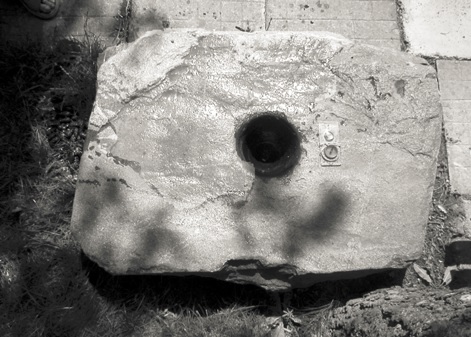


They are only in exceptional cases smaller than 60 x 70 cm and never exceed 100 x 120 cm. Stones thickness (height) is also very similar and varies between 25 - 35 cm. Several stones found in-situ protrude above the ground plane from 5 - 15 cm. The diameter of the upper part the bowl is rarely less than 15 - 16 cm and is never more than 23 - 24 cm. The bowls dept varies between 9 and 21 cm.


The stones are usually found on farms: near houses, barns and cattle sheds or inside them, quite often at the base of the building. Often there are 2 to 3 or even 4 to 5 stones with narrow bottomed bowls preserved in every village, for example Montviliskis, Vaiduloniai, Vileikiai. Today most of these stones are used as decorations. Sometimes these stones are used in churches for storing holy water, like in Dotnuva. But it seems that they were once used as corner stones, usually placed under the northern or north western corner of the house. 

Up until the seventeenth century it was customary to build wooden buildings without diging foundations. A layer of stones was placed on the ground and then the wooden house frame was built on top of it. Corner stones were the most important of all as they were placed under the main four supporting vertical beams. The bowl in the corner stone was usually oriented towards the inner side of building. 


The archaeological investigation which was carried near 9 of these stones dated them to the period 16th - 17th century. However, excavation near the Montviliskis stone uncovered two holes of about one meter in diameter full of ashes, cattle bones and potsherds dated to 2nd millennium AD as well as potsherds from the period 16th - 18th century. The bones were all of young animals, indicating that they were sacrificed in a "first fruits" kind of sacrificial fertility ceremony.

There are ethnographic records from Lithuania which show that in the past, when the corner stones were placed in the ground, a special blessing and sacrifice ceremony was performed.  The hole in which the corner stone was to bi placed was dug first. Then the owner of the house would step into the hole and would drink some vodka and then all the workers working on the house would do the same and then they would share some food and continue working. The corner stones were marked with wax crosses and money was placed next to or under them. It was believed that god lived in them. Not only that, but it seems that the stones with narrow bottomed bowls were used as family altars.

At the beginning of the 17th century Jesuits described the stones with narrow bottomed bowls calling them "Deiviu akmenys" meaning "Goddess stones".
The report  from the 1600 says: In stores big stones are kept. They are dug into the ground, with the flat faced facing up. They are covered with straw. They are called "Deyves" (Goddesses) and are faithfully worshiped as the protectors of cereal and cattle.
The report from 1605 says: Some very uneducated village people due to our efforts got rid of the bad habit of worshiping one stone which they thought to be the god of granary, fruitfulness and happiness of home.

Even though it is not specifically stated that the sacred stones were "bowled", there is much in common between the stones described by Jesuits and stones with narrow bottomed bowls: their location in farm buildings, the fact that the top face of the stone was flat, the stones had the function of the cereal, cattle, happiness provider.

There are legends about the stones with narrow bottomed bowls which state that in the old times they were used as mortar stones for milling, grating or pounding. In Veriskiai, the local legends states that the stone was used by the Devil to grind tobacco.

Some stories preserved by old people talk about holy water being stored in the stones and that before that people used to pour milk into the hole for the grass snake, the houses snake, the incarnation of the house protector spirit in Balto Slavic religion.

In the 17th century Jesuits recorded the existence of a god called "Pagirinis", meaning "The one who lives under the quern, under the mortar stone" basically "The one who lives under the stone with narrow bottomed bowl". Knowing this it seems that the most probable function of the stones was as an altar to the god (goddess) protector of home. Another 17th century Jesuit report states that the god "Pagirinis" sometimes comes out of his corner in a shape of a grass snake, but that it spend most of his time buried in the soil, which is kept in a clay or wooden dish or without a dish under the quern (mortar stone, the stone with the narrow bottomed hole).

So this is very interesting. We have:

1. a corner stone
2. which is shaped like an ancient mortar stone
3. which was used as a fertility cult altar.
4. which is referred to as a "Goddesses stone"
5. which is the home of the male deity whose name means "The one who lives under the quern, under the mortar stone"

In some parts of Serbia the " thick wall" made of stone which supports the house is called Baba.


In Bulgaria thick logs which are put under log cabin corners to support the house are called "bа́bka". This gives additional meaning to the Serbian proverb that says that "the house stands on a woman". I wrote about it in the post "Baba - the main column, pole that supports the house". It seems that baba was any supporting structure on which the house stood. 

In Serbian and in other Slavic languages the word Baba also means wich, goddess,  and not just any goddess, the Mother Earth. So it is not surprising that the above corner stones from Lithuania were called "Goddesses" stone. They are basically Baba's stone, as Baba, Mother Earth,  was the fertility goddess to which Lithuanians prayed to. Interestingly

The name of the male deity which is believed to live under the corner stone in Lithuania shows that that these stones were once actually used as grinding stones, as I postulated in my post about bullaun stones.

The fact that the mortar grinding stone was used as a fertility altar dedicated to the Mother Earth is not surprising at all either. A hole in the ground is where the plant seed is planted. A hole (vagina) in the lying woman is where human seed is planted. So a horizontal lying stone with a hole (mortar) is already suggestive enough. Mortar grinding stone and pestle even more. So much so that the mortar and pestle became the symbol of male and female genitalia in Hinduism (Yoni and Lingam).

This is a so called "wet" grinder mortar and pestle from India from this great blog post about making stone ground chutney


And this is Yoni and Lingam 


The union of sky and earth produces (releases) cereal seeds which are then poured into the mortar and pounded into flour with pestle in a motion which greatly resembles coital movement of penis (Lingam) inside vagina (Yoni) which produces (releases) human seeds which are poured into the vagina.... Do you see the link here? The fact that in the Baltic tradition milk was poured into bowl of the corner stone "for the snake to eat" confirms this, milk being symbolic replacement for sperm, milky white liquid containing human seeds. Once the cereal seeds are pounded into the flour flour is made into bread which is bake inside the bread oven which looks like the belly of a pregnant woman. And that bread oven is in Serbia called baba. Ovens were in old Slavic houses placed in north-eastern or north-western corner, just like the Goddess stones. 


The belief that the house protector snake lives in the house foundation does not only exist in the Baltic countries. It is wide spread in Slavic countries and it exist in Serbia too. In Serbia the house protector snake is believe to live in the house heart (stone oven) or the house foundations (the layer of stones which supports the wooden house frame, corner stones originally). It is believed that this snake is the spirit of the founder of the family, some other very distinguished ancestor, or the first male ancestor who died in the house. Either way this snake is the symbol of the male ancestor, just like Lingam. So we have a mortar stone (Yoni) which houses (in a bowl) snake (Lingam)...

And this is it, the story about Lithuanian co called "stones with narrow bottomed bowls". I hope you enjoyed it. Until the next time, stay happy.

References

"Aukštaitiški aukurai" by Vykintas Vaitkevičius
"Studies into the Balts’ Sacred Places" by Vykintas Vaitkevičius
"Pojmovnik Srpske kulture - baba" - Etnografski institut SANU

Friday, 6 June 2014

Cailleach - Kaljeva Peć - Zapećak

Cailleach (shúgáin), recess for bed, alcove. F: Snuggery.

I recently came across this article on the UCD Digital Library:
The bed outshot was a common feature of houses in north-west Ulster and north-west Connaught, consisting of an alcove in the back wall of the house beside the hearth. The purpose of this small extension to the house was to provide additional sleeping accommodation and it was often occupied by elderly people. A common name for the outshot was the cailleach, which according to folk etymology derives from "cúil theach" (the back of the house). 
Here is a picture of an Irish  cailleach, a bed built into the wall next to the hearth, oven.


Here an old person who may be bed bound or in need of heat would be near the hearth and could take part in the storytelling and gossip. A curtain could be closed across to give some privacy. 

In MacBain's Dictionary we find this meaning for word cailleach : old wife, nun, Old Irish caillech, "veiled one"; from caille, veil, which is from the Latin pallium, cloak, English pall. 

This meaning would fit in with the curtain and the old woman or hag and could give us a potential etymology for this architectural feature and the reason why it is called cailleach. But is it possible that there is another etymology for the word cailleach and the name of this architectural feature?


Exactly the same architectural feature exists in Serbia. It is called "zapećak". Word "peć" means oven, and word "za" means behind, so "zapećak" literally means behind the oven. In old houses, beds were always build next to the ovens, because walls surrounding the oven would heat up and radiate heat through the night. What is interesting is that these kinds of ovens are in Serbia called "kaljeve peći". The meaning of the word "kalj" is "mud", dirt, black which would make word "kaljeve" mean made of mud, dirt. These ovens are indeed made from clay, mud, bricks and stone. Here you can see some examples of mud and stone ovens from northern Serbia. 

These are outside versions of these mud ovens:


These are indoor versions of these ovens with "zapećak", place beside the oven for sitting and lying.

In Slovenia zapeček is more like a bench round the stove. People also slept on those benches or on top of the oven. This one is from a town house:


This one is from a village cottage:


These types of mud brick ovens are even more prevalent in north Slavic lands of Russia and Belorussia, where every cottage had one, with beds actually built on top of the oven or right next to it. The picture below shows an old Russian stove inside the coachman’s cottage with the little wooden ladder leading to a bed space over it. As this was probably the warmest spot in the cottage it would normally have been reserved for elderly parents to sleep on.


Here is another one from a peasant house in Russia:


These next two "kaljeve peći", mud brick ovens are from Belorussia. Belarusians built piečy similar to those in Russia. There was a place on pieč for children and elderly called 'čarień' . There was a bench near stove and a bed next to the stove (polati).


Why did Slavs build ovens made from mud and stone? Because they are the most efficient heaters in the world. 

The so-called “Russian stove” , a masonry heater was one of the main features of the Russian home. Throughout many centuries Russian stoves were used both for cooking meals, baking bread and pies, drying grains, mushrooms, and roots and for heating and drying the house in winter and autumn. If the stove had no chimney, which was often the case, the smoke from the straw or manure that was burned as fuel would fill the interior of the room. Houses did exist with chimneys, the interiors of which were much cleaner and healthier for the inhabitants.The Russian stove often turned into a folk personage, which can be found, in particular, in folk tales. Many positive characters of Russian fairy tales are fond sitting or lying on the stove.

Many years later the Russian stove is still very popular and it is considered as the most efficient and environment-friendly wood burner. It can be made by stone, brick, stucco or tile-clad units and is designed to burn the wood quickly at temperatures up to 2000F.

Masonry heaters can burn from 15 lb. to 90 lb. of wood in an hour and a half, which could be all that's needed for a day's worth of heat. The heat from the fire works its way through a series of internal channels that help to transfer the heat to the masonry. The stove slowly generates heat into the living space over a long period of time - as long as 24 hours. During the coldest days of winter could require only two fires and typically burns at around 95% efficiency. With a masonry heater, you can expect to heat a well-designed 3000-sq-ft home with as little as five cords of wood for the entire heating season. Masonry heaters are focal point of the room and bring warmth and beauty during the long, cold days. Here is the picture showing the internal design of one of these mud brick ovens:


I have already spoken extensively about potential South Baltic and even East Slavic influence in Ulster in my articles about Baba stones and Gavran and Golub ban. It is very interesting that the only place in Ireland where we find high concentration of these "Cailleach" beds built into the wall next to the hearth, is in the old Ulster, the same area where we find majority of the other South Baltic, "Slavic" cultural traits. I was told recently that some of these "Cailleach" beds were also found in Co. Meath, Wexford and Waterford. These are also counties where we have significant "Germanic" and "Slavic" non Gaelic cultural traits linked to the Laigin and later the Danish - Slavic Vikings. 

Is this another proof of the existence of "two Irelands" in early medieval times? The Irish annals actually talk about two Irelands. 

When did this cultural trait enter Ireland? 

If this cultural feature came with Cruithin, do we find the same types of beds built into the ovens or hearths in other Cruithin areas of Scotland?

If this cultural feature came with Anglo Saxons and their Slavic allies, do we find these types of beds built into the ovens or hearths in Britain? 

If this cultural feature came with the Vikings and their Slavic allies, do we find this feature in houses in Viking settlements? Most typical medieval Slavic houses sunken houses dug into the ground and had stone or mud brick oven built into the corner of the house. People probably slept on benches next to the oven. This architectural features are in Germany and Baltic region used to identify Slavic settlements among Germanic and Norse ones. Germanic and Norse houses from the same era had central hearths. Some of the earliest Viking houses from Ireland have exactly this design. Were Slavic Vikings among the first Danish Vikings to reach East of Ireland? Or did these "kaljeve peći", mud brick ovens, come later with Norvegian - Swedish - Russian Varangians?

This is an example of an early Medieval Slavic sunken house with a mud and stone corner oven. This design leaves space next to the oven for a sleeping platform, bench. The house in the picture is built from timber, but the same type of houses were also built from wattle and daub with timber support posts and from stone.


So in the end let me ask the main questions: 

Is it time to reexamine archaeological data from Ireland and see how many other "Slavic" cultural traits can be found? No one looked for them before, because officially Slavs never set foot in Ireland. But maybe we should reevaluate the official history. 

Did Slavs together with Norse Vikings, Anglo Saxons, Prussians, Celts, Gaels... contribute to the ethno and cultural genesis of the Irish?

The last question is: 

In Northern Ireland, beds built at the side of the hearth or stove are called "cailleach". Is this because of the old ladies who used to lie on these beds, or is the word "cailleach" the closest Irish word that sounded like Slavic "kaljeva peć", "kaljava peć" meaning oven made from mud bricks? 


Irish word "cailleach" means an old woman. The Old woman is the main ancestral figure of the past. She is the mother goddess, the earth goddess. But when she turns nasty, like during catastrophic climatic events of the mid 3rd millennium bc, which wiped out irish agricultural society, this makes old grandmother turn to a hag, witch. Goddess of fertility, land, crops, becomes goddess of cold, water, mud, muck, hunger, death. As rain falls day after day, for years, and as fields turn to bogs, you end up with Cailleach goddess of kalj, mud, blackness, darkness, witch with a dark veil which obscures the sun... 

So Cailleach is an old woman but not any old women. She is the old witch, the hag. You would never call any Irish woman Cailleach to her face as it is an insult. Cailleach is the natures destroying principle. She is the equivalent of Serbian Mora, the goddess of death, cold, water, winter. In Serbian she is known as Mora but also as Baba Mara, Baba Marta, meaning Grandmother Mara, Hag Mara, Hag Death. But also she became replaced with Grandmother Mary, holy Mary. No wonder Cailleach, the name for a veiled old witch, the goddess of winter, cold, rain, water, death became the name for new christian witches, nuns...Name Mora, Morana is based on the root "mor". This root is found in most Serbian words with diminishing, reducing, negative meaning. But is also root for the word mort meaning death which could be traced to common Proto-Indo-European root *mr̥twós, *mr̥tós.
Cailleach fits the description of the old witch, the goddess of death, cold, rain, mud, bogs, peat, dead forests and tree stumps, destroyed crops and hunger...

Interestingly Romans depicted winter in exactly that way, as an old woman covered with black cloak, holding a dead tree branch...


Is there any link here?

But I actually believe that the root for the word Cailleach is the Slavic word kal, kalj meaning black, mock, mud. This is actually an ancient Arian (R1a) word and is much older than both the Serbs and the Irish. It is interesting that the root is preserved in Slavic, Hindi, Nepali, Gujarati, Punjabi, Romani, Sanskrit and in Irish as a name for goddess of cold, death, darkness...This word is also the root of the name of the goddess of death Kali. This word is also the root for the word coal which is black and Slavic ugalj meaning coal...First coal was produced from wood by turning it "u + galj" meaning into black, into charcoal...

So actually in a strange way "Cailleach", the goddess of death, cold, darkness and "Kaljav" meaning black, muddy could mean one and the same thing. Cailleach = Kalj (j)e = dark, black, mud + is.

But this is a big story which requires a separate post.