As promised:
"Does it mean there will be no gifts this year?" by Jakub Różalski

This painting depicts 3 little carolers stumbling upon Krampus killing Santa...I love this image...Because it shows how successful Christian propaganda was in turning Old Gods into New Devils...I also love how New Age "Pagans" lapped it all up...
A news article title from the last year's papers:
"Austria struggles with marauding Krampus demons gone rogue (pic below). Police record rising violence and drunkenness in relation to traditional folkloric festivities!"

I would here like to answer the question: Who the hell is Krampus and why is he acting the goat?
I can tell you straight away that the "Evil Krampus" dudes are not gonna like the answer...At all...
First, who is Krampus (officially)?
Krampus is a horned, anthropomorphic folklore figure described as "half-goat, half-demon" (!!!) found in Austria, Bavaria, Croatia, Czech Republic, Hungary, Slovenia and Northern Italy....
The origin of this figure is unclear and some folklorists and anthropologists have postulated that it is a remnant of a pre-Christian cult...Let me spare you the suspense. Krampus is definitely a remnants of a pre-Christian cult...
Krampus appears on the eve of the feast of St. Nicholas, the evening of the 5th of December, when he accompanies St Nicholas in his procession from house to house...

While St Nicholas brings presents to "good" children (the ones who cross themselves and pray to god)...


If I was one of these little children, I know what I would do...I talked about this in my article "Little Christmas"...
Traditional props commonly used by Krampus are: bells, a birch switch, a back fruit (grape) picking basket, chains...He is accompanied by the "dark faced demons", otherwise known as "the dead"...And the hag...And the bride...Random? Or not random?
So...
1. Bells,

Krampus carries bells to announce his arrival and to drive away evil spirits...Hmmm...Why would an "evil demon" drive away evil spirits?
2. A birch switch

Krampus carries a birch switch with which he hits bad children...Hmmm...Wasn't birch linked with fertility? And wasn't swishing trees, animals and people (especially children) with a birch twig done to "protect them from evil spirits and to make them healthy and fertile"? Would a demon do that?
Also birch is (in Slavic and Celtic tradition) linked with the dead...And in Slavic tradition, it is the dead that bring all the good to the living...Hence all the ancestor worship...Is this why birch was used in fertility rituals?
So if Krampus is accompanied by the dead, are they there to bring bad things, or to bring good things to the living? Well, it depend how the living treated the dead....I talked about the relationship between the dead and the living in Slavic folklore in my posts "Wolf feast", "Thirst", "Blood red wine"...
Hittites forgot about their dead, and look what happened to them:
"...humiliation of the Hittite kingdom is the result of the fact that the living Hittite kings and their subjects have forgotten to respect the sacred bond with their dead..." - From the last Hittite king, Suppiluliuma II's letter...I talked about this in my post "House of bones"...
By the way, this is where the power of Pluto (Hades) comes from and why Hades and Persephone are depicted sitting on their throne in the land of the dead, holding sheafs of wheat...And flowers...I talked about this in my post "Pluto"...

Is that thyrsus stuck in the ground in front of their throne?

You know the magic stick that the god of death and resurrection, you know that guy, Dionysus, who was celebrated around winter solstice, carried with him everywhere? Strange...Or not...
I talked about this magic stick in my post "Thyrsus"
And is that cockerel, symbol of fertility? And a replacement for a human sacrifice in Slavic grain agricultural magic...Here a cockerel is slaughtered on a doorstep, one of the seats of the ancestors in Serbian folklore...

I talked about this in my post "Cock bashing", "Bleeding for Martin", "Thanksgiving"...
But why am I "digressing" talking about grain agricultural magic, when I should be talking about "Evil Demon Krampus"?
Well, interestingly, in smaller, more isolated villages, which have preserved the oldest version of this ritual, Krampus arrives accompanied by walking sheafs of wheat, like in Bavaria and Styria (Štajerska). Strange...Or not...

3. A fruit, grape picking basket,

Krampus carries this basket to take the bad children away...The ones who don't pray to the new god...Represented by his enforcer, St Nick...Who is now bringing presents to children...Who pray...

Hmmm...Is it possible that it was Krampus who once brought presents to children (and adults) in his basket? And is it possible that Krampus's position as the fruit, food (these were the presents in the old days) bringer, was usurped by Santa? Who turned Krampus into his opposite?
We have many examples of this happening all over Europe...According to the Serbian folk tradition, Hromi Daba was another name for the old god Dabog, "The Giving God", the ancestral deity of the Serbs. Hromi Daba, Dabog was also said to be "the oldest devil"...
4. Chains

Krampus apparently carries chains to tie the devil up...Why would a demon, who looks like what most people imagine the devil would look like (half man half goat) cary chains to tie the devil??? To symbolically tie himself?
So who is really Krampus, and why is he acting the goat?
Well to find out the answer to this question, we have to look at real Alpine goats, and more particularly, Alpine Ibex...Alpine ibex goats are huge animals, with dark bodies and big horns.

Alpine ibex mating season starts in December, and ends in January typically lasting around six weeks...During which time they "dance" and "fight" to attract the females...

So the Ibex goats start prancing around right at the time when Krampus does too...I talked about this in my post "Goat"...
But so what? Well:
The Hunter (Sagittarius) shoots The Ibex (Capricorn). The wounded ibex wonders off. He is dying (Capricorn ends). But from The Ibex's Blood (Aquarius) grows A Magic Flower (Spring). The Ibex eats one petal of this magic flower, and "springs" back to life.

This is in short the essence of the Slovenian legend about Zlatorog (Ibex with golden horns)

This legend is the key for understanding all Goat related European winter folklore...
This legend describes winter...

The time of death...And resurrection...Of the sun...And nature...And the symbol of this resurrection is the crazy, dancing, copulating Ibex goat...
Now in this Slovenian legend, The Hunter represents the beginning of winter, the time of the first snows, and the beginning of the fur hunting season in Continental Europe...This period is marked by Sagittarius...

The Goat is the Solar Goat...Hence the golden horns...He primarily represents the death and resurrection of the sun, which happens on Winter Solstice, in the middle of the Aline Ibex mating period...The period is marked by Capricorn...

The goat's blood, represents the snowmelt in Continental Europe which starts at the beginning of spring. In February...This period is marked by Aquarius...

The flowing water brings the revival of nature, and spring, which starts in the middle of Aquarius...And spring brings fruit, food (all the presents a peasant can want)...
So the dancing, copulating, dying and resurrecting Solar Goat is the bringer of spring and fertility and the bringer of wealth that resurrected fertile nature produces...The real Santa...
Wait...Wasn't pan, the Goat God of nature?

I talked about Pan and the lifecycle of Ibex goats in my post "Pan - Goat of rain"...
By the way, Aquarius is when Celts and Slavs celebrate the death of "Winter Hag" and the birth of "Spring Maiden". The Bride...

I talked about this in my posts "Gryla", "The old woman of the mill dust" and "Babji mlin"...Is this what "the hag" and "the maiden", which are sometimes found accompanying Krampus and St Nick, represent?
By the way, the Goldhorn lives in the mountains with "white ladies"...
That Goldhorn is not just a fluke crazy legend, and that "goat of resurrection of nature" is not something I have completely fabricated myself, can be seen from the fact that goats dance all over Slavic lands, from December to February...And not just Slavic lands...
In Ukraine, the group of Koledari Carol singers (Old Winter Solstice pagan carols which predate Christmas carols) always contains a goat character...

Carolers would go through the village and would knock on every door asking for permission to sing. If the answer was yes, they entered the house and sang carols for each member of the family, even for the smallest child...

Sometimes they even performed ritualistic dances. They also had to present a short comedy sketch involving the goat. The sketch showed the goat dying and then being brought back to life...Interesting right?
The same theme we find in Goldhorn legend. It symbolizes the death of the old solar year, which dies on winter solstice night and the birth of the new solar year which starts in Capricorn...The Sun Goat...But this "comedy sketch" also depicts the death of winter which is symbolised by a goat.

The same goat character is found in Russia, Belarus, Poland as part of the ritual called "Walking with a goat, goat procession"...

And there too the goat dies and gets resurrected as part of a "comedy sketch"...Oh, by the way, a bear and a stork (crane), both symbols of death and resurrection, accompany the goat...

This tradition survived until the mid 20th c. in Poland. But there it was performed during the period from Fat Thursday to Ash Wednesday. Beginning of spring...And surprise surprise, there is even a hunter with a bow and arrow who kills the goat...(Sagittarius killing Capricorn)

By the way the first character in this picture is "solomenyj ded" (straw old man). Remember "Walking sheafs of wheat" from Austria...Who wonder about with Krampus and St Nick...

Serbian supreme god Dabog (Giving god) was also known as Djed...In Ukraine, he was represented during Christmas (Winter Solstice) rituals by a decorated sheaf of wheat called Didukh (Grandfather, The Ancestor). I will talk about Didukh more soon...
In Cracow, Poland, goat went sometimes alone, accompanied only with a band and singers. In other parts of Poland, goat was accompanied by other masked characters (bear, stork, wedding couple, chimney sweep). The goat was however always the most important character...
Its costume consisted of a goat head mask with large horns, suite made from goat or sheep hide, a large stick and a large bell which was hang around the neck. Just like Krampus...But not evil...
During the procession, goat would be jumping around the room, dancing and miming to the music of "goat band" consisting of bagpiper, bassist and drummer. The belief was that the goat procession will speed up the arrival of spring...See...
The best part: The procession was accompanied with a song:
Where the goat comes - grain will be born (will sprout, will grow),
Where the goat comes - grain will double,
Where the goat comes - grain stacks will rise.
Here's what original Krampus looked like and acted like...

The same goat of resurrection and fertility dances in Romania...There Capra (goat) dances on New Year eve. For Romanians too, the death and resurrection of the Capra reflects the death and rebirth of vegetation...

This same goat also dances in Serbia, just before Christmas, as part of Winter Solstice Koleda procession, where he is accompanied by a bride, groom, musicians...

On the opposite part of Central Europe, in the Baltic we also find dancing goats...But there we see the distortion of the magic goat's nature, which turned it from positive character of fertility magic, into an evil demon...
It's on the Feast Day of St. Knut, the end of Christmas celebration, that in Sweden and Finland goat figures visited houses...There is a saying that "Good [St.] Thomas brings Christmas, evil Knut takes [it] away"...See...Goat bad...Kids terrified...

The Finish name for this festival is Kekri, Keyri, Köyri or Käyri in variant spellings. It was still a living tradition in the Finnish countryside only 100 years ago, more important at one time than Easter or Christmas...

It was originally celebrated at the end of the agricultural year (!!! Dionysus), which all the way up north in Finland can be anywhere from Michaelmas (Sept 29) to All Saints Day (1 Nov)...So just like Samhain, the Celtic new year...
Fins believed that this is when the spirits of the dead walked the Earth...Surprise, surprise...The celebration involved a feast. The spirits of the dead were invited to participate in a feast and a sauna. Where birch twigs are used to swish the body to "rejuvenate it"...
Young unmarried men would dress as Köyri goats, and would go from door to door begging for drink. The man of the house had to get as drunk as possible, so that the grain harvest next year might be equally indulgent. Dinysus??? Goat bringing grain fertility...Again...

Then we have the Swedish Yule goat. Originally, the Yule goat was the same kind of goat masked character found in the rest of Central Europe...

He danced at either Christmas or Epiphany, as part of the band of young men in costumes, who would walk between houses singing songs, enacting plays and performing pranks. The Yule goat was "the rowdy and sometimes scary creature demanding gifts"...So not bringing gifts, nooo...

Believe or not, after forgetting the origin of the whole thing, without knowing what they were doing, in the 19th c. the Yule goat's role in Scandinavia shifted towards becoming the giver of Christmas gifts, with one of the men in the family dressing up as the Yule goat...Love it...

But then...The goat was replaced by the jultomte (Father Christmas/Santa Claus) during the second half of the 19th century and early 20th century, although he is still sometimes called Joulupukki (Yule goat)...The goat was still there though...This time pulling the sled...

Interestingly, a Yule goat is also the name for the last sheaf of grain, which was often fashioned into a goat...A Golden Goat...Just like the Goldhorn from the Slovenian legend...Preserving grain spirit, grain fertility...
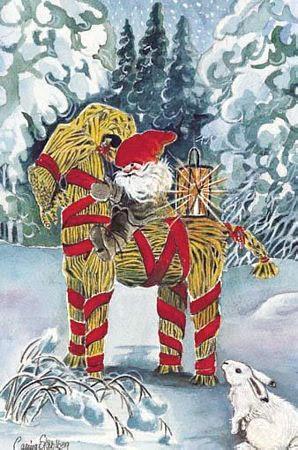
From Scandinavia, or maybe directly from Poland, with Knut the Great, the dancing goat arrived to England...There it is called Old Tup, sometimes Derby Tup. People think it's a ram...But actually it's the same old dancing, dying and resurrecting goat...

The Old Tup was part of the troupe made up of between four and six men and boys who all had blackened faces (the dead)...

The most common character in the troupe was the butcher, who carried a knife. And who eventually killed the goat! Another character carried a bowl to gather goats blood! But after the goat died, and bled, it jumped up, alive and well...Resurrected...
So, did I kill Krampus?
And here is the best bit...This goat character is an amazing example how an animal calendar marker gets mythologised, and how the myth evolves as the people who created move from one climatic zone to another...
And the first time I suspected this could be the case, was when I read this: "A popular theory is that the celebration of the goat is connected to worship of the Norse god Thor, who rode the sky in a chariot drawn by two goats"...

I wrote about this in my post "Goat riding thunder god"...
What??? Thor is a thunder, rain god...There is no thunder or rain in Scandinavia in the winter??? Or wild goats for that matter??? So what the heck is going on???
Soon...
To read more about ancient animal and plant calendar markers, start here…then check the rest of the blog posts related to animal calendar markers I still didn't add to this page, and finally check my twitter threads I still didn't convert to blog post...I am 9 months behind now...


